
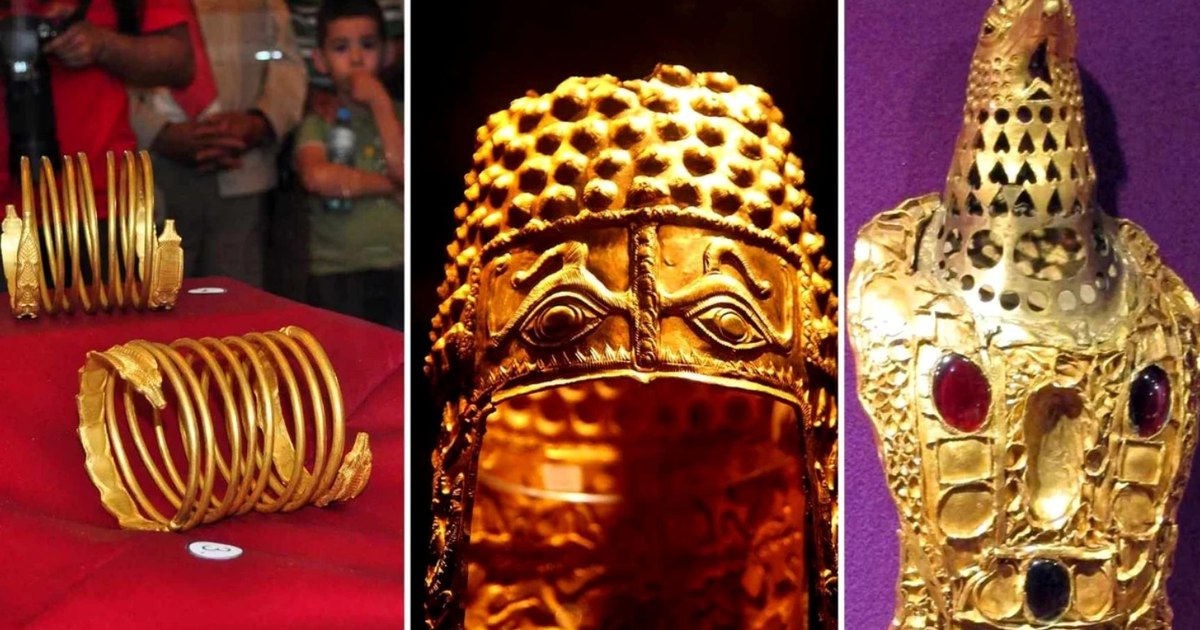
The pieces in the Romanian treasure would be safe if we send abroad and exhibit only children of the pieces of invaluable value. Heritage experts analyze the pluses and minuses of this extreme solution, which is adopted by some museums in the world.
Experts answered the question: Visitors would know that children of original pieces.
The theft of the helmet in Coțofenești and the three Dacian bracelets exhibited at the Dricest Museum in the Netherlands brings to the public discussion the solutions necessary to avoid similar situations in the future.
The director of the National Museum of History of Transylvania, Felix Marcu, argues that at present the legislation allows museums to produce and expose children of valuable heritage objects:
“Nothing compares, of course, with the exposure of an original object, but sure that, in terms of protecting the parts and in terms of conservation, it would be ideal to be exposed. But I repeat, a reply is not the same as an original. ”
The director claims that there is no unitary practice at national or international level: some museums expose and send to other children’s institutions, others – the original pieces.
“Even we have borrowed replies from the National Museum of History of Romania (MNIR), for example, a piece from the treasure from Pietroasele. MNIR owns the original treasure, the Buzău Museum has a copy of the treasure, very good copy. The problem is that a copy is not so easy to make and the copies that exist now, such as the treasure from Pietroasele, are quite old. ”
“Exhibitions with replicas are much easier to do”
The historian claims that lately he does not know how to make children after heritage objects, but it would be good to have such children, at least for valuable and sensitive objects.
Mark claims that the great museums of the world have different policies. “For example, the exhibition we have now is made up of loans and exhibitions from abroad. We also have children, and original pieces. ”
Copies have another advantage: exhibitions with such pieces are much easier to make, they can be exposed in principle anywhere, because there are no such high risks, neither degradation, nor disappearance of parts. “But, I repeat, it’s not the same. That is, an original is an original, a copy of the copy ”he points out.
The conclusion of director Felix Marcu is that “We should have children or start making children after The important pieces of treasure. ” The legislation allows this. In the more special case, says the historian, the realization of the children must be endorsed by the Ministry of Culture.
“We would laugh if we send children”
The historian and specialist in heritage Dănuț Huțu, director of the Botoșani County Culture Directorate, believes that we should not give up exposing original artifacts:
“In no case should we give up organizing international exhibitions, carrying heritage pieces in other museums in the world. Because in the end we make our own heritage known in all the cultural world. This is done everywhere on the globe. And we hosted international exhibitions, with very valuable pieces. For example, the Botoșani Museum also took very valuable pieces, such as Venus from Drăgușeni, the famous Eneolithic idol of Cucuteni culture, in several museums in the world. It is a cultural heritage that everyone has to enjoy. ”
The historian claims that we cannot send to the exhibitions abroad children of the original pieces: “We were laughing. What we do, we introduce ourselves internationally with fakes. Is that how we represent our country? What do we do, do we tell them that the original is at home and we came with a copy? There are people who come to see the original. We cannot get to make objects, from bronze, for example, and say that he is actually gold or other metal. “
Huțu believes that we should be more attentive to security measures. “That is, the legislation must be changed in this regard, with clear clarifications by types of artifacts and imposing certain types of security measures. It was definitely an escape at the Security level. I don’t think the contract was respected there. We have to expose the originals, for this is the end of the museum and scientific approach correctly throughout the civilized world, but with clear security protocols and to be respected, especially when it comes to special pieces. ”
Can you realize it’s a copy?
Marius Ciuta, the heritage specialist who was part of the team that recovered the Dacian gold, argues that the exposure or sending is a good idea that important museums have adopted: “If we were to take at least as civilized countries as for example Austria, it is a possibility. You see that in Cluj at the moment there is an exhibition at the National Museum of History of Transylvania with a number of particularly high heritage pieces during the migration period. And the goods that came from Austria, from the Museum of Art History in Vienna, are children, are replicas. ”
He also claims that it is very hard to figure out if you see a reply or the original: “In order to realize yourself, you have to have the opportunity to achieve the object, to do a trailological analysis, to do a metallographic analysis, to make a whole set of analyzes and only then you can Pronounce if it is a false or an authentic object. ”
While working on the file “Dacian gold”, the team of which was part of the defense of those who stole the Dacian gold bracelets: “They claimed that the bracelets would be false. But following the analysis, it has been shown to be authentic.“
