
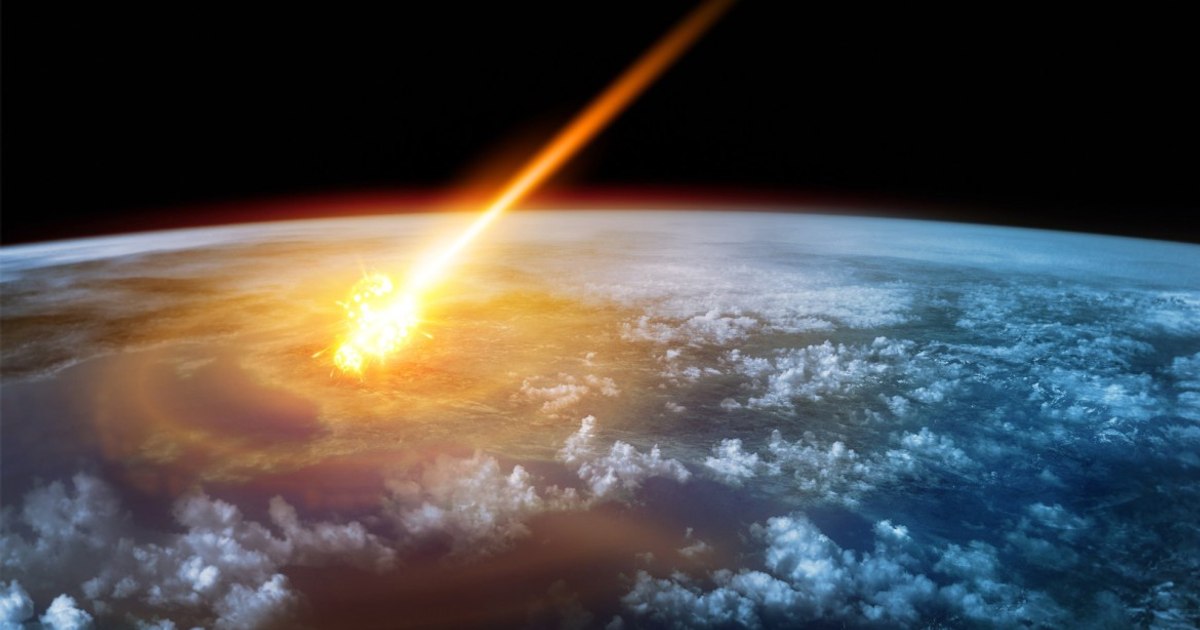
In a study published Thursday, August 15, scientists say that new methods of researching rocks from space have allowed them to identify the “genetic fingerprint” of the asteroid whose impact with Earth led to the extinction of the dinosaurs.
New data has been obtained regarding the asteroid that led to the extinction of the dinosaurs. Archive photo
The body that wiped out the dinosaurs 66 million years ago when it hit Earth came from an asteroid beyond Jupiter, according to a new study. The discovery, which relates to the nature of the asteroid and its origin within our solar system, could be useful for technology that predicts asteroid impacts on our planet.
The Chicxulub impactor was named after the community in present-day Mexico near the 145-kilometer-wide crater carved out of the rock. Most scientists agree that it came from within our solar system. But its precise origins have long remained unclear, due to the lack of chemical evidence that it was not contaminated by Earth’s own material, writes Live Science.
Now, in the remains collected from different regions of our planet’s crust, scientists have discovered that, in fact, the chemical composition of a rare element called ruthenium is similar to that of asteroids that float between the orbits of Mars and Jupiter.
The element is a “genetic fingerprint” of rocks in the main asteroid belt, where the city-sized chunk of asteroid was “parked” before hitting Earth 66 million years ago, Mario Fischer-Gödde told , a scientist at the Institute of Geology and Mineralogy at the University of Cologne, Germany, who led the new study. The asteroid was likely pushed toward Earth either by collisions with other space rocks or by influences from the outer solar system, where gas giants like Jupiter harbor immense tidal forces capable of disrupting otherwise stable asteroid orbits.
The findings are based on a new technique that essentially breaks every chemical bond holding a rock sample together, allowing scientists to measure specific levels of ruthenium in the Chicxulub impactor. The element has remained remarkably stable over billions of years in the face of Earth’s frequent geological activity that recycles the landscape, said Fischer-Gödde, who developed the new technique over the past decade and is one of the few experts in the world who can accurately analyze the rare element.
The researchers compared the results with samples from other asteroid impact sites in South Africa, Canada and Russia, and also with several carbonaceous meteorites, which dominate the outer region of the main asteroid belt. The chemical signatures of ruthenium in the Chicxulub impactor were only compatible with those of carbonaceous meteorites, indicating its origin in the outer solar system, the team wrote in a study published Thursday, Aug. 15, in the journal Science.
Scientists know, based on models of nuclear fusion, that ruthenium was forged in previous generations of stars and ejected into the nearby universe upon their explosive deaths. Eventually, the rare element was absorbed by the planets and asteroids that gathered in our solar system.
On Earth, it plunged deep into the planet’s interior long before the Chicxulub impactor hit the shallow waters off the coast of present-day Mexico, which spewed fine, acidic dust particles into the air that reduced sunlight and rocked Earth in a dark winter.
The apocalyptic moment wiped out more than 70% of all species, including the nonavian dinosaurs, and triggered irreversible climate changes that set the stage for the evolution of mammals that eventually led to humans.
“It is an event in the history of the planet, but especially in the evolution of life,” study co-author Francois Tissot, professor of geochemistry at the California Institute of Technology, told Live Science. “We’re just interested in trying to understand it better.”
Chicxulub Crater is the only known impact site on Earth produced by an asteroid this far away, so documenting its origins could help create models that describe the impact of celestial bodies in their systems on planets, Tissot said.
“The field of isotope cosmochemistry has seen these kinds of tipping points where suddenly there is enough data and it starts to weigh on how the models handle the predictions,” the researcher added.
