
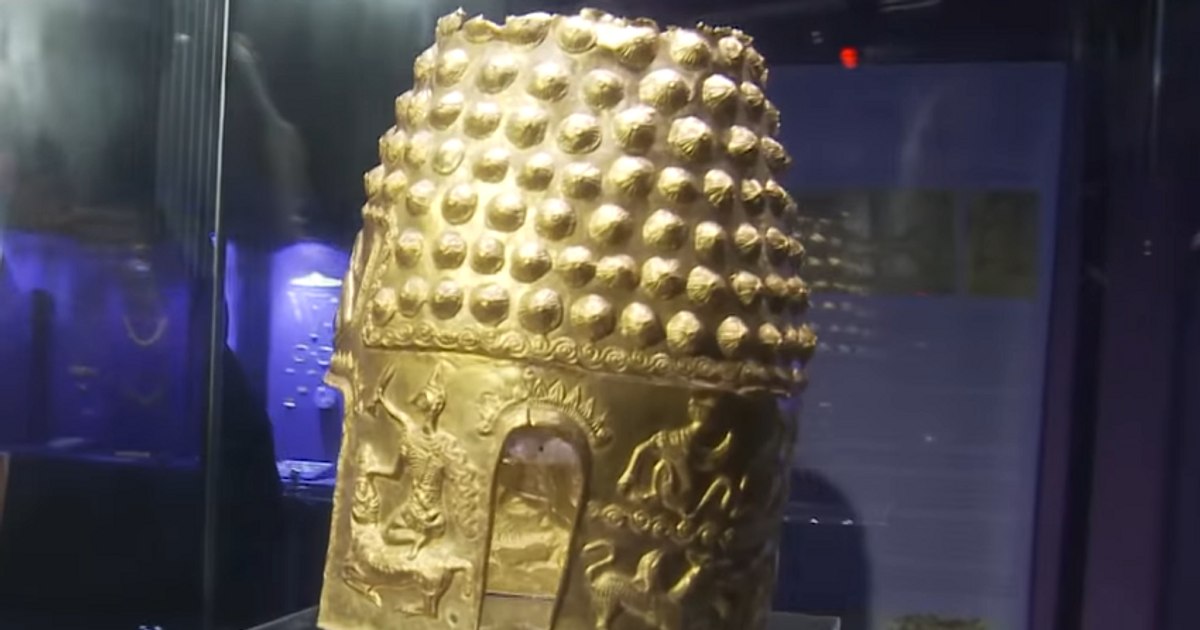
The golden helmet from Coțofenești, part of the treasure stolen on Saturday from the Museum in Drents, has an amazing story, which shows that the object was randomly found by a group of children, around 1926, and used as a water. before he was seen by a connoisseur.
The fame of the Getic helmet in Coțofenești is due to the fact that it was illustrated in all the high scholarship works that treat not only the history of art and processing of precious metals, but also the political and social history of the old populations that lived on the present territory of Romania, According to the National History Museum of Romania.
In addition, the helmet from Coțofenești is presented in all the school textbooks for the primary, secondary and high school, as well as in the great history treaties published in the country after 1960.
In recent decades, this masterpiece of gold art has been presented in numerous documentary films, on the covers of publications, on posters, illustrated, postal brands and even on a golden monetary show launched by the National Bank of Romania.
“We are surprised how to survive”
The story of the helmet was related in 2020 by Ernest Târnoveanu, the director of the National History Museum of Romania, in a TVR documentary.
The golden helmet from Coțofenești. PHOTO CAPTURE VIDEO TVR
“This helmet has such a strange history that many times today, looking behind, the almost 90 years of official existence of the song, we are surprised how to survive.”explained Ernest Oberlander-Târnoveanu, quoted by Antena 3.
“The children found a” hat “, so they declared”
Almost 100 years ago, the song – dated in sec. IV – V Î.en – about which no one knew then that he had an invaluable value, was lying on a hill in the village of Coțofenești, Prahova.
It was found by chance shortly after the First World War, in 1926 or 1927, by several children with the cattle.
“The children found a” hat “, so they declared, and put it one by one and brought it home, in the Simion family yard. The helmet was found by one of the children of this family, called Trajan ”, Târnoveanu report.
The boy’s family had no idea about the value of the helmet, so used in the household.
“After she was wet for chickens, she was found to be not the best thing, she was thrown on the roof of a cot. (…) They did not realize that the song is in gold. And because ancient gold naturally contains a large amount of silver. And this silver gives it an unusual yellow color for us. In our mind the color of gold is the gold of 14 carats, which is a golden and copper gold alloy, the pure gold has a yellowish color, and the gold mixed with silver has a whitish color, similar to the brass ””said Ernest Târnoveanu.
The fate of the helmet has changed when he was seen by a connoisseur.
“The destroyed helmet was presented by Traian Simion’s father to a former comrade of weapons from the First World War, a quite well -known merchant, Jean Marinescu”, Explained the director of the National Museum of History.
The merchant bought from the Simion family for 30,000 lei, an amount more than consistent for a family from the country, and later donated to the National Museum of Antiquities.
In 1971 the golden helmet in Coțofenești arrived at the National History Museum.
Since 1972, the helmet from Coțofenești has been exhibited in the historical treasure of MNIR being admired by millions of visitors from the country and abroad. Along with the most valuable Romanian archaeological discoveries, the helmet was exposed in honor in large exhibitions organized abroad: Paris, Oxford, Stockholm, Frankfurt, Rotterdam, Florence and Lisbon.
On Saturday, January 25, 2025, the golden helmet in Coțofenești was stolen from the Museum in Drencies together with three Dacian bracelets.
The princely diadem from Bunești-Averești escaped the eyes of thieves
The princely diadem from Bunești-Averești, a part in the exhibition at the Museum in the Netherlands, escaped the eyes of the thieves, according to the new weather.
The diadema is one of the Dacian treasure pieces exhibited at the Duits Museum in the Netherlands, information confirmed by the National History Museum of Romania, the County Museum “Stefan cel Mare” Vaslui being a partner of the exhibition “Dacia. Rijk van Goud and Zilver ”/” Dacia. Kingdom of gold and silver ”.
Ramona Mocanu, the director of the Vaslui Museum and the president of the Association of Museum Managers transmitted through a press release that the theft of Dacian treasure pieces represents “A serious blow to the Romanian identity”.
