
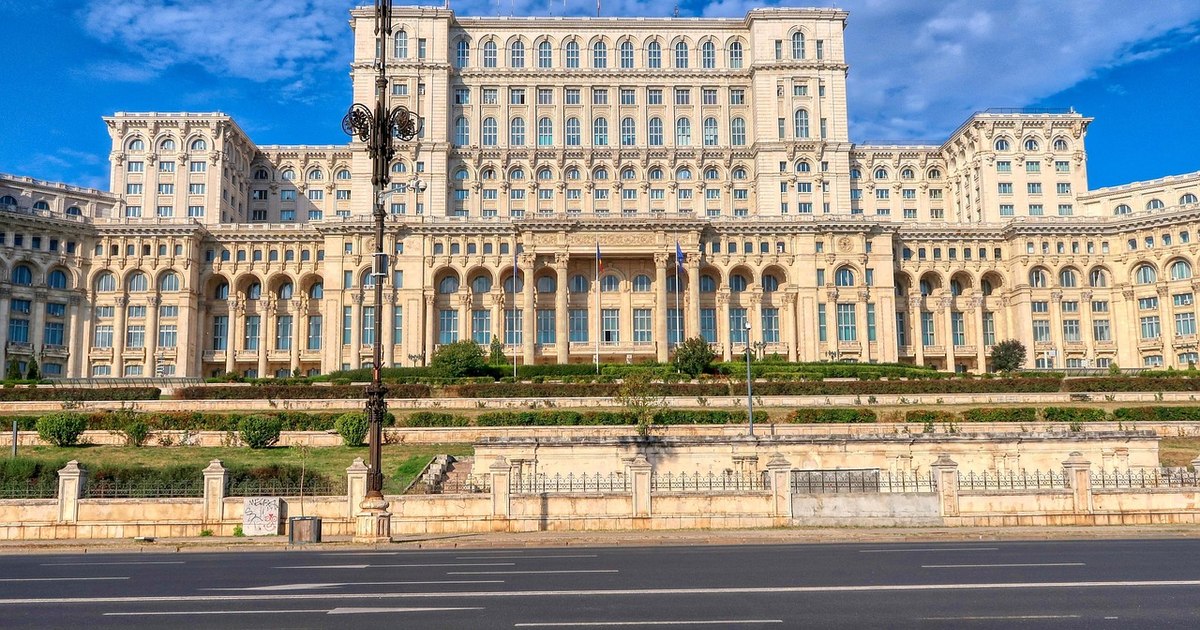
The General Council of the Municipality of Bucharest will decide on Thursday, January 29, the fate of the fence that surrounds the Palace of the Parliament (Casa Poporului). The urban regeneration project aims to transform the area of the former Uranus neighborhood and create public spaces open and accessible to pedestrians.
The project envisages the creation of interconnected leisure spaces, an urban promenade, the recovery and preservation of green areas and the optimization of circulation in the area.
“The whole space is currently dominated by the building of the Palace of the Parliament, the second largest building in the world. The adjacent land is delimited by a fence-type enclosure, which separates the urban public space from the (all public) one belonging to the Palace of the Parliament. The courtyard of the Palace of the Parliament is perceived as a barrier at the level of the city and does not allow a quick crossing of the area. At the same time, the fence at the Palace of the Parliament, which limits the access of pedestrians, generates a hostile atmosphere”. it is shown in the approval report.
In order to implement the project, it is necessary to sign a protocol between the Capital City Hall, the Government of Romania, the Chamber of Deputies, the Senate, Metrorex and the Romanian Patriarchy.
The approval report emphasizes that the purpose of the project is “the reintegration and restructuring of the urban tissue by creating functional and attractive public spaces, the efficiency of the circulation system in the central area by prioritizing sustainable and alternative forms of circulation, the promotion of a sustainable, integrated development, with an emphasis on the quality of life and urban accessibility”.
The project draws attention to mobility issues: pedestrian traffic is low, and road traffic is very intense. “This area is very important because it would make the North-South connection at the central level of Bucharest. The lack of this connection leads to very long distances to travel, even discouraging for pedestrians who have to get from the center of Bucharest to the Rahova – Uranus area”the document states.
The final decision regarding the urban regeneration project and the demolition of the fence of the Palace of Parliament is to be taken in the meeting on Thursday, January 29, of the General Council of the Municipality of Bucharest.
The plans for the realization of the “House of the Republic and the Victoria Boulevard of Socialism” were drawn up in the early 80s, after the 1977 earthquake caused over 1,400 victims and devastated the Capital.
The works on the urban complex began in 1984, on the land left after the demolition of the Uranus district, and the communist regime presented it as a grand plan to modernize the center of the most important city in Romania. Nicolae Ceaușescu started the works and attributed his merits to the project.
In the 1980s, over 100,000 people arrived at the construction sites of the People’s House and the current Bulevard al Unirii, and the demolitions that preceded the work on them extended over an area of 4.5 kilometers long and two kilometers wide, which was part of the capital’s surface at that time.
“20 churches were destroyed, eight were moved, 10,000 homes were demolished, and more than 57,000 families were evacuated. The following were demolished: Văcărești Monastery, Mihai Vodă’s Sacred Hill for the History of Bucharest, Brâncovenesc Hospital, the first medico-legal institute in the world, Union Hall, Operetta from Senate Square, the Army Arsenal and the Central Military Museum”. shows the International Conference Center – Parliament Palace.
