
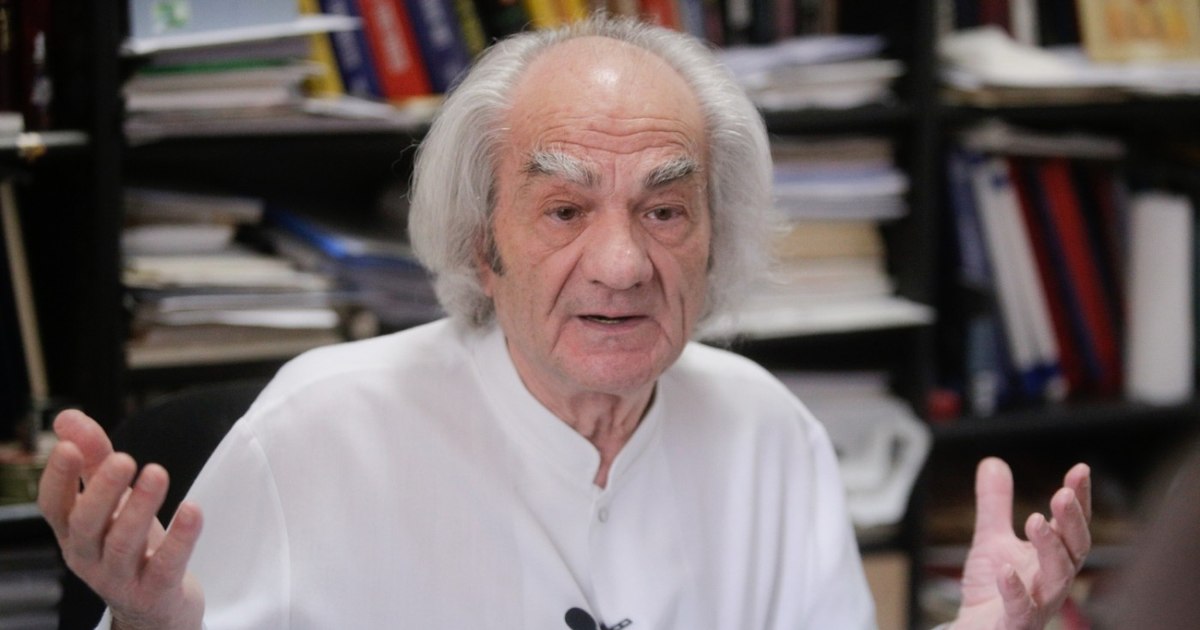
Leon Dănăilă is one of the most distinguished doctors in the history of Romania. Born in a market at the end of Romania, he managed, through total dedication, to save the lives of tens of thousands of patients. In addition, he became famous for his modesty, although he operated including prime ministers.
Leon Dănăilă (92 years old) is one of the most important and recognized doctors in the history of Romania. Throughout his entire career, which began in 1958, he saved the lives of tens of thousands of Romanians with neurological problems. In addition, he developed in Romania methods of surgical intervention that increased the hope of survival of patients. Academician, teacher, doctor, Leon Dănăilă is considered in international academic circles the best neurosurgeon in Europe and is listed alongside Einstein among the 500 geniuses of the 21st century. After 30 years of studies and research, he also discovered a new cell in the brain. Having become internationally famous, Leon Dănăilă operated on important statesmen from Romania and other countries, but nevertheless he kept his specific modesty and even refused important positions in the state. Recently, Leon Dănăilă, the Romanian doctor with a long life, was decorated with the Military Order of Romania for an exceptional career, a distinction conferred by colonel Dr. Adrian Constantin, honorary member of the Romanian Academy of Scientists.
The peasant child from the end of Romania, who wanted to become a doctor
Leon Dănăilă was born on July 1, 1933 in Darabani, Botoşani county, the northernmost city on the territory of our country. At the time, Darabi was a marketplace dominated by Jewish trade and an important agricultural area. The future academician and genius of Romanian surgery was born in a modest family of peasants, with material shortages specific to the rural world of the interwar period. His father was illiterate and his mother only had four primary grades. It is said that Leon Dănăilă, as a child, did not have any books in the house and, avid for reading, he devoured the books from the school library. In addition, he was always a faithful child, used to going to Church from an early age.
“My parents were of very modest means, my mother had four elementary grades, and my father did not know how to read, but he was a very active man. He wanted to become the mayor of Dărăban, but the war came and he did not succeed. I played with all the children on the street and from other parts and I was friends with everyone, there was no enmity between us, it was a period that will surely never return, but which I regret because we felt very good. Although in this environment I always felt the hunger, the cold, I didn’t give much importance to them. When you’re a child you don’t realize it, but my parents were very hardworking and they always taught me that faith is very important for a person.”stated Leon Dănăilă in an interview for “Adevărul”.
Although he was eager for knowledge and to explain all the phenomena that surround him, passionate about reading, Leon Dănăilă confessed that he did not like school from the beginning. Later, he was made to choose between attending high school or going to farm work, like most teenagers in the area. A brilliant mind with incredible work power, Leon Dănăilă chose to continue his studies. He attended the “Grigore Ghica” High School in Dorohoi, still today an elite school in northern Romania. In high school, the young man from Dărăbăne fell in love with anatomy, biology and everything related to medicine and the human body. He read all the books in the high school library that related to this field. The renowned academician testified that when he chose to follow this path of medicine, he thought that this was the only way he could help his peers. Basically, he chose his job out of love for people. In 1952, he entered through a difficult competition at the Faculty of Medicine in Iasi, which he graduated in 1958. Later, he was assigned to do his internship in the countryside. That’s how he ended up working for two years at the Comănești Hospital and another year at the Darmănești Health District.
Later, in 1961, he entered the competition and held the post of secondary neurosurgeon at the Neurosurgery clinic at the “Gh. Marinescu” Hospital in Bucharest. After 64 years of career, academician and doctor Leon Dănăilă still works at this hospital. Practically, in 1961, the neurosurgery career of the peasant child from Darabani began. It is probably one of the most motivational stories. A young man from the end of Romania, from a very modest family, with little book knowledge, reached professional heights through education, work, discipline and a sparkling intelligence.
Accidents at work, a student’s curiosity and anti-malpractice tests
The passion for neurosurgery and the choice of this branch of medicine was born in the Romanian academician when he was a medical student. He was doing his training in Bicaz, a small industrial town in Neamț county. The period of the internship coincided with the development of the large Bicaz dam (built between 1950-1960), located on the Bistrița river.
“When I was a student, I did my internship at Bicaz, there were a lot of accidents and there I saw the first brain operations, which surprised me a lot because in college I didn’t really participate in such surgeries. I liked then the patience with which you have to operate this organ and not only that. The surgeon must be very patient, have an aesthetic sense, have talent and, above all, must have grace. He must be innovative and inventive, because when if any complication arises during the operation, he knows how to solve it under optimal conditions”stated Leon Dănăilă. At the same time, seeing the importance of talent and the need for essential qualities that any doctor who approaches neurosurgery should have, later, Leon Dănăilă developed together with a psychologist a special test for those who want to practice surgery, intended to avoid the loss of human lives through malpractice.
“Together with Professor Golu, who is a psychologist, we proposed that those who want to do surgery be tested. Why, when you work on humans and the human life is in danger, is the surgeon not tested, if he has skills? Some do surgery because they hear that it is expensive, interesting, spectacular. I sent this test to a surgery journal, but they rejected it, they said they couldn’t publish it. Then, I published a book about tumors cerebral and it is inserted there. There are no such tests that are applied to someone who finishes a medical school and wants to follow surgery”adds Leon Dănăilă.
The doctor who saved the lives of millions of people in the country where he operated with his finger
One of the most important contributions made by Leon Dănăilă to Romanian medicine and neurosurgery in particular is the reduction of mortality in brain surgeries by introducing modern surgical methods, following models from abroad. To achieve this, Leon Dănăilă waged an all-out struggle. First of all, he convinced the secretary of the renowned professor Constantin Arseni, one of the founders of the Romanian neurosurgery school, to get him a key.
“Professor Arseni did not allow anyone to enter the archive, at night he took the key with him, and during the day he gave the key to a secretary. One day, I asked the lady in question to give me the key to the archives. And then I made a statistic, which I still have now, because when you make a statement you have to be very precise in the data. I found a mortality rate of around 50-60 percent, a very high mortality, that was the situation in the whole country (no in the 70s). Professor Arseni was a personality, he did a lot for neurosurgery, but in the field of surgical technique he was a little out of date. Apart from the Russian magazines, there were also magazines from America and I read that the most complicated operations reach a mortality rate of 3 or 4 percent.”stated Leon Dănăilă. And that’s because in Romania at that time, brain tumors were actually removed with the finger, while in the civilized world they worked with the operating microscope.
In those conditions, more than 50% of the patients were either left with serious sequelae or died. To solve the problem, academician Dănăilă obtained a Fullbright scholarship in the early 80s in New York. There he saw and learned the use of the operating microscope. “And then I asked myself the problem that I want to go and see how they do, how they operate. I obtained a scholarship and arrived in America, in New York. I saw another operative technique, the tumors were not removed with the finger, but with the operating microscope, which magnifies, illuminates the operative field and helps you preserve the important areas and the blood vessels, which are extremely important”. specifies Dănăilă. When he returned to Romania, he introduced this technique also in Romania, in brain operations. The results were exceptional.
Dănăilă versus Arseni
The introduction of new surgical techniques, however, met with the opposition of Professor Arseni, a personality, but conservative in approach. Moreover, he had begun to envy the success of his younger colleague. “Many of Professor Arseni’s patients asked him to take me into the operation as well, which annoyed him a lot. Especially since he also had diabetic retinopathy and his vision was not good either. I sometimes stopped him: “Professor, here is the carotid artery, here is the optic nerve, I was afraid of damaging it, of causing very large deficits.” Sometimes he got angry and said “go to hell, if you’re smart, stay and operate”. And then he would leave, I would stay and manage to reduce this mortality”stated Leon Dănăilă in an interview for “Ziarul financier”.
Later, in order to get rid of Leon Dănăilă, he created a new department, where he made him head. But the new ward was an empty building, full of ants, cockroaches and no equipment. With his legendary dedication, Leon Dănăilă did disinfestation, equipped the ward with regular instruments after asking the medical instrument factory to help him. Professor Arseni put sticks in his wheels even at the Ministry of Health from the communist period, after Dănăilă had asked him to give him appropriate equipment. Only after operating enough members of the Central Committee of the PCR did he get what he needed.
He operated on the prime minister of North Korea and refused the position of health minister
Few people know, for example, that Leon Dănăilă operated on the prime minister of North Korea during the years of communism, together with Professor Arseni. He had a brain tumor and was brought to Romania to be operated on. The surgical intervention took place at the Elias Hospital in the capital, and the Korean official went home on his own two feet. Due to the fame he had acquired and the incredible results, the doctor Leon Dănăilă was proposed as Minister of Health during the communist period, but he refused.
“During Ceausescu’s time, I was offered to be the Minister of Health, but I refused. I said that if you don’t have money to improve the health system, I’ll go there for nothing. That everyone is judging you. The minister does not come with a bag of money. He depends on the budget that is given to him”stated Dănăilă for “Ziarul financier”. The academician with origins from Botošan has published numerous specialist works recognized including at the international level, with exceptional scientific contributions.
He is the only neurosurgeon in the country who operated on aneurysms of the vertebrobasilar arterial system, he has dozens of pioneering works in neurosurgery and holds 18 inventor’s and ten innovator’s patents. Despite his success, academician Leon Dănăilă remained a modest man, who never made a fortune from medicine. During the communist period, he had a salary of 700 lei per month. Of these, he gave 500 lei per host and 200 for food. He confessed that his stockings were torn and he also demanded money from home.
.
