
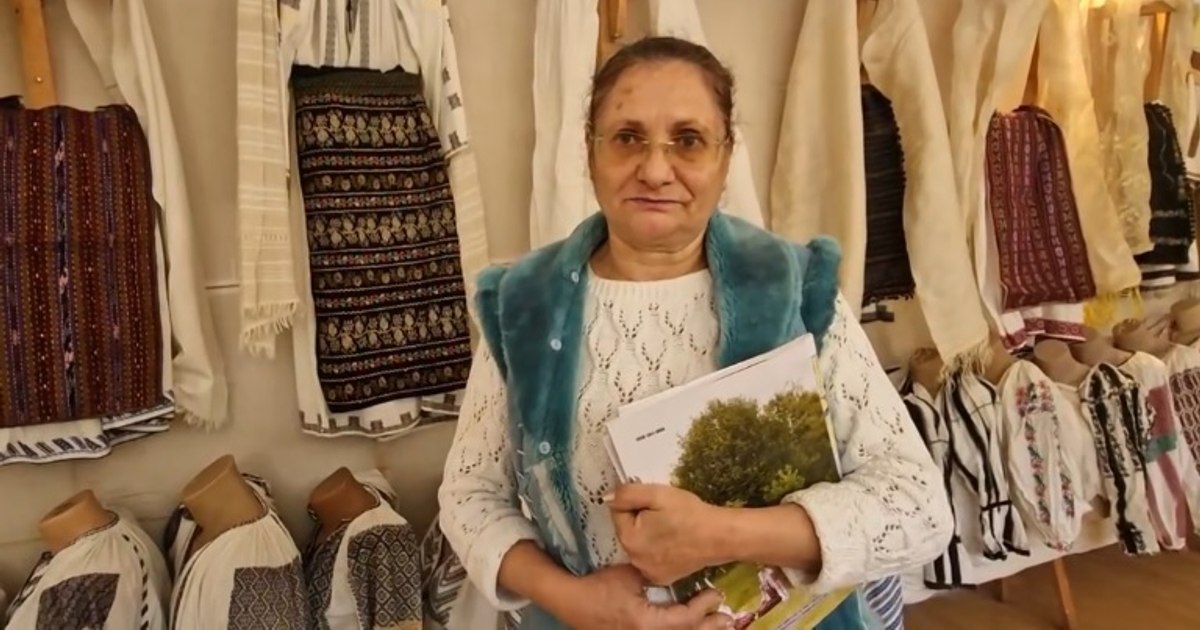
A librarian from a commune in Gorj County is a collector of folk costumes and ancient objects. It also has an impressive collection, with many of the folk costumes being over a hundred years old.
Mariela Borcan is passionate about collecting folk costumes Photo: Daniela Gapșea
Mariela Borcan, from Albeni commune, donated to the local ethnographic museum the collection of folk costumes that she owned, as well as other particularly important ancient objects.
“I've been collecting popular costumes since 1986. It's a hobby. Some of them I inherited, and most of them I received from citizens free of charge, in the form of a donation. The personal collection was donated to the museum, which was established in 2008, but I continued to collect. Most of the costumes are over 100 years old”says the librarian who is also in charge of the village museum in Albeni commune.
Most of the folk costumes the librarian owns come from a village where people left due to landslides.
“I have collected most of them since 2006, as a result of landslides in the village of Prunești, the oldest in the Albeni locality, because people were leaving that village. They took a few important things with them, and the rest were thrown away. I found them there and recovered them. Some of the costumes were donated to me by citizens”Mariela Borcan also reported for “Weekend Adevărul”.
“Costumes were sewn by candlelight”
The Ethnographic Museum of Albeni includes over 500 very old objects made of wood, ceramics and about 100 folk costumes and garments. “The technique and hard work of our mothers, grandmothers and great-grandmothers was unmatched. The designs are inspired by nature. The costumes were sewn by candlelight in secret. The costumes are from our locality, Albeni, the ethnographic area of Valea Gilortului. There are over 60 models. Costumes are different and they are objects of art“, mentioned the collector.
She says that the pieces in the museum's collection are the highlight because they are particularly interesting. “All the costumes come from our ethnographic area, the Gilort Valley – the Câmpu Mare depression,” said Mariela Borcan.
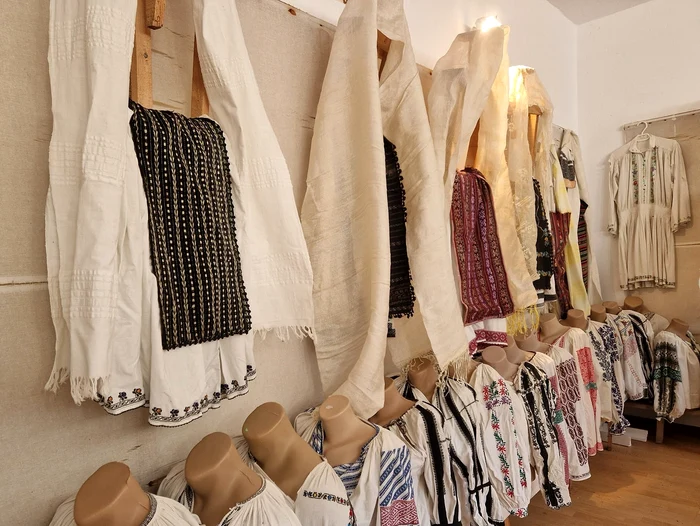
The librarian donated the popular costumes to the community Photo: Daniela Gapșea
Costumes are kept in good condition. Some have deteriorated, but not significantly, due to age and storage conditions. However, each costume hides a separate story:
“The cloth is warp-woven in-house and hand-stitched. The working technique is different from one suit to another and no two suits are the same. The wool was spun and dyed in the household. Each woman sewed her costume to go out with on Easter or Sunday, at the village hour“, said the librarian.
From the history of the Magheru family
Visitors can admire at the ethnographic museum in the town of Albeni pots for boiling, for preserving food, jugs for water and wine, large pots for lard, putineiul, measures for milk, straws, buckets, spoons, caucues, salt shakers, flour crates, barks , curtains, carpets, pieces of furniture, objects and household utensils. Among the exhibits there is also a mine lantern, because an underground coal mine operated in Albeni.
One of the most important objects was also found by the lover of popular costumes: “I found in the church yard, where the cemetery in the village of Bârzeiul de Gilort is now, the baptismal font in which General Gheorghe Magheru was baptized, who was born in 1802 in our town (no – Gheorghe Magheru was a military commander in Tudor's army Vladimirescu, then commander in the Russo-Turkish war of 1828-1829, bailiff of Romanati County from 1831, Minister of Finance in the revolutionary cabinet of Wallachia in 1848, then, temporarily, general commander of the revolutionary troops of Wallachia). I also found the tombstone of the grave of the general's father, Şerban Magheru”, confessed the librarian from Albeni commune.
Among the objects in the museum of the village of Albeni are also the maps of the locality, from 1977, because the former communist dictator wanted to transform the settlement into a city and build blocks instead of houses, but his plan was not carried out upon fulfillment.
A museum for posterity
“The museum can be visited every day. Those who want to come and visit him can come to the library, where I can be found, because I also take care of the museum”, said Mariela Borcan. “The museum also suffered degradation, because it was affected by a flood, so it needs rehabilitation works. The managements of the Albeni City Hall until now have not been involved. And the collection needs showcases. The space is enough. I have a lot more items, but I can't store them all there because there are no conditions“, said Mariela Borcan.
It also has a numismatic collection, another of very old seals, as well as books over 100 years old.
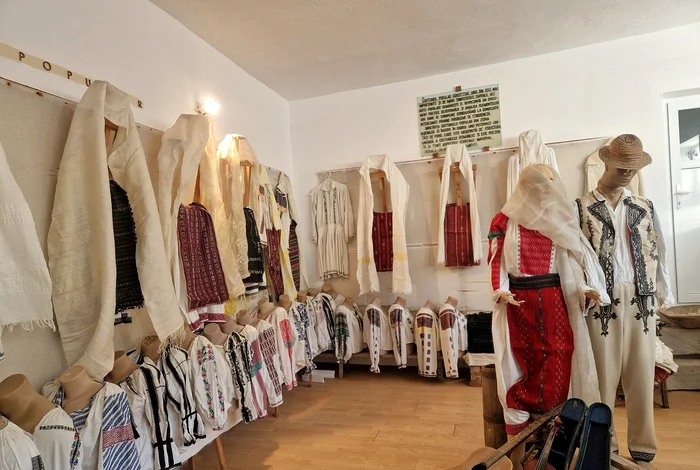
Many costumes are over 100 years old Photo: Daniela Gapșea
The collector confessed that she never thought of capitalizing on the collections she owns: “I believe that these objects should be left to our descendants. It was very simple to capitalize on them, but I consider them to have an inestimable value that cannot be calculated in money. They are unique art objects”.
Mariela Borcan also followed a museographer course and another room custodian manager course in order to be able to manage the museum, then she also graduated with a master's degree in Library Science.
