
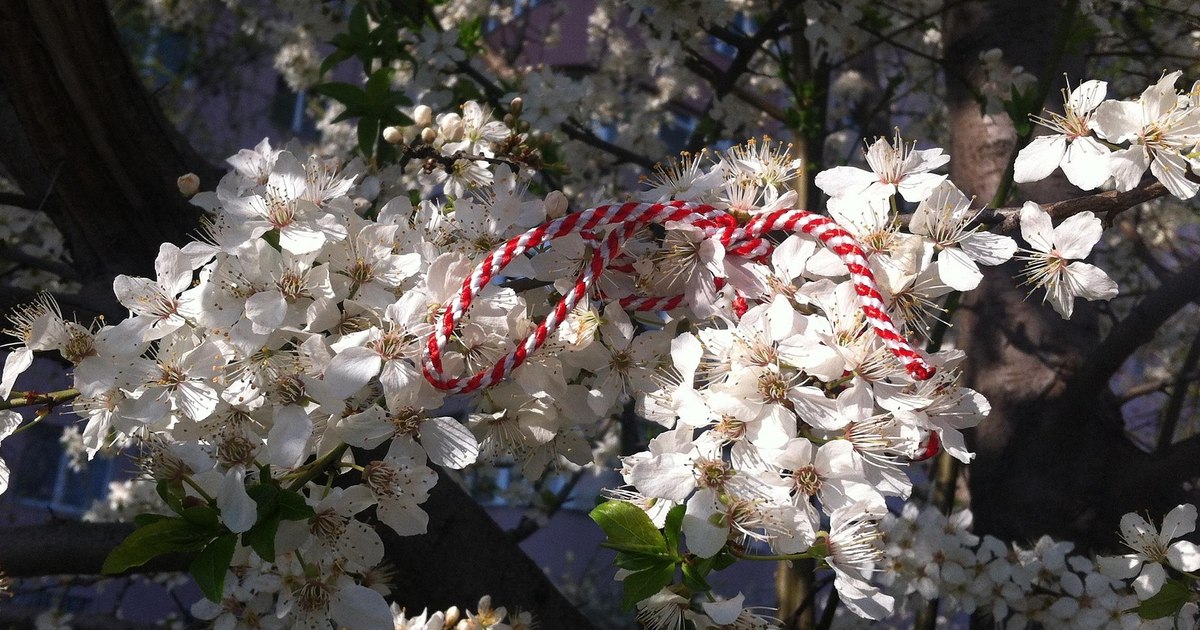
The martisor was not, in the beginning, a decorative object or a protocol gift, as it happens today. It was a protective symbol, linked to the beginning of the agrarian year and the rebirth of nature. The red and white string, without anything else or accompanied by small objects with symbolic value, was worn for health, luck and fertility.
Initially, the martișor – an object with very old roots, dating back to the Dacian and Roman periods – was not intended exclusively for women. It was also worn by children, but also by men, as a talisman against diseases and bad luck. It was first a red and white string woven from woolen threads, sometimes tied to a coin or a small amulet. Later, the coin/amulet was replaced by more and more expensive objects, ending up giving today’s commercial value to the tradition which thus risks losing its meaning.
How the martišor has evolved over time
Initially, the martișor was extremely simple: a braided cord, to which a penny or a ceramic amulet object was later tied. Red symbolized life, energy and the rebirth of nature, and white was associated with purity, light and new beginnings. The martisor was not only a gift, but a gesture full of meaning. Deeply grounded beliefs were attached to him. It was not worn whenever and however, it was not given up anywhere. With the modernization of society and the emergence of seasonal trade, the martișor gradually turned into a decorative object. The stalls were filled with brooches, figurines, jewelry, accessories or small festively wrapped gifts. In many cases, the focus has shifted from the symbolic to the commercial aspect.
Many people today are looking for something “more special”, and sometimes the small gift becomes an object that we give out of obligation, without reflecting on the original meaning of the gesture. However, in recent years there has been an interesting change: people are coming back to the idea of a small but useful gift that conveys real care, not just a ticked-off tradition.
Beyond these transformations, the important thing is that the tradition is preserved until today. This led to the inclusion, in 2017, of the martișor on UNESCO’s list of intangible cultural heritage, being recognized as a common custom of several countries in South-Eastern Europe. The argument was that the martișor is not a simple object, but a living cultural practice that unites communities, transmits values and symbols and resists the passage of time.
From silver coin to today’s extravagant jewelry
Before the 20th century, the martișor was extremely simple: a silver or gold coin tied with red and white string in wealthy families, or a small stone, shell or other natural object, sometimes small handmade amulets, in the simple country world. There was no idea of an expensive gift, the value being symbolic. The marigold was worn for a few days or weeks, then it was tied to the branch of a flowering tree, considered to bring good luck. Gradually, it came to jewelry.
Under communism, the martișor became a controlled tradition. Models with religious symbols that had previously made their way (for example, crosses or medallions with saints) disappeared from official production, being replaced by neutral decorative motifs, such as snowdrops, ladybugs, baskets, horseshoes, etc.
The image of crowded stalls in front of schools, bookstores or department stores endures to this day. The trinkets weren’t sophisticated, but they had a special charm: small colored plastic brooches, thin metal baubles, shiny ladybugs or golden horseshoes attached to simple cards. They were mass-produced in craft cooperatives. They cost little, so almost every student could afford to buy more. On the first day of March, the boys came to school with their pockets full of gifts for their classmates and teachers, and the gesture became a collective ritual of the beginning of spring.
Although the communist regime removed religious symbols from the public space, the martișor survived because it was considered a popular tradition, not a religious one. It remained a warm, discreet and accessible custom to all, perhaps even less commercial than today. It didn’t matter how elaborate the object was, but the joy of the moment and the attention given to the other.
The commercial boom after 1990
After the fall of communism, the tradition was completely liberalized. Gold and silver jewelry, commercial brands, thematic collections appeared. It even went to elaborate gifts, packaged as a trinket, and from the talisman it became a seasonal consumer product.
Today, a “symbolic gesture” sometimes amounts to budgets of hundreds of lei, with the martisor running the risk of becoming a social obligation. This creates a competition between parents and peers, puts financial pressure on those who can’t afford it, not to mention the fact that bulky decorations, cosmetics and impersonal gifts no longer have anything to do with their original meaning.
That’s how it came to be that every year discussions about the luxury martisores, which are otherwise officially prohibited in schools, appear in the public space.
The return to meaning. How we choose the martișor
If we go back to the origin, the martišor should have some basic characteristics: be symbolic, useful, discreet and accessible, because it is not the financial value that matters, but the intention and the message conveyed.
Here are some beautiful, useful and inexpensive gift ideas that you can consider for your loved ones:
Marches for teachers
• a minimalist brooch or a handmade wearable object;
• an elegant bookmark;
• a small pot with a spring plant;
• a quality pencil or pen;
• a bag with aromatic teas.
Cheers for colleagues
• scented mini-candles;
• a cup holder;
• a small agenda;
• a handmade decorative magnet;
• a reusable trinket (eg a brooch).
Carols for mothers
• a small potted plant (hyacinth, primrose);
• a simple spring scarf;
• a discretely personalized mug;
• a natural soap or an artisanal cream.
Little carols for sisters
• a fine bracelet with red and white string;
• a hair accessory;
• a minimalist jewel;
• an artistic sticker or a handmade object.
Fortunately, the current trend is to return to the essence, looking for small objects that also have a meaning to be offered as gifts.
