
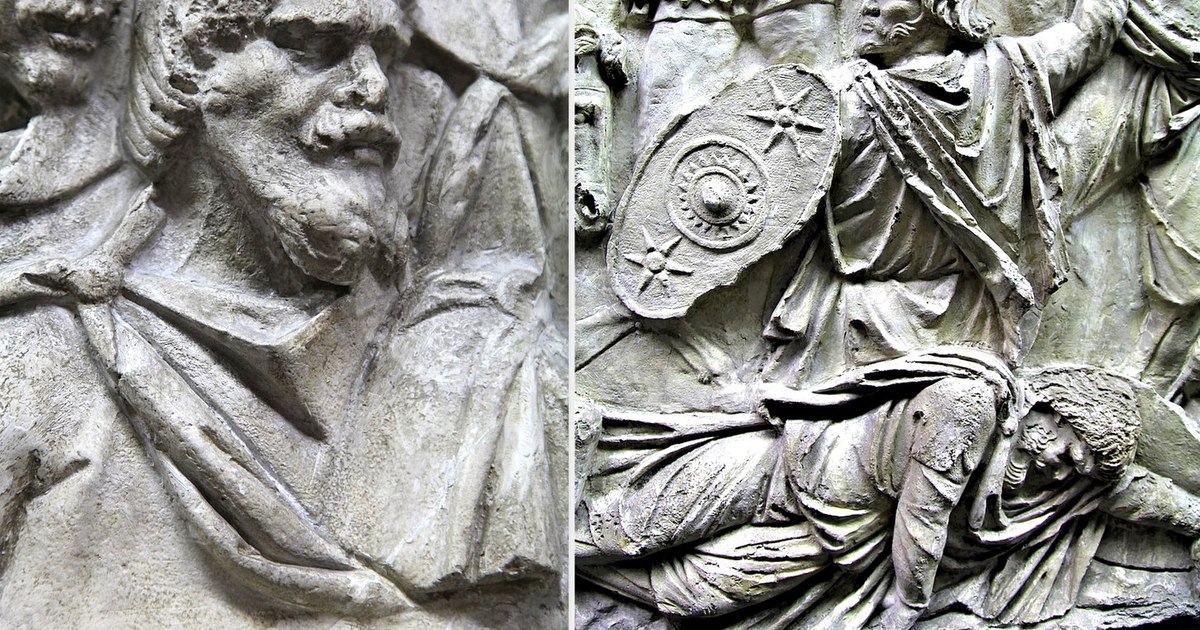
Before Burebista or Decebal, the best-known Dacian kings, the North-Danubian barbarian tribes were ruled by powerful chieftains, but with a mysterious, little-known history. From the few remaining documentary sources it is clear that they were powerful warriors, feared by their neighbors.
Dacian warriors depicted on Trajan’s Column PHOTO The truth
Before Burebista became one of the greatest barbarian kings north of the Danube, the Geto-Dacians’ fame as fearsome warriors was already widespread throughout the Balkans and even Central Europe. Those who helped raise the political and military power of the Getae and Dacian tribes were a number of chieftains about whom little is known today. The rare documentary sources that mention their existence, however, suggest that they were particularly powerful from a political and military point of view, managing to control or dominate the Greek cities on the banks of the Euxine Pontus. All these mysterious characters and their deeds are part of a lesser-known history of the Carpatho-Danubian-Pontic space.
The slayer of the Celts, the first great king of the Transylvanian Mountains
The one who prepared, about a century before, the political and military rise of the Dacians under the rule of Burebista was a mysterious king who reigned in the heart of the Transylvanian Carpathians. His name was Rubobostes and his fame reached the ears of the Romanians. The only important mention we have of this Dacian chieftain is in the Latin historian Trogus Pompeius. “The Dacian power increased under King Rubobostes“, wrote the Latin author in the work, largely lost “The History of Philip”. This chieftain, if he had lived in the 2nd century AD, i.e. about a century before Burebista. Archaeological research indicates that this Rubobostes ruled an extensive and well-fortified territory, a prosperous reign marked by the construction of many settlements in the Mureș area, but also in Jiului, called Rhabon in the Dacian language. Also on Jiu, during the rule of Rubobostes, a strong fortified area would have been built.
It is assumed that from this fortress on the banks of the Ji river, the Dacian kings of the Rubobostes family would have extended their rule over the southern and central areas of Transylvania, with the peak during the time of Burebista, who managed to unify the Daco-Getic tribes. The same Rubobostes favored Burebista’s rise to power, indirectly, through effective resistance to the Celtic threat in the Transylvanian area, both by coagulation of the tribes, but also by erecting fortifications capable of resisting attacks. Later, the Dacian warriors, under the leadership of Rubobostes, managed to annihilate the dominance of the Celts in the Transylvanian area, creating all the conditions for the realization of the powerful state of Burebista. Rubobostes, although little known, is one of the most important Dacian leaders in Romanian history. For a while it was thought to be one and the same as Burebista, but recent research has disproved this.
The powerful basileus to whom the Greek cities paid tribute
Another great mysterious chieftain of the Geto-Dacian race was Zalmodegikos. And this was one of the basileis that raised the political power of the Dacians north of the Danube and created the perfect conditions for the formation of the great Geto-Dacian kingdom of Burebista. Zalmodegikos ruled in the area of present-day Dobrogea around 200 BC, also about a century before Burebista. The only information we have about him comes from the Greeks from the Histria fortress, near today’s Constanta. It is a decree carved in stone, from which we learn that the Greek cities were obliged to pay this powerful Geto-Dacian basileus a kind of protection fee, i.e. tribute. In addition, in order to intimidate the people of Histria, he took 60 townspeople hostage. To free them, the elders of the fortress sent three clever messengers to Zalmodegikos. Their mission seems to have succeeded.
“The Council and the People found their way: For Diodorus of Thrasikles, Prokritos of Pherekles, and Klearchos of Aristomachos, having sent messengers to Zalmodegikos concerning the hostages, traveled through the enemy’s country, and – facing dangers of all kinds and showing the most full zeal – they brought back the hostages (being over sixty in number), at the same time convincing Zalmodegikos to return the revenues to the city, the Council and the People to find a way for them and their descendants to be enrolled among the public benefactors; to be crowned, like their descendants, at all theatrical performances, for their manliness and zeal towards the People, so that the other citizens, knowing that the People honor worthy men, may be encouraged to serve the city. The hegemons should see to it that this decree is engraved on two slabs, one of which should be placed in the agora, in front of the portico, and the other near the altar of Zeus Polieus”. it is shown in the decree.
It is not known how long Zalmodegikos ruled the area of Dobrogea, but given the information from Histria he was a powerful barbarian chieftain with a formidable military force capable of providing security guarantees to the Greeks on the shores of the Black Sea. Also in the Black Sea area, in the northern part of Dobrogea, ruled another powerful basileus called Moskon. Even less is known about it. The only evidence of its existence are some silver coins, from the 3rd century BC, discovered in Dobrogea, inscribed on one side with a warrior with long hair, and on the other with a horseman. In addition, the inscription on them states that it is about King Moskon. If he had the ability to mint money, it means that his tribe showed military strength as well as economic strength. Rhemaxos was in the same area, but his ethnic origin is uncertain.
The warrior of the north
One of the greatest Dacian chieftains, before the rule of Burebista, was Oroles. He would have collaborated closely with Rubobostes, realizing, it seems, a first phase of strong tribal union. It can be said that this Rubobostes-Oroles alliance represented the preliminary phase of the foundation of the Dacian state during Burebista’s time. While Rubobostes annihilated the Celtic threat in Transylvania, Oroles, east of the Carpathians, stopped the warring nations of the Bastarni. His story, succinctly, is also presented by Trogus Pompeius in the “History of Philip”. Oroles ruled east of the Carpathians, probably in today’s Bucovina area, and had to face an invasion of the Bastarians, probably Germanic peoples. In the first battle, the Bastarni put the Dacians to flight. Angry, Oroles humiliates his warriors by forcing them to do women’s work.
In the second, decisive confrontation, the Dacian warriors show their valor on the battlefield and succeed in defeating and subduing the Bastarni. The feats of arms of Oroles and his warriors prevented a Bastran invasion of Transylvania. “And the Dacians are an offshoot of the Getae. In the time of King Oroles, they fought unsuccessfully against the bastards, and therefore, as a punishment for their weakness, they were forced, by the king’s command, to put their heads instead of their feet when they wanted to sleep, and to do their wives the services they before they used to do them. This punishment was removed only after their bravery wiped out the disgrace they had incurred in the earlier war.” specified Trogus Pompeius, the text being contained in the work “History of Romania in Texts” by Bogdan Murgescu.
.
