
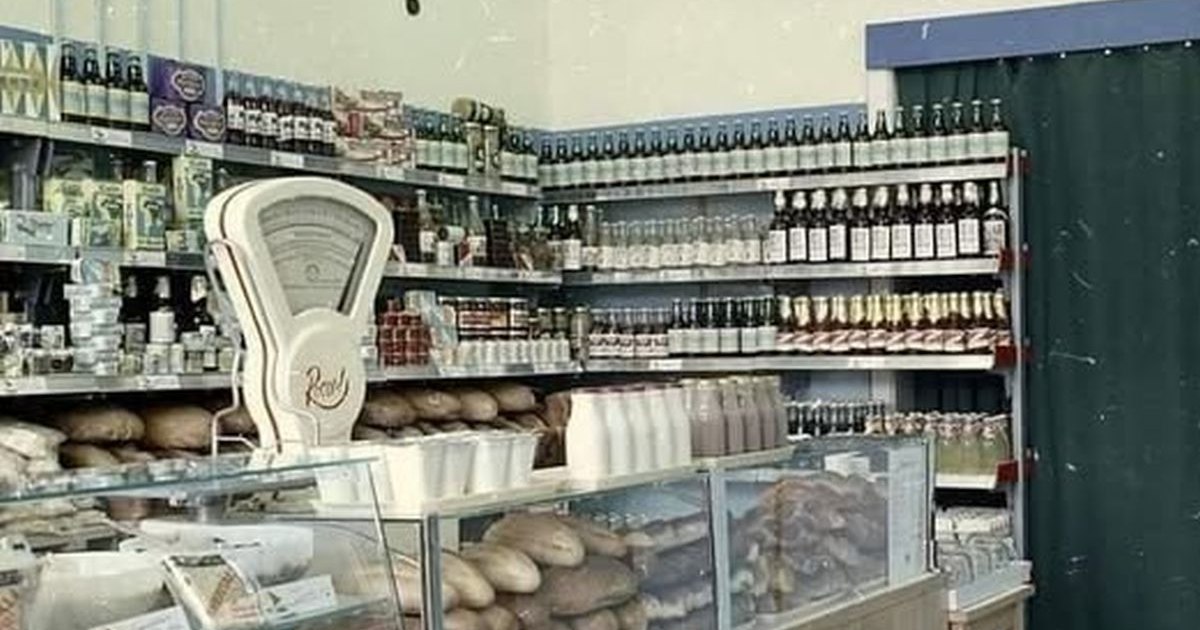
A photo of an Alimentara-type store, from the 80s, with full shelves, divided Romanians. If most understood that the photo did not reflect the realities of the time, others were quick to praise the abundance of the “Golden Age”. Finally, someone discovered the real story behind the picture.
The photo of a Hungarian store was altered to look like the Ceausist Alimentara. PHOTO: Facebook
A Facebook post featuring a grocery store from the 80s has gone viral and divided Romanians. The post quickly garnered over 4,500 comments, 3,800 shares and over 30,000 likes.
The photo shows a grocery store with full shelves, overflowing with merchandise, although in reality in those years food had become hard to find and the stores were empty. While some claim that in the time of Nicolae Ceaușescu it was good and there was enough food, others believe that it was a grocery store where goods were brought to give good luck, before a visit by Ceaușescu. Obviously, the last ones were closer to the truth, but not 100%.
Debate during the turbulent years of communism
“Food 1980″, it’s the laconic message of the post that caused a real debate in the virtual environment.
“I didn’t see it, the shelves were empty, you stood in line for five hours to get something. We held children in our arms to be more people, the ration was small. When I got home, the electricity was off, water after 9 pm, we’re talking about the cold! Painful memoryi!”, someone wrote.
And others remembered the sad communist times when shops were filled only on special occasions, and Romanians lived in conditions rather specific to those in the third world.
“In the rows, everything was given in portions, to reach everyone: a packet of butter, a loaf of bread, 10 eggs, a kg of onions, etc.. Sometimes it ended with a fight, after we sat in line and 10 hours…”, someone else wrote. “Sometimes they didn’t even arrive and you had to wait in line again”another netizen recalled.
Communism nostalgics have a different opinion
However, there were also voices that claimed that, in reality, life would have been better during the years of communism than today. For this they resorted to an antithesis with the present, but they were careful to emphasize only the negative aspects of our days.
“Today is better, we have 6 million migrants, the youth unemployment rate has exceeded 25 percent and we are in the first place in Europe in terms of poverty level. And there’s a line at the garbage cans for a fart or a piece of moldy bread”, someone commented.
“Strange, I am one of those who left, precisely because of the sick mentality that Romanians have. To glorify your executioner and pay tribute to him is pure mental illness”someone else quickly contradicted.
Others recalled other details of the dire poverty and privations of the time. “At the bottle, he stood in line for 2 weeks. They made lists, broke up, argued like at the tent door, it was beautiful”, one netizen recalled. “”The Golden Age» of the shoemaker, after which the nostalgic cry!”, added another.
The tricks of party bosses
Others thought that it was one of the stores visited by Nicolae Ceaușescu, where the party leaders rushed to bring goods and fill the shelves just to give a good look to the news of the time.
“Shop prepared for Ceaușescu’s visit!”, someone wrote. “Maybe 78…or some business visit coming up”, there was another opinion.
“We suffered for all 5-6 years so that we wouldn’t owe anyone. How the debt was paid, how they shot him. We were one of the strongest economies in the world. Do dogs now walk with bagels in their tails?“, someone asked.
Others tried to remember the zero point, the moment when Ceaușescu decided to sacrifice the population to pay off the country’s debts, thereby exposing his people to cold, hunger and humiliation.
“After 1985 this happened,” wrote a netizen. “About 1983,”
someone wrote.
“Right, after 1984 or 1986 I don’t know for sure because I was a kid, but until 84 they had everything. So some were speaking just because they are part of this infected and corrupt system” and “After ’82. I had finished high school and entered hungry, cold and dark”, au were just a few of the messages on the same topic.
Others, however, continued to deny the reality and speak of the “Golden Age” years as a glorious time.
“It took about seven years to pay the external debt to the IMF. Let today’s thieves and traitors have something to brag about and give to foreigners. In 1989, Romania was the only country in the world without a single leu of debt. That’s why they killed Ceaușescu. I understand that then no one knew, we all screamed that it was not good, but now, after 34 years of American, Jewish, etc. occupation, we still don’t know how it is? That’s right, idiocy as much as it can fit. Romania is occupied, they are dragging us into the war, the people are impoverished, pensions are a mess. They have special pensions as much as a hundred normal pensions, they have salaries and bags of money, Romania no longer produces anything. We live on loans, the country is sold or given to charity, the food is poisoned with additives, but it’s good! How stupid can you be to not see the truth?”someone got angry.
The mystery of photography, made clear
“Nothing was missing, we had everything we needed, including: free education, jobs, shame, respect and one very important thing – fear, in case of disobeying the laws,” wrote another. “More people are “starving” now than then! Then a salary was a salary and a pension was a pension. Not now! But we have democratized, we have arrived. I mean thieves”, was another message.
“It was beautiful once upon a time and all the products were Romanian, produced in our country!”, said another. “It was all that was needed and without chemicals”someone insisted. “Run away, me! The shelves were empty!”, a netizen pointed out.
“I grew up in Bucharest and that’s how the shelves looked, they were full and you had money to buy. Now they are full of everything, but most of them have no quality. They are all tasteless, it’s hard to find anything good. And when you find something better, it’s expensive, you don’t have money to buy it. Now the bosses live well, not the workers. They all stole after the Revolution and now they are bosses and they make fun of employees”, someone added.
“The crisis started after 1982 and yet the workers had enough, nothing was thrown away“, came another in turn. “The meat went to the USSR“, someone contradicted him. “That’s right, they ate chicken claws, cattle or pig hooves, smoked bones that were not exported”someone pointed out.
“How beautiful it was, we were standing in line like milogs when he brought meat, they defied us, the mayor, the secretary, the militiaman, and all the knowledge entered through the (back) door, and the honest people, when they arrived at (the counter) the meat was finished and they were served with “no meal without fish”“, another netizen wrote.
Several netizens discovered the mystery behind the photo: in reality, the photo was taken in Hungary, a country where grocery stores were really full even in those years, but those who wanted to prove that life was good in communist Romania took over -o and they edited it in such a way that the labels of some products written in Hungarian are not visible.
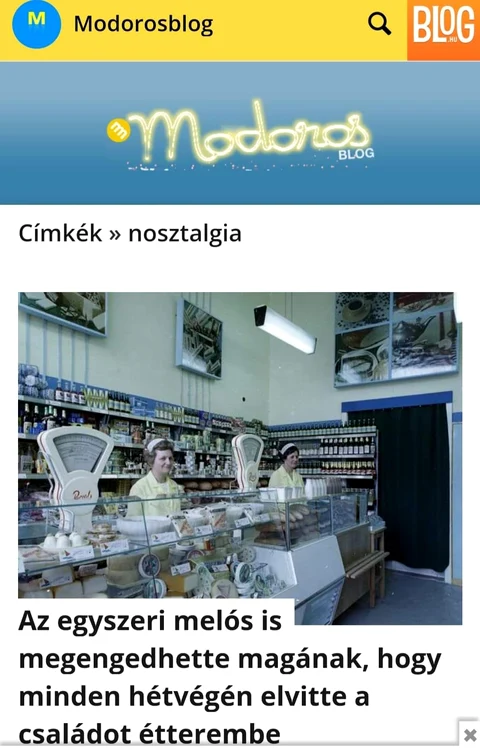
The real photo of the Hungarian grocery store from the 70s-80s. PHOTO: Facebook
“There was no way you could see something like that because the picture is from Hungary! One of the packages has the name “Univerzál”, clearly in Romanian”,
someone clarified the problem, and as proof he also posted the original photo, taken in Hungary.
“Yes, Romanian spelling! The problem is that they took the sellers out of the frame and enlarged the right side of the photo. But the photo can be found on several Hungarian websites”, explained another.
The truth about the 80s
As the global economy periodically goes through periods of crisis, beginning in 1979 and continuing through 1982, the world economy faced a complicated situation. The economies of developing countries were the most affected, and the countries of Eastern Europe felt the shock to the full. Nicolae Ceaușescu’s Romania was by far the most affected.
If in countries like Hungary, Poland and the former states of Yugoslavia and Czechoslovakia, all from the former socialist camp, food was found, and the communist governments of that time did not sacrifice the population, Romania entered a dark period of its history starting from 1980. A was the year in which Nicolae Ceaușescu gave the famous law number 13/ regarding the establishment, distribution and use of resources by county for supplying the population with meat, milk, vegetables and fruits.
As if that were not enough, Nicolae Ceaușescu would impose the drastic rationalization of the supply of natural gas and electricity. The decision was taken in 1987, and during the last two years of communism, Romanians had electricity and natural gas for only a few hours a day.
