
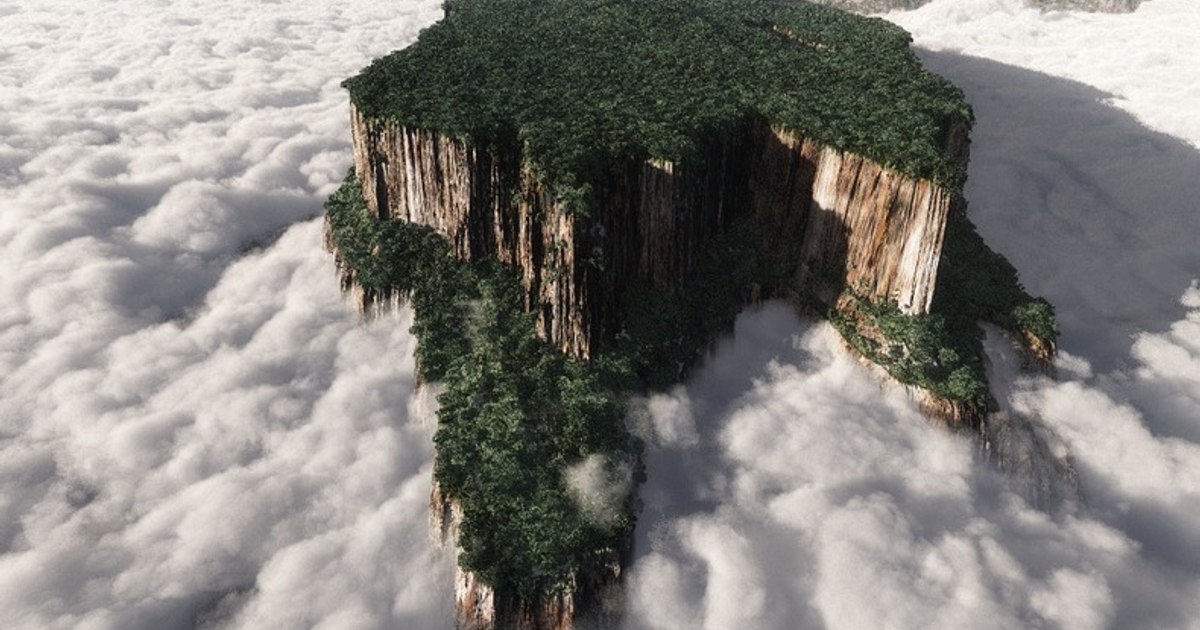
We live surrounded by natural wonders that it would be difficult for us to visit even if we dedicated our whole life to their discovery. Even if we cannot admire them on the spot, the almost unreal images captured by professional photographers reveal the beauty of some views that seem to belong to other worlds.
The Peakless Mountain, the natural wonder in the oldest place on Earth
Mount Roraima, the oldest place on Earth, a mystery still unsolved. The mountains are part of the Pakaraima range, which stretches between Venezuela, Brazil and Guyana. It is a sedimentary plateau that borders the Amazon basin and is said to be the oldest geological formations on Earth, estimated to be over 2 billion years old, Google Arts&Culture says
For more than 500 years, scientists from all over the world have tried to decipher the mysteries surrounding this place, declared the oldest on the planet.
In addition to rising nearly 3,000 meters above sea level, the mountain has an unnatural morphology that appears to have been cut with knives so precise are its angles.
This rock formation is the largest of its kind in all of South America and is part of the Pakaraima mountain range.
Its origin is a mystery. Mount Roraima is believed to have been the product of a large earthquake in the past. However, its origin is uncertain, as similarly created geological features do not have this shape.
This has led scientists to believe that it may be the oldest rock formation on Earth.
It has been 5 centuries since Mount Roraima puzzled historians, geologists, and many scientists. Basically, Mount Roraima is a mountain without a peak.
The top of the mountain formation is completely horizontal and occupies an area of more than 30 square kilometers, surrounded by waterfalls, cliffs and other rare geographical features in the world.
Seen from above, it looks like a towering island. Mount Roraima is home to a great diversity of endemic animal and plant species. The mountain is famous for having plants and animals found nowhere else in the world, according to Click.
Geologists and biologists around the world estimate that it hides species that science has not yet known, as there are spaces in the mountain that are still unexplored.
