
After almost 20 years since the content has not been changed, high school students will study according to new programs from next year. The Ministry of Education launched the new projects in public consultation The Romanian education system urgently needed this change, says Education specialist Gabi Bartic. “The old programs were mostly built for a world that no longer exists. There was a need for updating, a connection with the economic, digital reality, with the way science is done today and with the way children think”. Until the end of the week, every day, the new contents and what they bring new will be presented on the You Tube page of the Ministry of Education.
PHOTO The Truth Archive
The new program from History. Ioan Aurel Pop: “We tried very hard not to contain nationalist accents in the sense of exaggerated nationalism”
The proposal for the History program was presented by the president of the Romanian Academy, Ioan Aurel Pop, and by professor Mirela Popescu. Both contributed to the curriculum, and Pop was the scientific coordinator of the working group.
“We tried very hard not to contain nationalist accents in the sense of exaggerated nationalism. I say this because a lot of people today, when they hear the word nationalism, think of xenophobia and chauvinism. Which is something else entirely. Nicolae Iorga, when he declared that he was a nationalist, he understood only one thing: the love of the nation. And he said <
He also spoke about the need to understand historical chronology: “If we manage to impose the sense of chronology, know that it is very important, I meet students who do not have the sense before our era, before Christ and after Christ”.
According to the academician, the thematic study of history “destroyed the chronology”.
Professor Mirela Popescu: A program closer to the needs of the current generation
History teacher Mirela Popescu specified that the emphasis will be placed on concepts and personalities less discussed in secondary school, but which are in line with the needs of current generations.
“In the philosophy of the program, aspects related to the themes of contemporary education, civic education, environmental education, and health education were captured. For the simple reason, here too I allow myself to quote Cervantes, who says that history is a repository of actions, a witness of the past, but it is also an example and a notice of the present and a warning of the future, respectively. The examples that the History discipline can bring can be relevant for their formation as future citizens”.
Greater emphasis on the study of Romanian History
The new program will place more emphasis on the study of Romanian History, the teacher said. According to her, after the new changes, high school graduates will have more information about national history, “on the elements of culture, of civilization, which can build that feeling of belonging to a people and to a geographical space as part of today’s Europe”.
Critical thinking, encouraged
The new program will not only develop skills, but also critical thinking, added Mirela Popescu: “In such a way that during high school we give the student the opportunity to form and use what he learns in History wherever he will go and whatever career he will pursue. Critical thinking based on scientific evidence. (…)From a reminder in the ninth grade of the basic elements related to causality, chronological milestones, it goes to the formulation of points of view, to make the student of the twelfth grade able to have a point of view argued and justified, with scientific evidence, not based on what is offered to him, I know, in various contexts or for various reasons”.
The programs proposed for History, depending on the profile, can be found here, along with the other subjects. By the end of the week, the main changes will be presented by the coordinating teachers, on the Ministry’s YouTube channel.
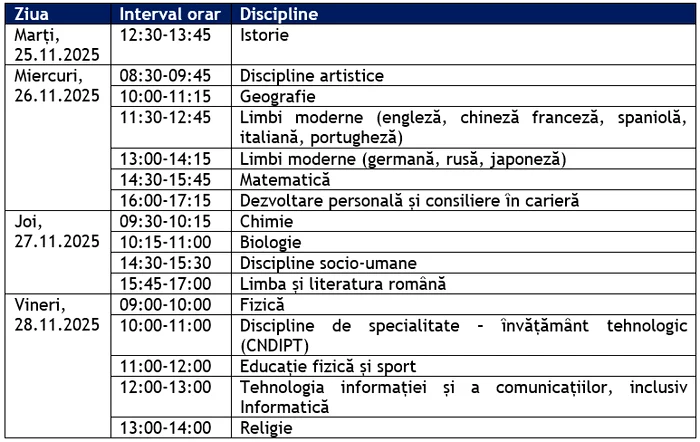
Schedule of presentations on You Tube of new programs Source: Ministry of Education
The new programs will be open for public debate until December 12, and opinions and proposals will be received at the e-mail address [email protected].
Why new programs are needed
The Romanian school urgently needed an update of the taught content, says Education specialist Gabi Bartic. “The old programs were mostly built for a world that no longer exists. There was a need to update, to connect with the economic, digital reality, with the way science is done today and with the way children think.
The real question was not <
New curricula should focus on understanding and application, not just going through the material.
“It should focus on real skills, not content lists; thinking, not mechanical memorization; transfer between domains, not isolated fragments; equity — programs that most students can take, not just the top. And they should be organically linked to school orientation: programs cannot operate in a vacuum. If a profile becomes very difficult, there must be serious advice on choosing it”says Gabi Bartic.
And in this sense he gives the example of the new program for Mathematics:
“I’m not a content specialist – I’m speaking as a former student who did a lot of math and for whom math has been useful all her life. And the new program goes exactly in this direction: it emphasizes understanding, how you get to the result, not just the result itself, and applicability in real contexts. All openings to progressions, patterns, statistics, probabilities – these are areas that make sense of mathematics for most children – are welcome.
What I noticed, however, very clearly in the Mate-Info profile is that a stronger differentiation appears. The common core becomes more practical and accessible, but the specialization mathematics becomes much harder and deeper – exactly as it should be for a Mathematics-Informatics profile. It’s a sign that we can no longer go to Mate-Info “let’s see if we can do it ourselves”. This specialization will require solid reflexes and concepts from secondary school and a much more careful choice of profile”.

Gabi Bartic, expert in Education
New programs, necessary but not sufficient
Because in recent years there has been a lot of discussion about the worrying level of functional illiteracy in Romania, the questions inevitably arise: will the new programs help to reduce this phenomenon? And what other elements are needed to encourage critical thinking?
Gabi Bartic says:
“They can only help if they are taught in a way that emphasizes meaning, understanding, connection to real life. The simple fact that the subject is modernized does not automatically reduce functional illiteracy.
Critical thinking occurs in programs—through modeling, through applied problems, through interdisciplinary connections. But the real impact depends on: how much time teachers have to go deeper, not just “tick off”; the resources they receive; how well they are trained for the new requirements; volume calibration at the level of students
In other words: programs can help reduce functional illiteracy, but not if they are too dense or too abstract for the vast majority of children. Here a spectacular role will be played by the new textbooks, which we hope to see emerge from the old, hyper-theorized and very unattractive paradigm”.
According to the Ministry of Education, more than 1,500 specialists contributed to the development of the new programs. Their list can be consulted here.
After the approval of school programs, the next step will be the development of textbooks, but also, say the representatives of the ministry,“the training of teachers to implement this curriculum with modern methods, along with the completion of national assessment standards for each school program”.
