
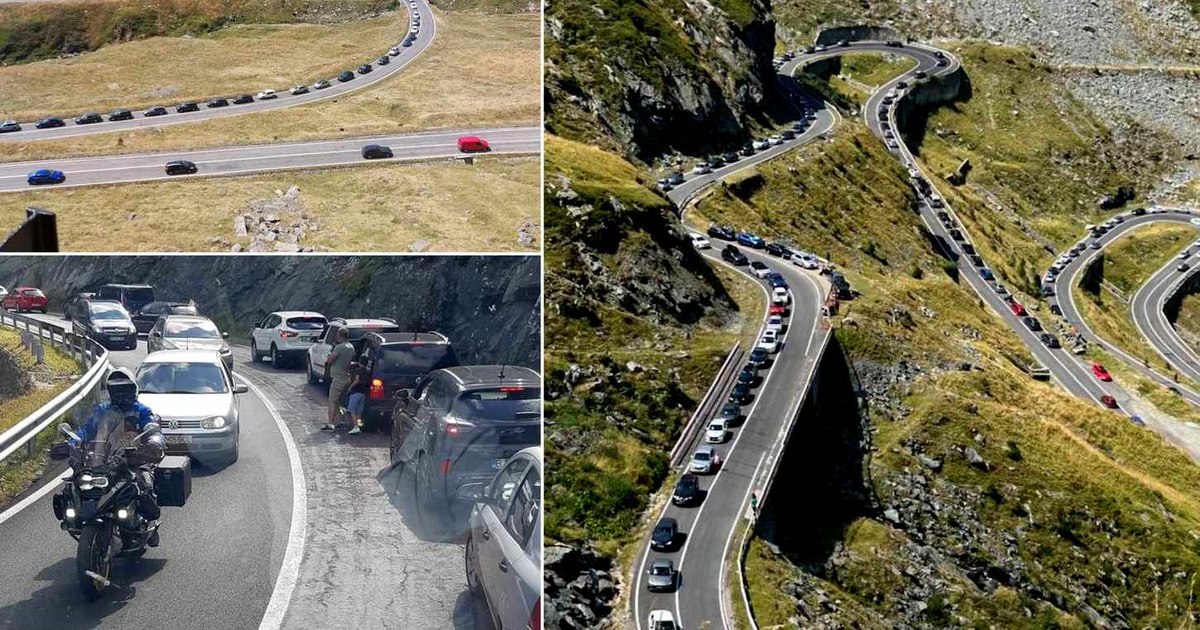
Congestion on Transfăgărășan, the mountain road that connects the historical regions of Muntenia and Transylvania through the Făgăraș Mountains, became one of the most congested national roads in Romania this weekend.
Transfagărașan at the weekend. Source: Facebook Maria Mariana, Georgel Murariu
Columns of cars stretching for several kilometers were also formed on Saturday, on National Road 7C near Bâlea Lake, one of the favorite stopping places for tourists.
The images that show how crowded the road is that climbs to over 2,000 meters were published by several Romanians on social networks (video – Cătălin Manescu).
Some of them complain about the chaos created by those who park their cars on the road to admire the spectacular view of the mountains or to get close to the few bears that have become accustomed, out of necessity, to the presence of tourists.
“It’s terrible. There is always a queue on the road from Sibiu and at Curtea de Argeș it starts to queue and there are no free parking spaces. People leave their cars on the road. I went out of my way not to wait in line until tonight”reports a driver, on the “Transfăgărășan” Facebook group.
Some of the tourists who stopped on the road to approach the bears came close to being injured by the wild animals on Saturday. Several travelers wanted to feed a bear and her three cubs on the side of the road, but she rushed at them.
Traffic flowed from bar to bar on Saturday in the alpine area crossed by the road, but there was also agglomeration the other days, on the feast of St. Mary.
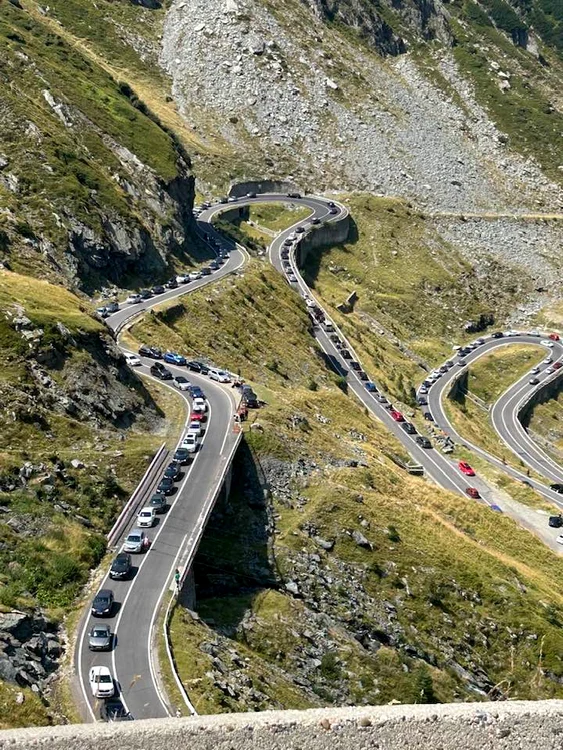
Transfagarasan. Photo: Maria Mariana. Facebook
“I went on Friday, around 2 pm, and for the last five kilometers, I was bar to bar. There weren’t many parking spaces up there. On the route we saw 12 bears. Arm yourself with patience. Have a good trip and don’t feed the bears”transmits a Romanian, on the “Transfărgărășan” Facebook page.
Tourists who want to avoid the crowds are advised to take this road during the week.
Transfăgărășan, one of the most spectacular roads in Europe
Transfăgărașan has completed five decades since its inauguration. The National Road 7C that connects Argeș and Sibiu counties was built in the early 70s and is among the most spectacular mountain roads in Europe,
The mountain road that crosses the Carpathians through the Bâlea caldera in the Făgăraș Mountains, climbing up to 2,042 meters, near Bâlea Lake, was inaugurated in 1974 by Nicolae Ceaușescu, and thousands of soldiers were used in its construction, the plans of the communist regime being to reduce labor costs as much as possible.
The construction project of Transfăgărășan was approved by a decree of December 1969 of the Council of Ministers. The road was designed in a few months, by construction engineers, who needed the help of mountain hunters and climbers to make topographical markings in the precipitous places of the mountain.
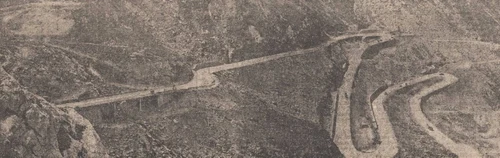
Image 1/10:
Transfagarasan illustrated (1) jpg
The construction of the Transfăgărășan was one of the most complex road infrastructure works carried out before 1990. The mountain road in the Făgăraș Mountains starts from Arefu commune, in Argeș county, at kilometer 61 of DN7C and ends in Cârţişoara commune (Sibiu), at the intersection with DN1. 27 bridges and viaducts were built along the entire route of the Transcarpathian road, as well as the longest tunnel in Romania (884 meters), the Bâlea Tunnel.
The Ceaușescu regime set out to complete this difficult project, started in 1970, in only three years, with thousands of people working on it, most of them soldiers from the units stationed in the area. In the spring of 1970, the first explosions disturbed the peace in the wild land of Făgăraș. Dynamite was then used on thousands of other occasions to dislodge rocks, or to uproot centuries-old trees along the route of the new road.
Ceaușescu inaugurated Transfăgărășanul
However, the authorities of the time were proud of the many machines brought to the construction site of the mountain road: bulldozers, excavators, tractors, compressors, tippers, most of which were supplied by the Romanian industry.
Transfăgărășan was inaugurated later than the proposed term, on September 20, 1974, in the presence of Nicolae Ceauşescu, but it was only in the following years that it was completely paved.
The most spectacular work of art on Transfăgărășan is the Bâlea – Capra tunnel, built between 1972 and 1974. To build the tunnel, more than 41,000 cubic meters of stone were displaced, using 20 tons of dynamite, according to the testimonies of the time.
Five decades after its opening, Transfăgărășanul is no longer seen as a strategic road – as it was considered in the past -, but as a tourist landmark of Romania, which can be crossed, along its entire distance of about 150 kilometers, only during the summer.
The Bâlea Hut in the Făgăraș Mountains, one of the attractions of the route, was known as a tourist landmark long before the construction of the mountain road. The first mountain cabin in the Făgăraș Mountains was built in 1873, at Bâlea Cascada.
