
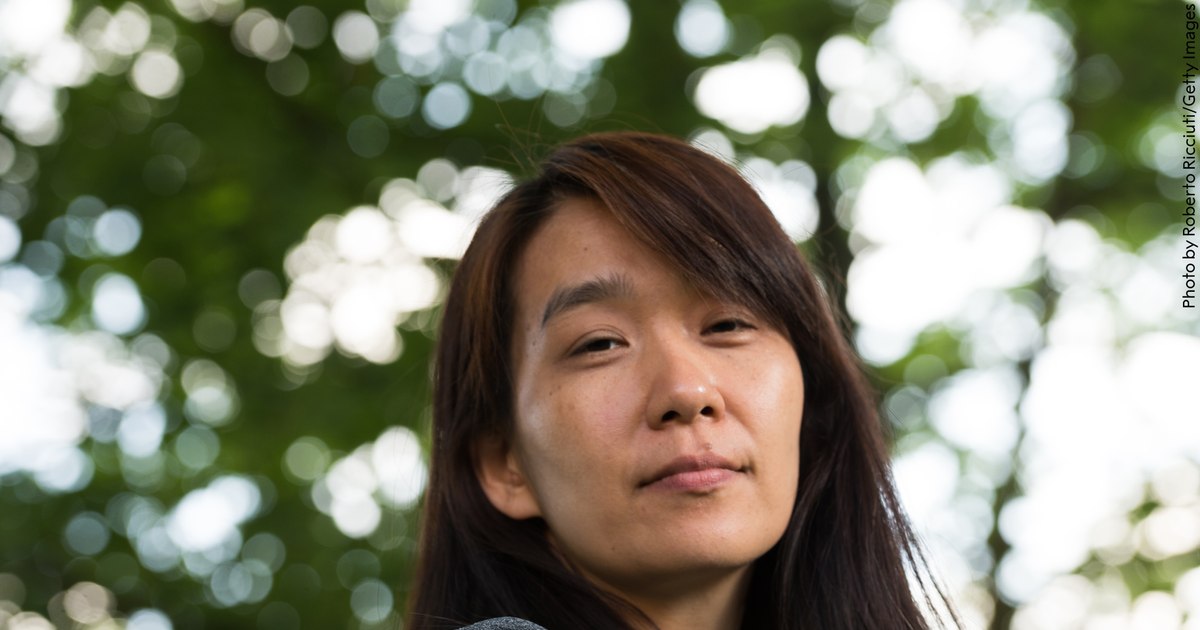
South Korean writer Han Kang won the 2024 Nobel Prize for Literature “for her intense poetic prose that confronts historical trauma and exposes the fragility of human life.”
South Korean writer Han Kang Photo: The Nobel Prize/X
Han Kang, aged 53, becomes the 18th woman out of 116 laureates of the Nobel Prize for Literature to receive this prize. He is the first South Korean author to receive this distinction.
“In his work, Han Kang also confronts invisible sets of rules and, in each of his works, he has a unique awareness of the connections between body and soul, between the living and the dead, and through his poetic and experimental style he has become a innovator in contemporary prose“, said Anders Olsson, the president of the Nobel Committee for Literature.
This year’s Nobel Prize season kicked off on Monday, October 7, with the awarding of the prize for medicine, which went to researchers Victor Ambros and Gary Ruvkun for the discovery of microRNA and its role in post-transcriptional gene regulation.
On October 8, the Nobel Prize for Physics was awarded to researchers John Hopfield and Geoffrey Hinton, rewarded for discoveries and inventions related to the learning process of machines through artificial neural networks.
On October 9, researchers David Baker, Demis Hassabis and John Jumper were awarded the Nobel Prize in Chemistry for computational protein design and protein structure prediction. The prize for peace, the only one announced in Oslo, will be awarded on October 11. Also, the Riksbank Sveriges Prize in Economic Sciences in memory of Alfred Nobel will be announced on Monday, October 14.
The official Nobel Prize ceremony takes place every year in Stockholm on December 10, the day on which Alfred Nobel’s death is commemorated. In 2024, each Nobel Prize is accompanied by a check worth 11 million Swedish kroner ($1.05 million).
The main works of the writer Han Kang
Writer Han Kang was born in 1970 in the South Korean city of Gwangju before moving with her family to Seoul. In addition to writing, she also dedicated herself to art and music, a detail that is reflected in her entire literary creation, the Nobel Committee states.
He started his career in 1993 with the publication of some poems in Literature and Society magazine. Her prose debut came in 1995 with the short story collection “Love of Yeosu”, followed shortly thereafter by other prose works, both novels and short stories.
Among her most important novels are volumes such as “Your Cold Hands” (2002), which contains clear evidence of the writer Hang Kang’s interest in art. The book reproduces a manuscript abandoned by a missing sculptor who was obsessed with making casts plaster casts of female bodies.
Her great international success came with the novel “The Vegetarian”, published in Korean in 2007 and awarded, after being translated into English, with the prestigious Man International Booker Prize in 2016. Written in three parts, the book describes the violent consequences that arise when its protagonist, Yeong-hye, refuses to obey the norms of food consumption.Her decision to stop eating meat is met with various, completely different reactions.
A more plot-driven book is “The Wind Blows, Go” from 2010, a large and complex novel about friendship and art, in which pain and the desire for transformation are strongly present.
Another highlight of the South Korean writer’s career is her recent book “We Do Not Part” from 2021, which, from the perspective of its pain-inducing images, is closely related to “The White Book”. The story unfolds in the shadow of a massacre that took place in the late 1940s on Jeju Island in South Korea, where tens of thousands of people, including children and the elderly, were shot on suspicion of being collaborators. In 2023, the Swedish Academy awarded the Nobel Prize for Literature to the Norwegian writer Jon Fosse.
