
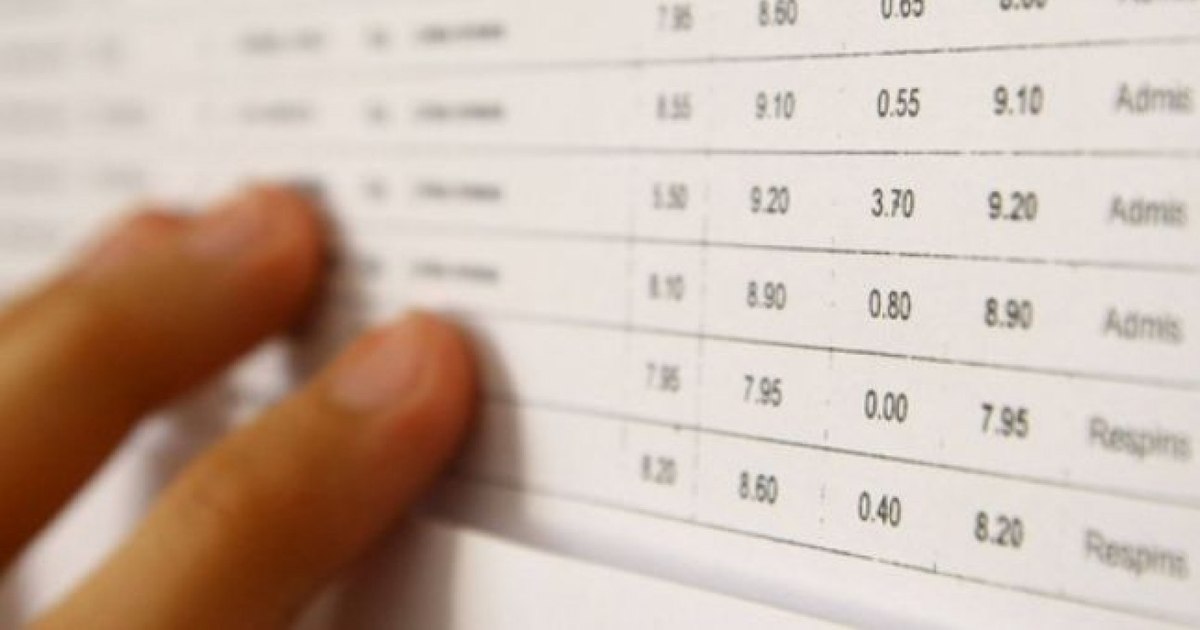
The family of a student from Bucharest, who supported the national evaluation last year, sued the Ministry of Education requesting the correction of the note from the Romanian language and literature.
Following the appeal, the student’s note decreased. Photo archive
Last year, after publishing the results at the National Assessment, a student from Bucharest decided to challenge the initial note obtained in the Romanian language and literature test, of 9.20 (from the average notes 9.40 and 9.00), then, after resolving the appeal, at 8.25 (from the average of 8.50 and 8.00).
The student of the student, comparing the official scale with the correct answers in the work, claims that he had noticed objective punctuation errors and, because an additional evaluation could not be made (the threshold for 1 -point reorecation could be met), he requested in the court the obvious material errors, more precisely the objective and integral correction of the score according to the scale, without the scope.
The request addressed to the court took into account the fact that the family found errors in objective (grammar) items, which shows that the final note was affected by material mistakes, such as omitting additional pages or erroneous transcripts in the computer system, support the child representatives.
“In total, there are 90 points (sutimi) that were not granted, according to the documents submitted to the file by the Ministry of Education. Thus, it has been shown that it was an error of 90 points (sutimi) in minus, in topics with objective response items, for which, according to the procedure for secreting and securing, loading and collecting, evaluating the written works and solving the appeals, if there are differences between the two evaluating teachers, the application will notify this, and this will be notified. But in the case of this student in Bucharest, this did not happen “, Said Victor Stanilă, Managing Partner Victor Stanila Law Office, lawyer in this file.
The court forced the ministry to submit the individual evaluation board and
According to him, initially, the ministry defended itself by drawing up a report by which its signatories attested that they checked the work and that there were no material errors. However, the court obliged the ministry to submit the individual-individual deduction and scoring border on the items-which contains the score of each evaluating teacher granted on each contest (requirement) according to the scale-from which the score granted erroneously was shown. Therefore, the family filed a criminal complaint for the offenses of intellectual false, theft or destruction of evidence or documents, abuse in service for the refusal to straighten the note, negligence in service against the teacher who failed to complete the score in the computer application.
“This case is not about an extra or minus point. It is about the failure of an educational system that decides the academic future of tens of thousands of children. Hundreds, maybe thousands of students are discouraged to challenge a note they consider unfair, for fear that they might lose even more. The psychological and legal effect of a system that punishes the correct initiative is devastating to children and for public confidence, and if the flagrant errors are not recognized and corrected, we transmit to young generations that it does not matter how well you learn, but how lucky you are. Justice in education does not mean only equal access to learning, but also correct treatment in evaluation. If a wrongly noted work cannot be corrected objectively, we are talking about a form of institutionalized discrimination. The court has, in this case, not only the role of arbitrator between the parties, but also a responsibility to a fundamental principle: the right to a correct assessment”Says lawyer Victor Stănilă, adding that the errors were generated by a teacher who was not part of the body of the evaluating teachers.
It is necessary to reform the evaluation procedures
The lawyer points out that, although it was the first year in which he was corrected digitized, “Instead of taking additional safety measures, the ministry has continued to be part of teachers who are not part of the national body of evaluating teachers to correct works in the contest, as in this case.”.
Moreover, says Stanilă, the digital correction platform, which should have reported the differences between the evaluators and trigger the verification procedure has proved its inefficiency.
“The case brings to the discussion the urgent need to reform the evaluation procedures, to increase the quality of the evaluating teachers, as well as to ensure transparent and functional mechanisms to correct the mistakes. In the absence of firm measures, confidence in the national evaluation system risks being deeply affected. In this case, we are not talking about subjective evaluation opinions, but about proven errors on objective items, with clearly regulated answers. It is obvious that the procedure worked defective, directly affecting the educational future and the student’s emotional development”, Said lawyer Victor Stănilă.
The Bucharest Court of Appeal, as a first instance, rejected the request for a trial as unfounded, but the family decided to file an appeal.
“We will continue this fight in court not only to correct a punctual injustice, but to protect the right of each student to a correct and objective evaluation. If we accept that the obvious errors remain unparalleled, we compromise the entire meaning of the appeal and the public confidence in The education system ”, concludes lawyer Victor Stanilă.
