
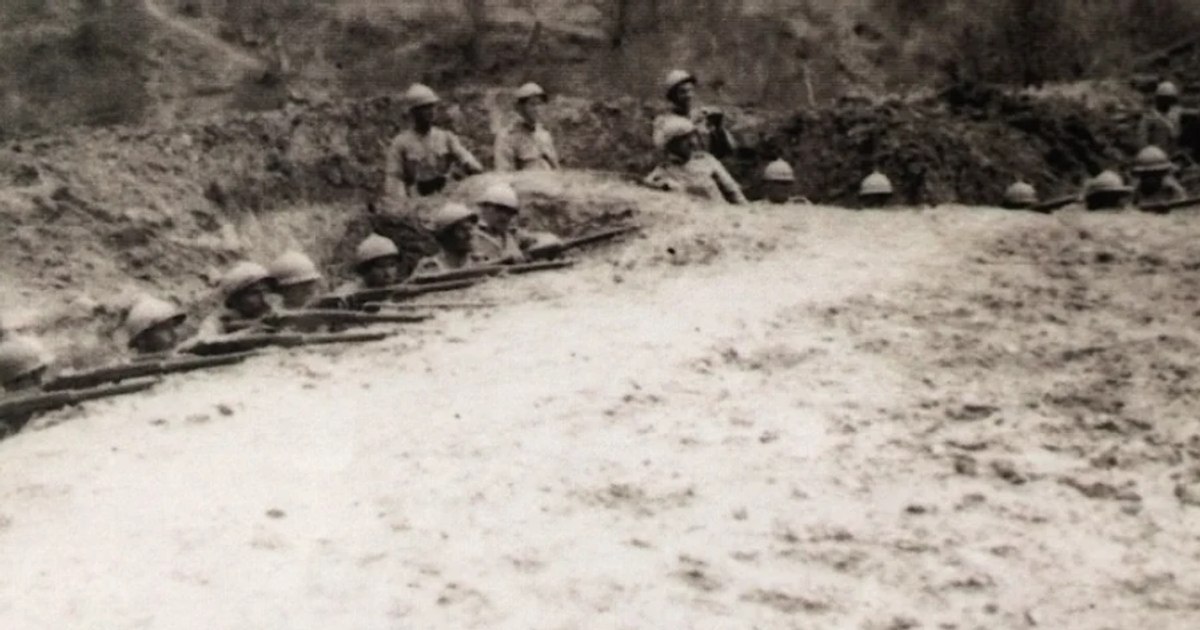
The Răzoare Forest at Cota 100 witnessed heroic battles in the First World War. Instead, the front lines of 1917 will be covered by the future A7 motorway.
Romania in the First World War PHOTO: Sînziana Ionescu Source: MNIR
Northwest of Mărășești, in the area known as Pădurea Răzoare and Cota 100, some of the fiercest battles of the First World War took place on the Romanian front. In these places, the nation’s heroes fought tenaciously against the enemy, writing pages of glory and sacrifice with their blood.
The documents of the time describe in detail the bloody battles that took place on this alignment. One of the emblematic figures of those hot early August days was Captain Ignat, a true hero who met his end with his fingers caught on a machine gun. His courage and determination, along with the slogan that became famous “You can’t pass through here”have inspired and continue to inspire whole generations of Romanians.
Today, the mausoleums, monuments and statues erected in memory of those heroes bear witness to the ultimate sacrifice made for the defense of the homeland.
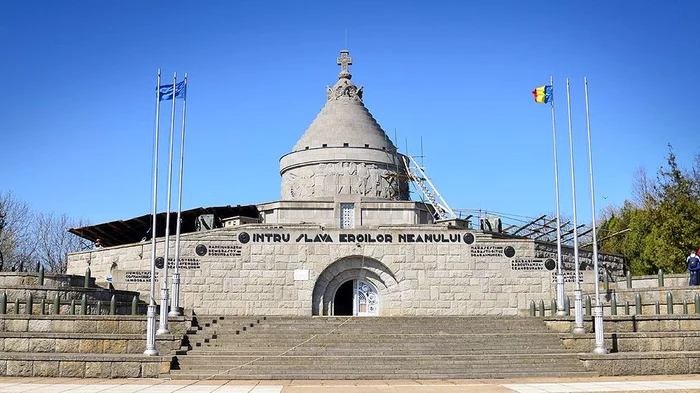
Mărășești Mausoleum PHOTO: Archive
However, there are few who know in detail the history of the battles at Pădurea Răzoare and Cota 100, especially since a road now crosses the old battlefield, from Panciu to Haret and further to Mărășești.
The journalist Silviu Stanciu from Focșan claims that it would be appropriate for the county authorities to pay more attention to this aspect, as do other nations that do not have such a dramatic history, and from place to place informative panels should be placed to remind passers-by that without the sacrifice to the heroes of that time, history would have been written differently for the Romanian people.
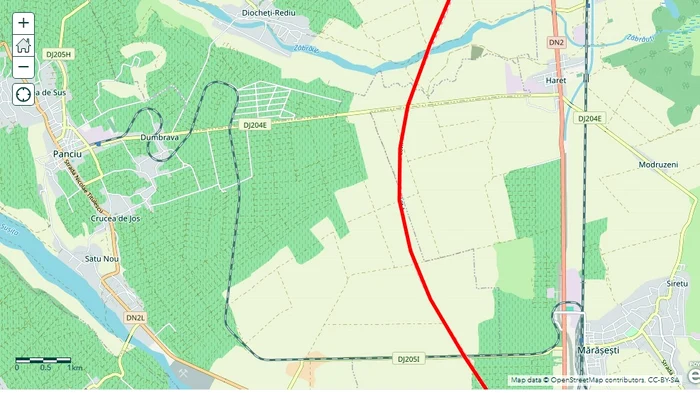
“Yesterday I drove from Panciu to Haret past what was once the Răzoare forest or elevation 100. Apart from a few portions of vineyards and cornfields and some plots of some households, you don’t see anything else that reminds of that place. In addition, soon, a part of the A7 highway will pass through this area, bringing with it a paradox of history: if in 1917 the slogan “Pe aici nu se trece” was vital for the existence of the Romanian state, now, on the same road, we will he could pass free, thanks to the sacrifice of the heroes of that time. To honor the memory of those men and their sacrifice, it would be appropriate to place an information board around this historic field. On this board we should write: “In 1917, You can’t pass here, so that in 2024 we can pass. Free and master in our country.”
Thus, we would show our gratitude and respect to those who fought and sacrificed for our freedom and sovereignty”. says journalist Silviu Stanciu.
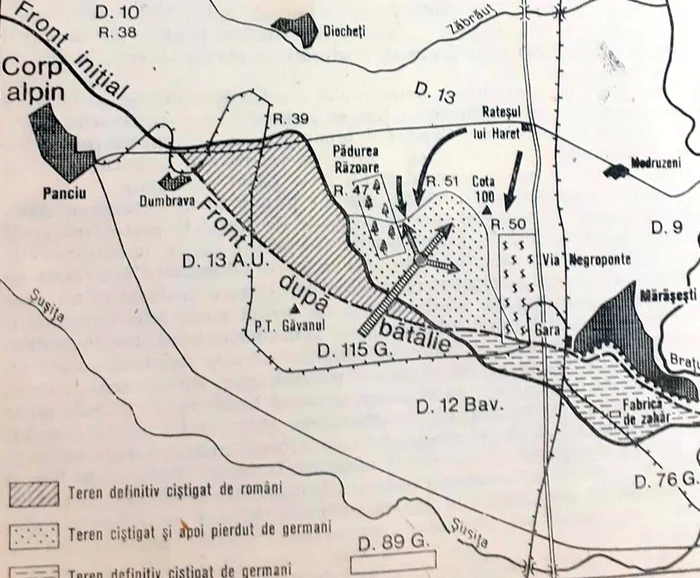
A page of heroism was written during the First World War by the machine gun company commanded by Captain Grigore Ignat, in the bloody summer of 1917.
The company’s 180 soldiers received a mission for August 6 to defend Cota 100, practically a height of land located west of the Mărăşeşti train station.
The historiography of the battles at Mărăşeşti unanimously mentions the heroic death of all 180 soldiers, including the company commander Captain Grigore Ignat. Only one survived, sub-lieutenant Teodor Grigoriu, commander of Platoon 1.
The Battle of Mărăşeşti, which began on August 6, 1917, lasted 29 days, until September 3, 1917, and represented the largest military engagement that took place on the Romanian front during the First World War.
“On the morning of Sunday, August 6, a day of apparent calm with a warm and mild sun, at about 6:30 the enemy unleashed an infernal artillery bombardment from the mouths of over 1,000 guns. In the language of the front, artillery preparation meant the prologue to the attack. On the main direction of attack, fixed by the enemy in the sector of the 1st Battalion of the 51st Infantry Regiment, there was also the Machine Gun Company commanded by Captain Grigore Ignat. The German army managed to create a breach in this area, taking advantage of the numerical superiority. In view of the created situation, the task of stopping the enemy’s advance was also entrusted to the Machine Gun Company, which had to go into action because the Romanian first line of defense had been disorganized by the bombardment and repeated enemy attacks. Machine Gun Company, Last Island of resistance from this sector, well camouflaged, was firing at full blast with its eight pieces”, according to historians Gheorghe Popa and Alecu Lenco.
The German infantry penetrated the device and headed towards Cota 100, defended by machine guns. The commander had informed his soldiers that the price of resistance to the position will have historical value, given that stopping the enemy’s advance, even for an hour, can mean the time needed for the regrouping of the Romanian army. It was a fierce battle, in a hellish atmosphere, in which the German guns pounded the 100th Floor.
“An enemy shell fell on a machine gun, blowing it into the air with its servants torn apart. Another Romanian machine gun had the same fate, killing the platoonist student Ralea Emil, commander of the 2nd platoon. Then one by one the machine guns fall silent. The servants fell one after the other and there was no one to replace them. The moment was critical, desperate, and Captain Ignat and Second Lieutenant Teodor Grigoriu switched to the machine guns.” according to the mentioned historians. In the middle of nowhere, Captain Ignat dies.
The statistics record the losses of the opposing troops at over 60,000 dead, wounded and missing, while the Romanians, out of the 170,000 soldiers engaged in the fighting, had 27,140 losses, namely 5,125 dead, 9,818 missing and 12,467 wounded. For its part, the Russian 4th Army had 25,650 dead, wounded and missing. The battles from Mărăşeşti remained in history as “the most brilliant page of our great national war”, and the hero city acquired, through the sacrifice of the Romanian soldiers and the Russian and French allies, not only a national, but also an international consecration.
There is no way through here
“The great engagement lasted 29 days and engaged, on both sides, 25 infantry divisions, 2 cavalry divisions and a cavalry brigade. 16 of the 29 days were marked by particularly fierce battles, attacks and counterattacks, all consumed at the highest tension. Along with Mărăşeşti, in the historical geography of Romanians, the names of localities, rivers or forests have acquired a special place: Bizigheşti, Străjescu, Furceni, Doaga, Moara Albă, Şuşita, Zăbrăuţ, Chicera, Cosmeşti, Călini, Răzoare, Muncelu. The enemy’s attempt to break through the front held by the Romanian 1st Army (commanded successively by generals Constantin Cristescu and Eremia Grigorescu) was foiled. Here, in Mărăşeşti, the Romanian army won a new and great victory, proving to the world that “You don’t pass this way”, according to the historian Constantin Kiriţescu.
