
Although students in Romania complete over 1,200 hours of Mathematics up to the 8th grade, their performance in this subject is one of the weakest in Europe. This is the conclusion of a study recently published by the OECD based on the results obtained in the PISA tests and commented by a specialized teacher. “We have a system based on stupidity, not logical thinkingProf. Denisa Tănăsescu declared for “Adevărul”.
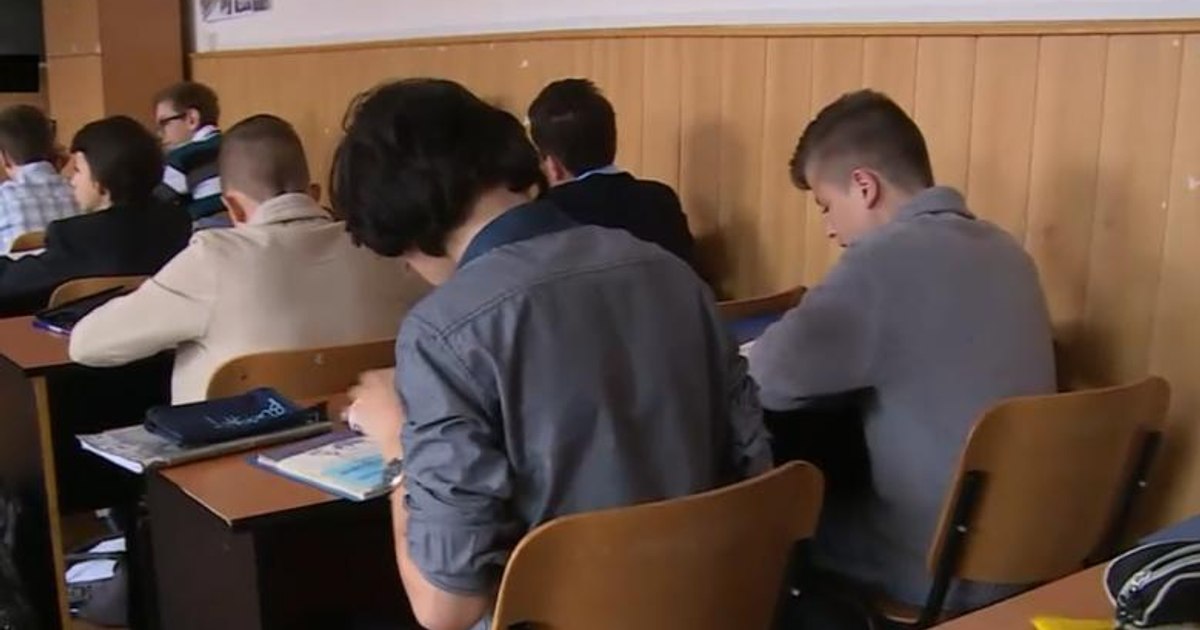
Romanian students, among the weakest in mathematics in Europe. Photo source: archive
Romania obtained an average of 428 points in the 2022 PISA tests, in the Mathematics test, although the number of hours provided in the curriculum for the first 9 years of school in this subject is over 1,200. Our country ranked 45th in the ranking of the 81 participating countries and in the penultimate place in the European Union.
Thus, Romania is the champion in the top of the countries that allocate the most hours to training for this discipline, but it is positioned at the bottom of the ranking when it comes to performance in Mathematics. These are the least alarming conclusions of the study “How is the school year organized in OECD countries?”, published by the Organization for Economic Co-operation and Development (OECD) on August 1, 2024.
Mathematics teacher Denisa Tănăsescu is of the opinion that the PISA results of Romanian students have no relevance in the context in which our system of teaching, learning and evaluation is totally different from the one outside. “It is normal that we had poor results, because our students are not used to that evaluation system. It is about something completely different. The requirements are different, the approach is different. These results should be reported to our own curriculum or we should try to align ourselves with the system of European countries. Because, otherwise, we cannot compare apples with pears”.
The teacher believes that the Romanian students recorded bad results for several reasons. First, they were evaluated by other criteria that they are not used to. “They did not do such exercises, problems in class. They are not used to the PISA style”.
Matter, a lot and poorly conceived. Learning, based on nerding out
The number of hours of mathematics circulated in the OECD study is indeed high, but that would not be the problem, the teacher believes. “The subject should be taught by heart, better, more efficiently. At us, in addition to the fact that it is many, bushy, it is also poorly designed and taught. Romanian students were not encouraged to contribute their minds, to think, to make logical associations. Instead they were encouraged to blunt. With us, everything is memorized. I’m working on the 2nd degree position until I can’t anymore”.
Prof. Denisa Tănăsescu makes a comparison with the subject taught in schools in Holland and Greece, and the differences between our education system and theirs are astronomical. “I had the opportunity to guide students who prepared to take exams in the Netherlands, but also in Greece. I took the courses there, I looked over the subject, over the way it is structured, I analyzed the way of teaching, the requirements, the way of evaluation, I saw what the emphasis is on. I tell you that it is completely different from what happens here. And I also did a little experiment: I went to the classroom and taught according to those models. The result was beyond expectations. The children understood faster, easier, they started to like math, they liked doing those exercises”.
“Let’s take the model from outside and the results will come”
The teacher also brought up the subject taught at the Greek school. “It makes them think, judge things with their minds. With us it is based on memorization. The more the merrier. My advice: the example should be taken from other schools, from outside. Let’s copy their model because razors work. I’ll give you another example: our students study mathematical analysis, the study of functions in the 11th grade. Greek students start in the twelfth grade and complete our subject in one semester. Well, we struggle for a year with the integrals and they succeed in a semester? Well yes, because we have thick matter, many things to remember. And in the end the child accumulates nothing”.
The teacher believes that the Romanian education system should follow the model of those outside. “Let’s not copy it, but adapt it to us because it’s the recipe for success. And then they will come too PISA results better”.
PISA 2022. Top of the smartest countries in the world
Japan has the second highest score (536 points), after Singapore (575 points), PISA 2022 results show. . The Japanese curriculum provides for almost 1,100 hours of Mathematics, according to the information in the cited report.
Next is Korea (527 points), where students have just over 800 hours of Mathematics in the first 9 years of school.
Above-average results were also recorded in Estonia (510 points), the Czech Republic and Austria (487 points), Slovenia (485 points), Finland (484 points) and Latvia (483 points), with between 900 and 1,100 hours of mathematics .
Only 2 countries that dedicate more than 1,100 hours to preparing students in Mathematics far exceeded the OECD average in PISA tests 2 years ago. These are Ireland (492 points), with over 1,100 hours of mathematics, and Denmark (489 points), with over 1,300.
Germany (475 points), France (474 points), and Spain (473 points), all with more than 1,100 hours of mathematics, exceeded the OECD average threshold, but by less than 5 points.
473 points were also obtained in Hungary, where students between the ages of 7 and 15 have 900 hours of Mathematics.
Portugal, which requires 1,800 hours of Mathematics, had a score of 472 points, reaching the OECD average. Although it is the country with the highest number of hours for this subject, Portugal did not perform well in the students’ skills tested by PISA.
Countries that provide a maximum of 1,100 hours of Mathematics, but which performed below average are Norway (468 points), Slovakia (464 points), Croatia (463 points), Iceland (459 points) and Turkey (453 points).
Israel, with approximately 1250 hours, scored only 458 points, placing 14 points below the average.
The lowest performances in relation to the number of hours in the classroom were in Costa Rica (385 points), where students have almost 1,700 hours of Mathematics, respectively Chile (412 points), where the curriculum provides almost 1,600 hours of mathematics in the first 9 years of school.
Bulgaria’s performance in this subject is also far below average (417 points), although, like Korea, it allocated a small number of hours of Mathematics – just over 800, writes edupedu.ro.
