

The phone has become the prison that children, teenagers and young people accept without realizing how much time they actually waste every day, away from their loved ones – family or friends. A psychologist managed, in just a few minutes, to make them think by talking to them about it.
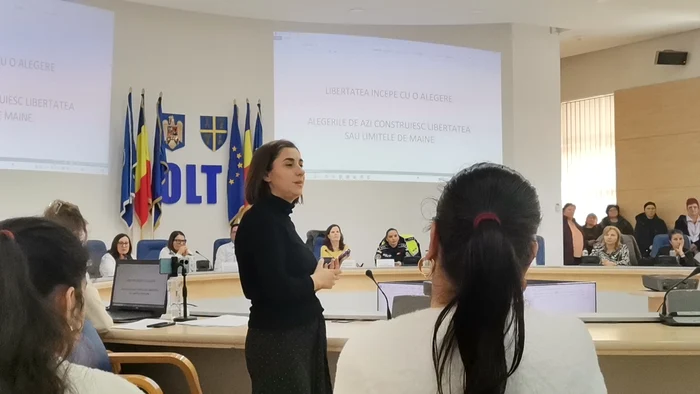
A psychologist spoke to teenagers about the danger of using the phone many hours a day, without limits and without realizing the danger, making them think. The discussion came after a meeting of teenagers with two young people detained in the Craiova Detention Center, sentenced to hard years in prison. The inmates had just answered many questions to the young people and had also told them about their biggest wish – that of spending time with their family in a different way than on visitation days in the penitentiary, separated by a window.
“How much time do you spend on the phone every day?”/ “10-15 hours”
The conversation started simply. “Hello dears! Let me see how many of you have something like this?”, psychologist Aurora Szocs addressed them, asking them to show their phones. “In the settings, you can check yourself while you’re sitting, it’s called
“I recommend you check this daily. Why? Because the moment you cross a certain limit it’s already addictive. And it’s not just a dependency on this object, it’s a dependency on several things, because behind this object there are many dependencies.” Aurora Szocs told them.
The following information would instead create even more discomfort for the adults in the room, responsible for the children’s education.
“I’ve been working with teenagers for 20 years and we have these discussions quite often. The moment we cross a limit, it reaches five hours a day, we have to ask ourselves who is educating our children. Who are you educated by? Because as long as there are 24 hours in a day, let’s say you sleep 8 hours. I hope you sleep eight hours. You go to school and I hope you don’t have access to these devices at school. How much time do you have left to spend quality time with your friends, your family, your colleagues, the people who care for you? Because in the conditions in which you spend more than 5 hours under the influence of these devices, on everything that means TikTok or Insta, we, the adults, can no longer educate you. And your values are taken from here.” said the psychologist, pointing to the phone. “I mean you end up being raised by a screen. It has no life. You learn just to look at it, you don’t feel anything, this screen has no affectivity,” continued Szocs. “And at some point we end up asking why our children no longer have values, why our children no longer have empathy. Because what they see 5 hours, 12 hours a day is completely different from what we are trying to educate”the psychologist further addressed the adults.
Miniseries recommended as “homework”
Aurora Szocs pointed out that often adults do not find the right language to effectively draw children’s attention to the danger of screens. Adults talk a lot, get lost in advice, children don’t hear them. Those present were instead given “homework”: to watch the mini-series “Adolescence”, a film that may not be very comfortable to watch, but which asks the questions that many families avoid: how well parents know their children and how lonely teenagers really are in a constantly connected world.
“Maybe we learn to communicate in the same way. Maybe for you the pictures are more important than us telling you anything. Maybe that’s the only way you learn one thing: to beware of what might happen. I recommend you watch it, maybe we’ll have another discussion sometime where you express how you felt after watching this mini-series, if you were able to transform yourself into that kid. He was a child like you, 13-14 years old, the same, who had killed a girl. And maybe that’s how we learn to communicate with you differently, using the same language, but not over the phone. I trust you. I trust that you know how to set some boundaries for yourselves at some point. I know, I am firmly convinced that you have adults around you who want you well and who will guide you. And you will understand that you are making choices for yourself, not for someone else. The fact that you give up this (n. – the phone), slowly, slowly, every day, and spend your life with your loved ones, I think it’s a choice. And it’s a good choice. Because, frankly, it’s kind of a prison. You’re just here, connected to everything, and you no longer have a right to your life being connected all the time. Tell me I’m wrong,” the psychologist also told them, and the teenagers answered almost in unison: “No, you’re not wrong!”.
How do you know your phone is controlling you?
The habit of using, or at least checking, the phone non-stop is not specific only to children and young people, but in their case the implications are even greater. We are not only talking about a behavioral addiction, which works like other addictions, but also about the fact that children take their role models from the digital world, there are meetings that they no longer have time for in the real world, there they are “connected”, although more and more people say they feel lonely.
You realize that you don’t control the phone, but it controls you, when you get to check it without wanting to, you automatically take it in your hand, you decide to “take a look” for 5 minutes to see “how the world is doing” and without realizing it, hours go by. This is because running apps are meant to keep you connected. You constantly feel the need to check notifications, short videos keep you “glued” to the screen and make you scroll without pausing.
However, psychologists talk about an effect that you are not always aware of: paradoxical social isolation. Apps, while theoretically connecting people, have led to the decline of face-to-face conversations, increase our feelings of loneliness, and make us compare ourselves all the time socially.
Using the phone excessively – and not for educational purposes, to communicate quickly or to use it as a professional tool – we will notice that it is increasingly difficult for us to focus on complex things. We sleep poorly, we become anxious, we tolerate boredom more and more.
When we stop using it consciously, everything coming from the reflex, it is the signal that we have a problem.
You can test how addicted you are to your phone by taking some simple tests:
– stay 2-3 hours without your phone and evaluate how you feel, whether or not you have any discomfort;
– think about whether you are using it reflexively or with a clear purpose;
– think about how you feel after using it, are you relaxed or tired.
If there are signs that it is becoming automatic, then it has become “prison”.
Psychologist Aurora Szocs emphasized in the discussion with teenagers and those who take care of them that the problem is not that we use the phone for a lot of time every day, but especially that we can’t do many other things by using it.
In the case of children and teenagers, the problem becomes even more serious because at this age their brain is not mature, the area responsible for self-control developing fully only around the age of 24-25 years. The impulses at this age are strong and the reward the brain receives while scrolling is immediate.
The World Health Organization and pediatric guidelines show that constant digital stimulation can alter attention habits and emotional regulation in children. Real life activities – like reading, learning, real conversations – become too slow compared to the speed at which everything happens online.
Small steps that can help reduce the time you spend online
If the time spent on the phone is very high, giving up without an alternative is an attempt most likely to fail, so try to gradually replace the time spent on the phone with something else.
It can also be useful to establish a set of rules for the whole family: no phone in the bedroom, at the table, in the car, in the first hour after waking up.
Psychologists point out that the parents’ model works much better than the lectures they give to children. Children will not follow rules that adults do not follow, experts warn, because they will copy the behavior, not the instructions.
Here are some small steps that can help: reduce your screen time by 15 minutes a day; disable notifications; remove the apps that keep you hooked the most.
