
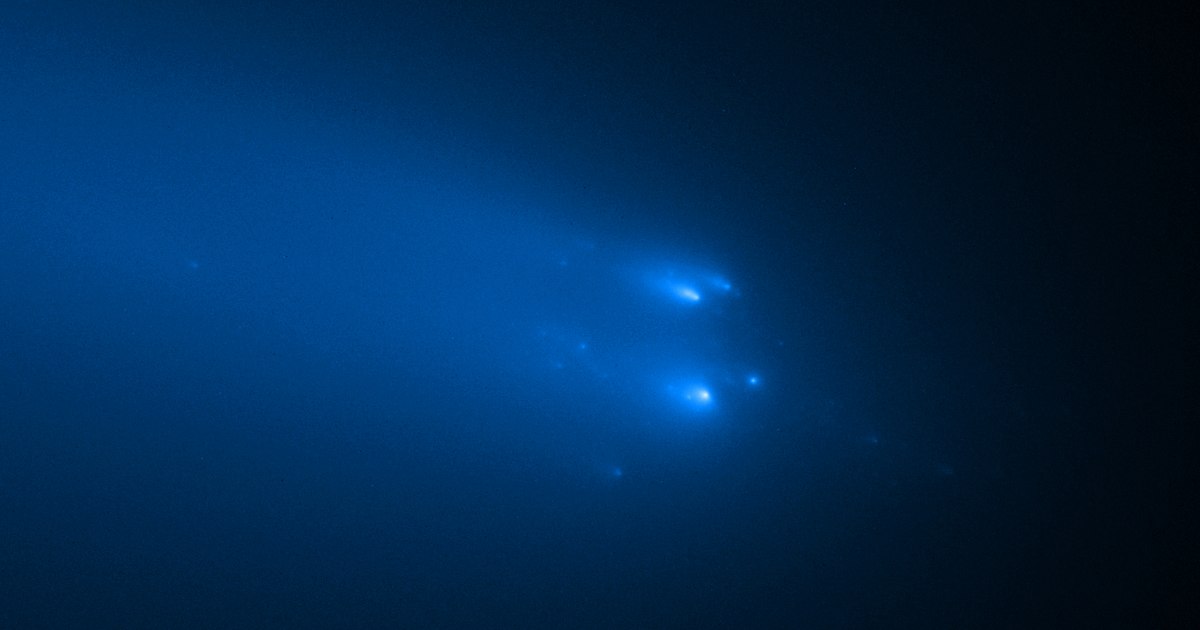
The fate of a comet predicted to pass close to Earth remains a mystery six years after its dramatic breakup in the inner solar system — but some astronomers believe part of it may still be out there.
In early 2020, astronomers discovered the icy traveler, known as C/2019 Y4 ATLAS, and predicted that it could provide a nighttime spectacle that would cheer everyone up during the quarantine imposed by the COVID-19 pandemic: a comet visible to the naked eye as it passed within 37.5 million kilometers (37.5 million kilometers) of the Sun, or about a quarter of the distance at which Earth orbits the star ours. But then the comet broke into dozens of pieces, leaving would-be observers in suspense and astronomers wondering if anything substantial might be left of our icy, unlucky visitor, writes Space.
A team of astronomers led by Boston University’s Salvatore A. Cordova Quijano hoped to answer that question by scanning the sky since the fall of 2020. And according to their recent paper in The Astronomical Journal, there may be a half-kilometer-wide piece of the comet still in orbit, heading back into the cold darkness of the outer solar system.
The remains of the lost comet may still be there
Cordova Quijano and co-authors Quanzhi Ye and Michael SP Kelley scanned the sky in August and October 2020, looking for any sign of the comet’s remnants, but to no avail. Observations with the Lowell Discovery Telescope (a 4.3-meter telescope in Arizona) and nighttime images from the Zwicky Transient Facility (which performs a wide-angle scan of the northern sky every other night, looking for changing or short-lived objects such as comets and supernovae) yielded no results. But that doesn’t mean there’s nothing left of C/2019 Y4; it could just mean that what’s left is smaller than the smallest fragment these telescopes could see, which is about half a kilometer wide.
In addition to solving an intriguing astronomical mystery, this new study of C/2019 Y4 offers some clues about what happens when comets break apart in the intense heat near the sun, as well as a chance to study the millennial decline of an ancient family of comets (C/2019 Y4 could be a fragment of a larger comet that broke up thousands of years ago, according to a 2021 study).
“The uncertain fate of comet C/2019 Y4 raises an interesting question,” the astronomers wrote in the study. “How many comets supposed to be destroyed have completely destroyed themselves, and could any of them have survived with a reduced and inactive nucleus?”
In the case of C/2019 Y4, the answer to the second question could be yes: it is possible that a comet fragment, less than half a kilometer wide, is still following the long path of the parent comet around the Sun.
A dramatic story
Comet C/2019 Y4 ATLAS was just a faint speck of light in the distance when astronomers from the Asteroid Terrestrial-impact Last Alert System first spotted it in December 2019. The comet began to brighten very quickly in early 2020 as it headed toward the inner solar system, and astronomers excitedly predicted that it might be visible to the naked eye by the time it reaches its closest distance to Earth in late in May.
Then, like all of us, C/2019 Y4 suddenly fell apart at the end of April 2020.
Following this event, astronomers used the Hubble Space Telescope and other observatories around the world to track several dozen fragments of the destroyed comet, which appeared to be grouped into four main groups of frozen debris. But one of these groups later turned out to be an error in the data, and another lasted only a few days before dissipating completely. This left two groups of debris, called fragment A and fragment B.
The last time astronomers saw a piece of the icy debris of comet C/2019 Y4 was on June 8, 2020, in images transmitted by NASA’s STEREO spacecraft, nine days after the comet reached its closest approach to the Sun. At that time, the comet’s nucleus seemed “completely destroyed”Cordova Quijano and colleagues wrote. The question that remains is what happened to the core after those observations.
By now, the A fragment is probably nothing more than a slowly expanding cloud of gas and maybe a few grains of dust. In the first three days after breakup, the pieces of the former cometary nucleus that made up Fragment A appeared to have lost about 70% of their mass (because, again, ice sublimates, and smaller pieces tend to sublimate faster than larger ones).
Just before perihelion in late May 2020, the largest piece of the B fragment was about 1.2 kilometers wide. At the time of Cordova Quijano and colleagues’ observations in late August and mid-October 2020, it was clear that “the B fragment had undergone further major decay,” but it is still unclear exactly how much. Cordova Quijano and co-authors couldn’t identify any trace of fragment B in their Lowell or Zwicky data, which could mean there’s nothing left — or that the remaining fragment is less than half a kilometer wide.
“We cannot conclude from the available data whether there are still fragments of considerable size”they wrote. “The observed decay events produced long-lived fragments only 0.3 kilometers in diameter, which is smaller than our detection limit.”
How to catch the next one
For astronomers, the dramatic disintegration of C/2019 Y4 provided a rare chance to observe the disintegration of a comet. So far, they have managed to observe this dramatic phenomenon only a few times: three confirmed and four only suspected. Of the four, astronomers have no idea what happened after the breakup—for example, whether large chunks survived long enough to exit the hot inner solar system—and, according to Cordova Quijano and colleagues, that’s mainly due to a lack of follow-up observations to confirm the comets’ fates.
The researchers wrote that about two or three months after each comet passed “behind” The sun from our point of view, then reappeared, should have been easier to observe with the telescope. This would have been the perfect time to look for surviving fragments—or the absence thereof. Such observations would have confirmed the demise of the comets and clarified whether smaller pieces of their broken nuclei continued to orbit the Sun as mini-comets.
“In the case of comet C/2019 Y4, an in-depth search immediately after solar conjunction (such as immediately after the initial more shallow search in early August 2020) could have conclusively determined the status of the remnants,” they wrote in their recent article. “Similarly, dedicated deep searches would be useful to close cases like those of the other three comets and provide insights into the dynamics of comet breakup.”
It’s a little too late to do that for C/20129 Y4, but the study gives astronomers a warning to be prepared for these kinds of observations the next time a comet breaks up on its way through the inner solar system.
