
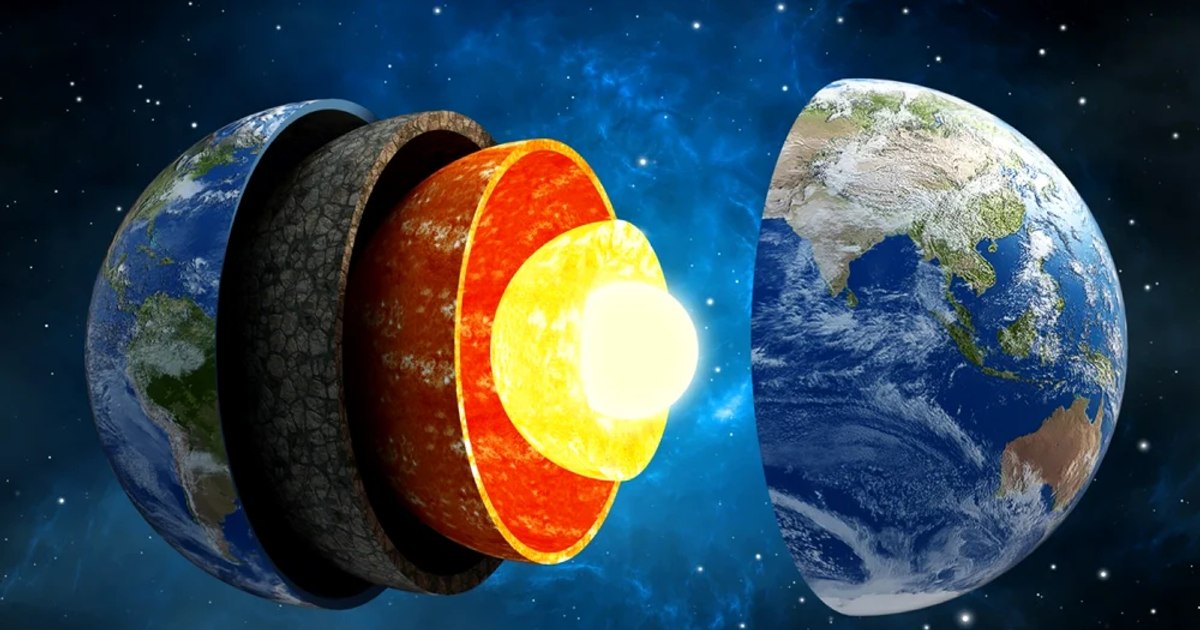
The center of our planet has been spinning unusually slowly for the past 14 years. If this mysterious trend continues, it could lead to an increase in the length of terrestrial days, although the effects would be imperceptible to humans, according to a recent study, informs livescience.com.
The Earth, in a graphic representation. PHOTO Shutterstock
Earth's inner core is a sphere roughly the size of the Moon, composed of solid iron and nickel, that lies more than 3,000 miles below our feet. It is surrounded by an outer core – an extremely hot layer of molten metals, similar to those in the inner core – covered in turn by a layer of molten rocks known as the mantle, above which is the Earth's crust. Although the entire planet rotates around its own axis, the inner core of the Earth can rotate at a slightly different speed than the mantle and the crust due to the viscosity of the outer core, writes Agerpres.
Since scientists began mapping Earth's inner layers through detailed records of seismic activity about 40 years ago, the inner core has rotated slightly faster than the Earth's mantle and crust. But in the new study, published on June 12 in the journal Nature, the researchers found that, starting in 2010, the rotation of the inner core began to slow down and that it now spins slightly slower than the other layers of the Earth.
“When I first saw the seismograms that suggested this change, I was stunned,” said John Vidale, a seismologist at the University of Southern California, Dornsife. “But when we found two dozen other observations that signaled the same pattern, the result was inescapable.” he added.
If the rotation of the inner core continues to slow, its gravitational pull could eventually cause our planet's outer layers to spin somewhat more slowly, altering the length of our days, the researchers wrote.
However, any potential change would be on the order of thousandths of a second, meaning that changing the length of the day “it would be hard to notice”, stated John Vidale. As a result, people probably won't need to update their clocks and calendars to adjust for such differences, especially if it's a temporary change.
It is not the first time that researchers have suggested that the rotation of the Earth's inner core is slowing down. This phenomenon, known as “backtracking”has been debated for about a decade, but has been very difficult to prove.
In the new study, researchers analyzed data from more than 100 repeat earthquakes – seismic events produced repeatedly in the same place – along a tectonic plate margin in the South Sandwich Islands in the southern Atlantic Ocean, between 1991 and 2023.
Each earthquake allowed the researchers to map the relative position of the core in relation to the Earth's mantle, and by comparing those measurements, the science team was able to “will give” the way the rotation of the inner core has changed over time.
The new study represents “the most convincing” proof so far that the phenomenon “backtracking” it's really happening, said John Vidale.
It is not yet known why the rotation of the inner core has slowed down, but this is probably caused by either “thickening of the liquid iron in the outer core that surrounds it”, either of “the gravitational attractions of the dense regions of the overlying telluric mantle“, stated the authors of the study.
Also, the frequency with which the phenomenon occurs is not known “backtracking”. It is possible that the rotation of the inner core is constantly accelerating and decelerating, but such changes probably occur over several decades. For this reason, longer data sets are needed to infer long-term trends.
The inner core remains the most mysterious of Earth's hidden layers. But in recent years, new technology has allowed scientists to learn more details about the inner core, including that it is slightly asymmetric, that it is softer than researchers expected, that it can spin off Earth's axis, and that it has a separate inner core.
The study authors will continue to analyze the seismic data to learn more about “heart” our planet and how it changes over time.
“The dance of the inner core may be even more lively than we currently know”added John Vidale.
