
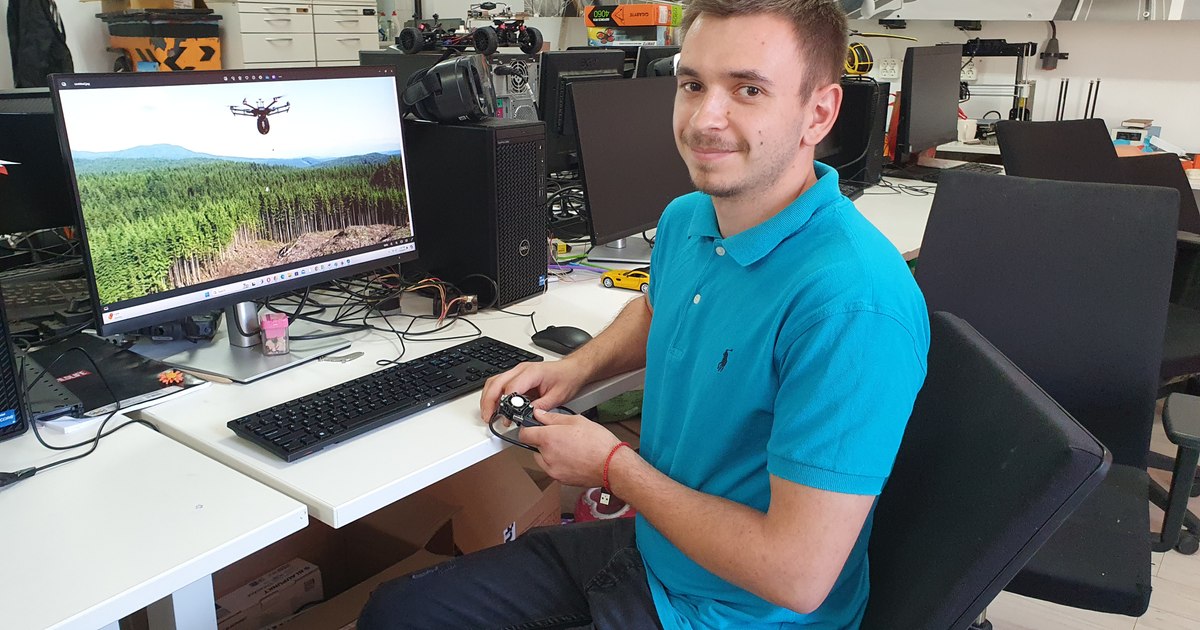
Andrei Geru has developed a program that can be installed on a drone's mini camera, which allows it to automatically avoid obstacles in its path. The rescuers would thus have access to the forests with drones, which is impossible at the moment.
Andrei Geru and his innovation PHOTO Valentin Trufașu
Andrei Geru (21 years old), third-year student at the Faculty of Engineering in Galati, specializing in Medical Engineering, from the “Lower Danube” University, recently created a software that allows drones to avoid the obstacles they encounter in flight.
“The drone is directed by remote control to the victim of an accident in the forest. When it encounters an obstacle, it bypasses it by itself with the help of a software installed in the microcomputer of the mini camera installed on the drone and which allows the operator to locate the people in danger”, Andrei explained to “Adevărul” what his innovation consists of, which he worked on for three months.
Basically, we are talking about a program through which drones become semi-autonomous, bypassing trees in forests and other obstacles they encounter on the way to reach places that are difficult for humans to reach and locate missing victims in those areas.
“The video camera mounted on the drone contains a minicomputer that allows it to be programmed. Andrei created a software for this minicomputer, which allows the drone to avoid obstacles in its path. Many drones are lost due to the fact that the operators do not notice in time the obstacles on the route. A rescue operation in a forest is not possible at this time because the operators would not be able to bypass the trees encountered on the route and the drone would be lost,” Florin Marin Bogdan, doctor of engineering and head of works at the Faculty of Engineering in Galati, details the advantages of the innovation created by his student.
SOURCE FLORIN MARIN BOGDAN
The software created by Andrei successfully passed the testing in the laboratory and is now to be put to the test in the field, in a forest, in order to correct, together with his coordinating teacher, any errors in its operation.
“In the lab testing we used some extremely tough scenarios. To give you an idea, the drone has the ability, thanks to this software, to sneak through extremely small spaces. It will be able to identify and pass through very thin branches if the software detects a gap that the drone can pass through.” points out Florin Marin Bogdan.
The student from Galati is now working on the second part of the project, which involves significantly improving the signal transmitted by the operating remote control to the drone. This is another thorny issue that operators often face in rescue operations.
Capsule for the diagnosis of diseases of the stomach and intestines
It is not the only innovation of the student from Galati. Andrei Geru also created a medical capsule last year, which, once swallowed by a patient, allows it to be stopped in the area of the stomach, small and large intestine with the help of a device that emits a magnetic field, allowing the doctor a thorough investigation in real time of possible medical problems.
“The medical capsule will have metallic material inside and will be controlled from the outside by a magnetic device according to a certain pattern. In addition, the medical capsule will also have a microactuator (no. microscopic servomechanism), in Romanian, a tail, which will be magnetically actuated by the same magnetic device”explained the student.
The medical capsule will not have a battery, its advancement and stopping in any area of the stomach and intestines will be done with the help of the magnetically actuated micro-actuator. After collecting the data of interest to the doctor, the medical capsule will be eliminated naturally.
“We are talking about a microrobot intended for medical exploration of the digestive system. Importantly, this tail attached to the microrobot will not cause any damage to the digestive tract and intestines.” Florin Marin Bogdan wanted to specify.
The microrobot, successfully tested
The microrobot was successfully tested in the laboratory of the Student Scientific Circle of Applied Informatics in Materials Engineering from Galati, of which Andrei Geru is also a member, the circle being dedicated to students who want to test their creativity and resistance to effort, by solving problems whose degree of difficulty increases with advancement in the college years.
The next step is to take over the innovation of the student from Galati and medically test the microrobot through clinical studies.
There is currently an endoscopic capsule on the market, which is equipped with a tiny video camera that records images of the digestive tract.
After swallowing, the capsule passes down the stomach in about half an hour, and through the entire small intestine in about 4-5 hours, being then eliminated in the stool. After the image recording is complete, the stored images are retrieved using specialized software on a computer, and a specialist doctor analyzes and interprets the data.
The advantage of the microrobot created by the student from Galati is that it allows it to be stopped in areas that are of interest to the doctor and which he can then analyze in detail with the microsensors and the minicamera installed in it.
Software for rescuing victims trapped under rubble
Andrei Geru previously also developed a software that allows the detection of human life and the specific noises made by victims in the event of an earthquake starting from what happened recently in Turkey and Syria.
The software created by the student from Galati eliminates background noise (excavators and other machines working in the earthquake-affected area) and only identifies the signs that indicate that a person may be alive under the rubble, including hitting walls to be found more quickly .
