

Since 1995, every December 8, Romania celebrates the Constitution, the holy book of democracy. The first constitutional acts appeared on the territory of our country as early as 1830, the Organic Regulations marking the end of the Phanariote period.
The Romanian constitution has changed 7 times. PHOTO: Inquam Photos
Then, the next attempt was in 1864, when Al.I. Cuza approved the developing Statute of the Paris Convention. Then followed two constitutions under the sign of the monarchy (among the most democratic at the time, drawn up under the careful supervision of King Charles I and Ferdinand I “The Whole”) and until the end of the Second World War, one more constitution – an authoritarian one, which reflected the reign of King Charles II. Communism left its mark with three constitutions, far from having anything to do with democracy, and the last 35 years brought us a Constitution and its revision, in 2003, which guaranteed us the European way. Now, the pages of the Constitution are in the wind, and democracy is barely standing in the face of the extreme right.
FIRST CONSTITUTION (1866)
it was inspired by the Constitution of Belgium (1831) and established a constitutional monarchy, thus laying the foundations of a modern state. It separated the legislative from the executive (of the ruler). New institutions were introduced: the Senate (Parliament became bicameral) and the Council of State (which drafted laws based on the ruler’s initiatives). It also provided for the country’s status and was approved without consulting the Guarantor Powers or the Ottoman Empire – so, in itself, an act of independence.
It has 8 titles and 133 articles, and among the most important rights are:
• individual freedom,
• the right to trial,
• the inviolable domicile,
• the right to property,
• freedom of conscience,
• freedom of education and the obligation of primary education,
• freedom of the press,
• freedom of assembly and association.
The vote was census (depending on the state, but most men had this right) and secret, and the age limit was at least 21 years.

Carol I, the first king of Romania. PHOTO: Wikipedia
THE CONSTITUTION OF 1923
It is considered one of the most democratic in Europe at the time, consolidating the monarchical regime and introducing new civil liberties. It kept 76 articles from the old constitution.
• Citizen rights and freedoms are recognized regardless of ethnicity, language and religion.
• The census vote is replaced by the universal vote (equal, direct, secret) and stipulates the possibility of granting the right to vote to women as well. The age limit remains 21 years.
• Introduced, through Article 103, “the right to judge the constitutionality of laws and to declare inapplicable those that are contrary to the Constitution”.
THE 1938 CONSTITUTIONinstituted by King Charles II, limited the powers of Parliament and strengthened royal authority.
• Its promulgation was made by plebiscite. More than 4,300,000 Romanians turned out to vote by verbal declaration with “yes” or “no”, on separate lists, only 0.13% opposed.
• The separation of powers in the state was abolished, and the power was in the hands of the king who not only ruled but also governed.
• No one else had the power to change it, through article 97: “The present constitution cannot be revised in whole or in part except at the initiative of the King”.
The Electoral Act of 1939 allowed both men and women to vote, but with certain conditions:
a) They are at least 30 years old;
b) They are literate;
c) He actually practices an occupation falling into any of the following three categories: 1. Agriculture and manual work;
2. Trade and industry;
3. Intellectual occupations.
d) Does not fall into any of the cases of incapacity or indignity provided by this law.
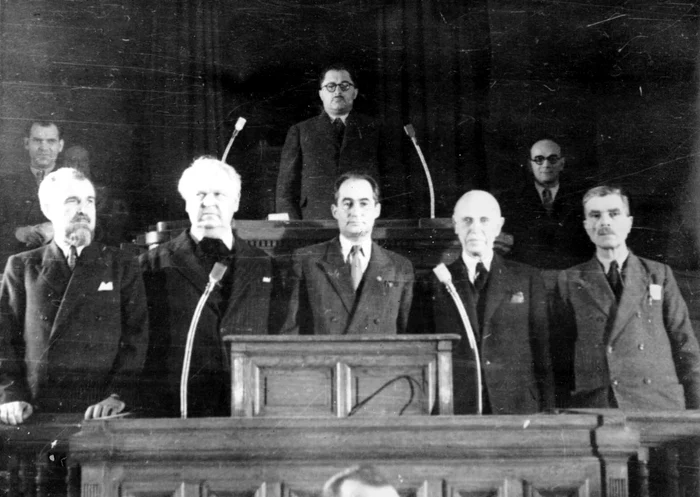
The Provisional Presidium of MAN in 1948, with Mihail Sadoveanua, second from left to right
By the 1948 CONSTITUTION the monarchy is abolished, the communist regime is established, and the Parliament is dissolved – the new form of government becoming the people’s republic. It was modeled on the Soviet Constitution of 1936.
• The class struggle and the enmity of the population was triggered by the creation of two classes of citizens: the working class and the others.
• Other articles created the legislative framework for future nationalization and collectivization: “When the general interest requires, the means of production, banks and insurance companies, which are the private property of natural or legal persons, can become the property of the State, i.e. the property of the people, in the conditions provided by law”.
• Although we cannot talk about exercising a right in a democratic framework, the first communist constitution offered this right to women as well: “All citizens, regardless of sex, nationality, race, religion, degree of culture, profession (… ) have the right to elect and be elected in all State bodies. All citizens who have reached the age of 18 have the right to vote, and those who have reached the age of 23 have the right to be elected”.
THE 1952 CONSTITUTIONknown as the “Constitution of the construction of socialism”, is the one that showed the state’s dependence on the USSR and defined the terms of totalitarianism in Romania:
• The apparent multi-partyism of the MAN (Grand National Assembly, which was the country’s only legislative body) elections in 1948 has meanwhile been replaced by a single party (the Romanian Workers’ Party).
• The state is subordinate to the party: “The Romanian Workers’ Party is the leading force of both the working people’s organizations and the state bodies and institutions”.
• The economic life of the Romanian People’s Republic develops on the basis of the state plan of the national economy, in the interest of building socialism and the continuous growth of material well-being.
• Foreign trade is a state monopoly.
All citizens over the age of 18 could vote.
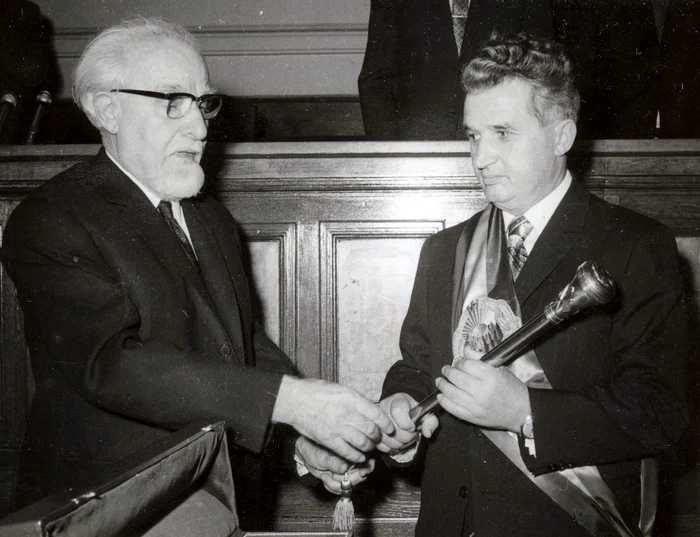
Ceaușescu, at the inauguration ceremony as president, in 1974
THE 1965 CONSTITUTION it reflected the era of Nicolae Ceaușescu, granting totalitarian power to the sole leader of the state.
• The name of the country changes to the Socialist Republic of Romania.
• In a distancing from the Soviets, references to the Soviet Union introduced in the 1952 Constitution were removed and a principle of “non-interference in internal affairs” was asserted, leading to nationalist communism.
• This constitution also violated the principle of separation of powers in the state, only that the ruling political force of the country was the Romanian Communist Party.
• In 1974, the position of president of the RSR was introduced for Ceaușescu.
• “Wealths of any kind in the subsoil, mines, land from the state land fund, forests, waters, natural energy sources, factories and plants, banks, state agricultural enterprises, resorts for the mechanization of agriculture, communication routes, means of transport and state telecommunications, the state fund of buildings and housing, the material base of state social-cultural institutions belong to the entire people, they are state property”.
• As in the case of other totalitarian constitutions, civil rights and liberties were recognized regardless of age, race, sex or religion, but were not respected.
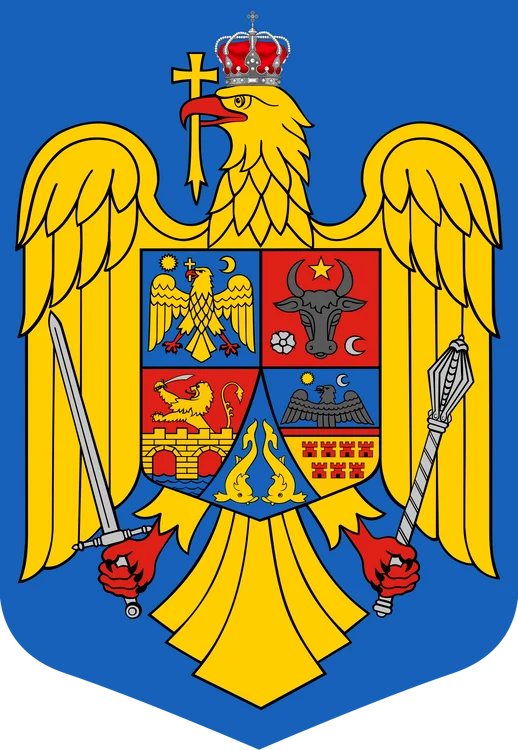
THE 1991 CONSTITUTION
It was adopted after the fall of the communist regime, restoring democracy and political pluralism. The 2003 revision of this constitution was essential for Romania’s integration into NATO and the European Union, adapting the legal framework to the requirements of the international community.
• The principle of the separation of powers in the state was reinstated, as follows: the legislative power is exercised by the Parliament (bicameral, consisting of the Senate and the Chamber of Deputies), the executive power belongs to the Government and the President, and the judicial power is exercised by the High Court of Cassation and Justice and by the courts.
The 1991 Constitution, revised in 2003, contains 156 articles, divided into 8 titles:
Title I – General principles
Title II – Fundamental rights, freedoms and duties
Title III – Public authorities
Title IV – Economy and public finances
Title V – Constitutional Court
Title VI – Euro-Atlantic integration
Title VII – Revision of the Constitution
Title VIII – Final and Transitional Provisions.
