
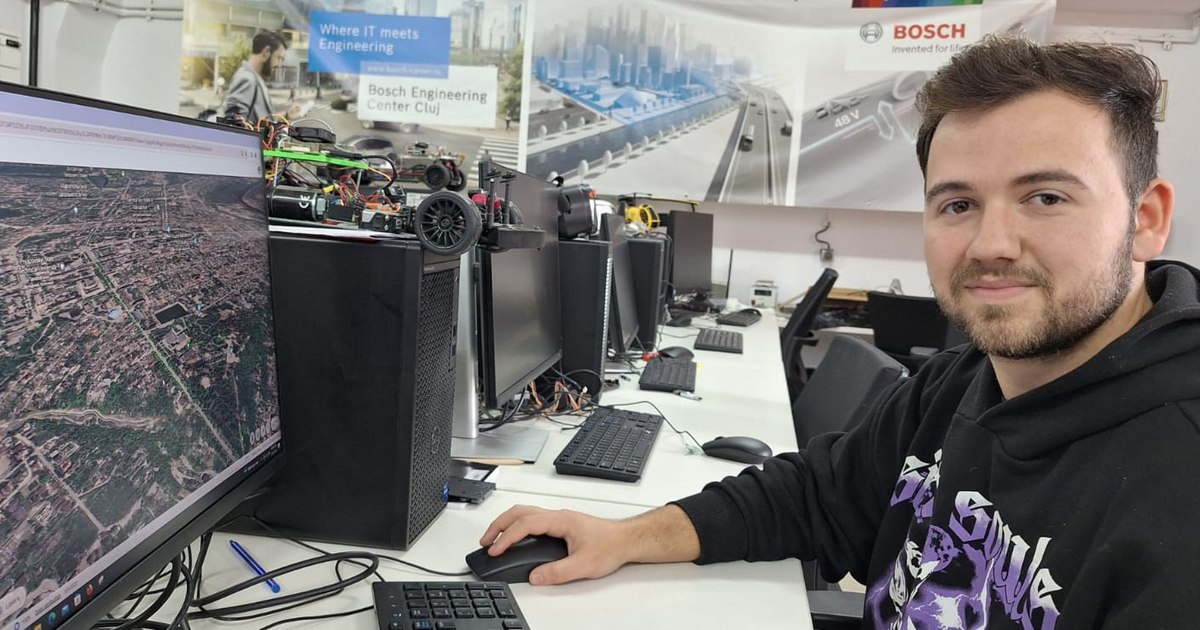
Ionuț Răzvan Mihai, a student at the Faculty of Engineering in Galati, has developed a program through which the damage suffered by buildings during an armed conflict can be quickly and accurately assessed, but it also provides an estimate of the costs for their restoration or reconstruction.
The software created by Ionuț can quickly determine the degree of destruction of buildings PHOTO Florin Marin Bogdan
Ionuț Răzvan Mihai (20 years old), second-year student at the Faculty of Engineering in Galati, majoring in Applied Informatics in Materials Engineering, from the “Lower Danube” University, created a software that allows the precise assessment of the damage caused to buildings war.
The idea came to the young man after the outbreak of the conflict in Ukraine, but he says that he also thought about the 1.2 billion dollars that Romania was obliged to pay as damages to the Soviet Union after the Second World War and which, in the opinion his, would have been much greater than the destruction caused during the war.
The algorithm he created after about 4-5 months of tests and simulations allows the comparison of images captured by Google Earth before and after the destructive event. It was written in a programming environment used for artificial intelligence and also uses modules from artificial vision, and the student combined the two technologies.
“Google Earth helps us monitor and calculate the damage caused to buildings in Ukraine by the war. Basically, we have the image of these buildings before and after the destruction. We have most of the images from 2019, and in them you can see the number of buildings and how they looked at that time, and the software I created compares the degree of their destruction in 2023 and also provides an estimated cost of the damage.” the young man explained to “Adevărul” what his innovation consists of.
“An independent, fast and accurate source of damage assessment”
In this way, the software created by Ionuț accurately estimates the percentage of destruction of buildings and can be a useful tool after the war for assessing the damage caused to them and estimating the costs needed for reconstruction.
“The software is an independent, fast and accurate source of war damage assessment. The alternative would be for this estimate to be done physically, in the field, by specialists, and that means a lot of lost time and very high costs. Basically, the program runs the images received from Google Earth and compares those before the conflict with those after the war,” elaborated Florin Marin Bogdan, head of works at the Faculty of Engineering in Galati and coordinator of the Student Scientific Circle of Applied Informatics in Materials Engineering, where the student created the program.
Several outside firms are currently trying to develop such software to make as accurate an estimate as possible of the destruction caused to buildings in Ukraine by the war. The algorithm created by the student from Galati takes into account many variables, such as the existing vegetation near the buildings, but also the angle in which they were filmed at different times of the year.
“Engineering gives you many opportunities”
“The software also takes parallax errors into account,” adds head of works Florin Marin Bogdan, who says that the program now has an accuracy rate of 90%, and his student is still working on improving it. Parallax error is one of the most common errors in common measurements. It is an error that does not arise from human inattention, but due to the optics of the human eye and the propagation of light.
Parallax error occurs when the human eye does not look perpendicular to the scale and is responsible for some errors in construction, especially in precise measurements where clear dimensions are needed to achieve perfect work.
After graduating from the faculty, Ionuț will focus on digital design and create buildings and cars in the virtual environment.
“Engineering gives you many opportunities. You can create great things if you just put your imagination and creativity to work. I think that we, the young people, can bring change in Romania. If we stay here, it will certainly be a chance for the change we all want,” is the student's message for young people of his age who are now thinking about making a future for themselves abroad.
