
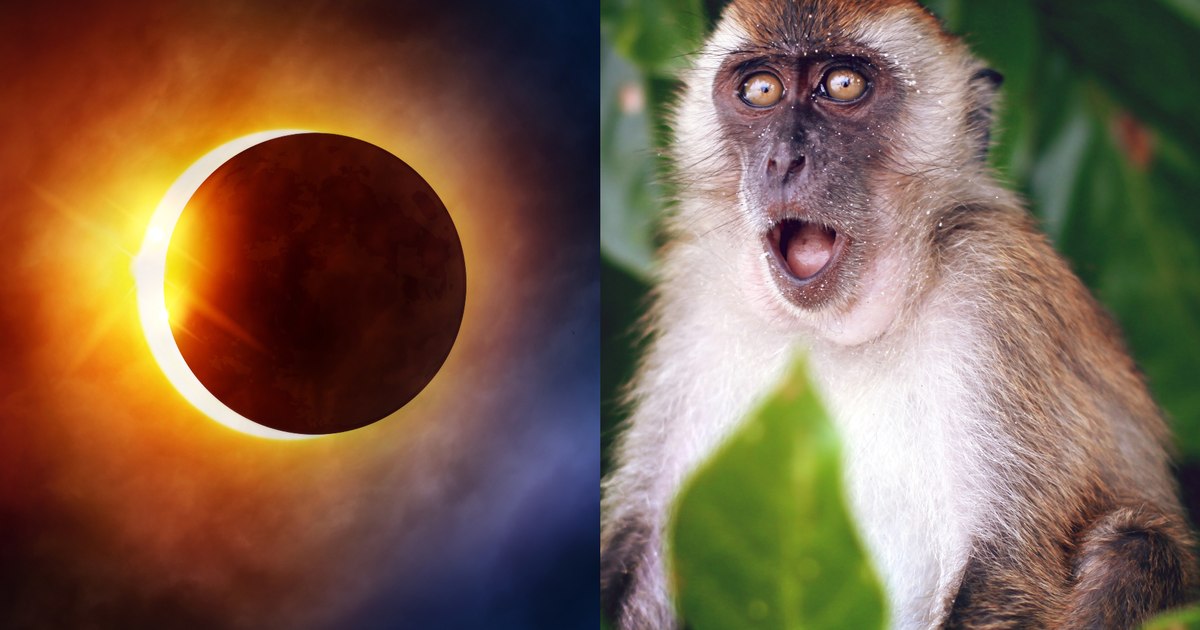
Coyotes howl, owls hoot and gorillas march to sleep. Monday's solar eclipse caused animals to react in strange ways.
PHOTO: Shutterstock
While people in North America reacted with surprise when they witnessed a total solar eclipse on Monday, humans were not the only species to behave unusually during this rare celestial event, writes news.sky.com.
A team of 40 people at the Fort Worth Zoo in Texas watched as their animals gave some interesting responses to the darkness of the sun in the middle of the day.
“Our band of gorillas got up and headed for the door as if it was time to go indoors for the night,” Dr John Griffioen, who led the team, told Sky News.
“Two of our flocks of flamingos got much closer. They started vocalizing a lot more, and one of them even started marching, which is a group bonding behavior.”
In a Nevada swamp, researchers listened as coyotes began howling and a tawny owl began hooting and flying.
Kim Rosvall, a biologist from Indiana who has studied life in the swamp, called the experience “incredible” on X.
Although there is an eclipse every 18 months, very little is known about how animals react to such phenomena.
The studies that exist show that animals behave very strangely.
During an eclipse that occurred in Mexico in 1991, scientists saw colonial orb-weaving spiders tear their webs during the darkest part of the eclipse.
As soon as the sun returned, the spiders rebuilt their webs.
In Arizona, scientists collecting cicadas have noticed that they stop singing when the sun is 50 percent covered. It took 40 minutes for them to start making noise again.
And giraffes, baboons, gorillas and lorikeets display anxious behavior during eclipses, as reported in the brilliantly titled Total Eclipse of the Zoo study, in which researchers recorded how animals at Carolina's Riverbanks Zoo The South reacted to the 2017 eclipse.
The giraffes began to “swing in a coordinated manner”, and the baboons huddled together, although they normally separated into small groups.
Lorikeets, a colorful member of the parrot family, began to “swing in a coordinated manner,” became noisy and then followed a “common silence”.
In fact, 75% of the animals at the zoo reacted to the eclipse.
But the reactions of animals to solar eclipses are relatively little studied. Now scientists need your help.
