
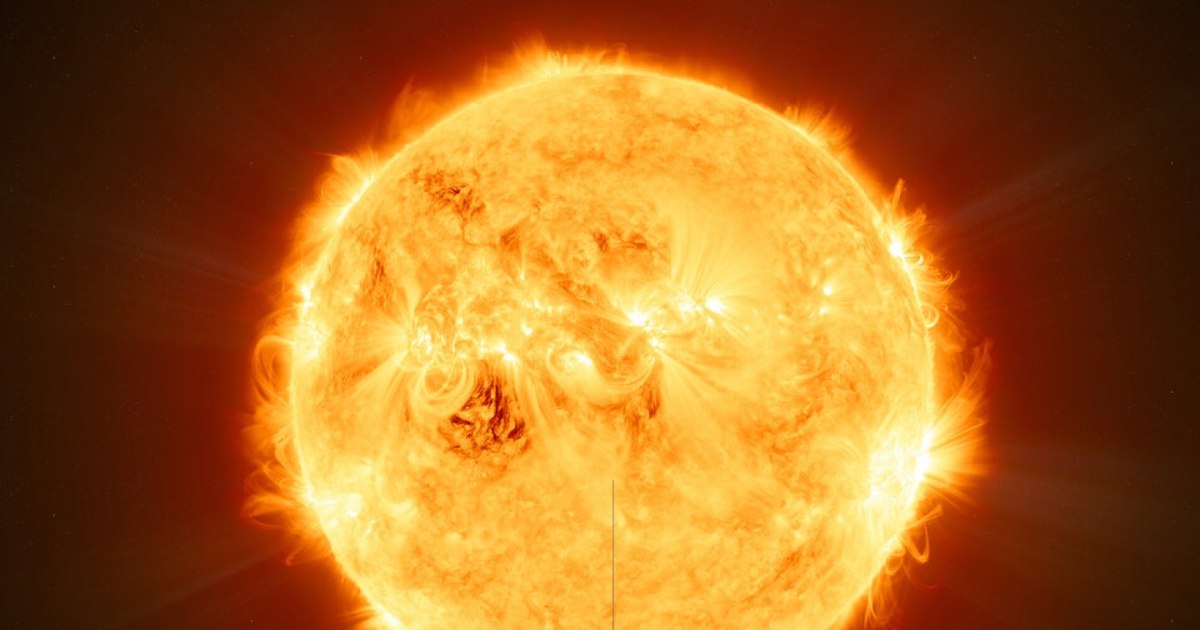
The Sun is on the brink of a significant event: a magnetic field reversal.
This phenomenon occurs approximately every 11 years and marks an important stage of the solar cycle. The change in polarity indicates the halfway point of solar maximum, the height of solar activity, and the beginning of the move toward solar minimum.
The last time the sun's magnetic field flipped was towards the end of 2013. But what causes this polarity change and is it dangerous? Let's take a deep look at the reversal of the sun's magnetic field and investigate the effects it could have on Earth.
To understand magnetic field reversal, it is first important to be familiar with the solar cycle. This approximately 11-year cycle of solar activity is driven by the sun's magnetic field and is indicated by the frequency and intensity of sunspots visible on the surface. The height of solar activity during a given solar cycle is known as solar maximum, and current estimates predict that it will occur between late 2024 and early 2026.
But there is another very important, though lesser-known, cycle that encapsulates two 11-year solar cycles. Known as the Hale cycle, this magnetic cycle lasts about 22 years, during which the sun's magnetic field reverses and then returns to its original state, Ryan French, an astrophysicist who studies the solar system, told Space.com.
During solar minimum, the Sun's magnetic field is close to a dipole, with a north pole and a south pole, similar to Earth's magnetic field. But as we move toward solar maximum, “the sun's magnetic field becomes more complex, with no clear north-south pole separation,” French said. By the time solar maximum passes and solar minimum arrives, the sun has returned to a dipole, albeit with a reversed polarity.
The future polarity change will occur from the north to the south magnetic field in the northern hemisphere and vice versa in the southern hemisphere. “This will bring it to a magnetic orientation similar to that of Earth, which also has its magnetic field pointing south in the northern hemisphere.”French explained.
What are the causes of polarity reversal?
The reversal is driven by sunspots, magnetically complex regions on the Sun's surface that can generate significant solar events such as solar flares and coronal mass ejections (CMEs)—large bursts of plasma and magnetic field.
As sunspots form near the equator, they will have an orientation that matches the old magnetic field, while sunspots that form closer to the poles will have a magnetic field that matches the incoming magnetic orientation, a French said. This is called Hale's law.
“The magnetic field in the active regions moves poleward and eventually causes the reversal,” solar physicist Todd Hoeksema, director of the Wilcox Solar Observatory at Stanford University, told Space.com.
But the exact underlying cause of such a polarity shift remains mysterious. “It goes into the whole (solar) cycle, and we're wondering what that is,” Stanford University solar physicist Phil Scherrer told Space.com. “We still don't have a truly self-consistent mathematical description of what's going on. And until you can model it, you don't really understand it – it's hard to really understand it.”
It really depends on where the magnetic field is coming from. “Will there be many sunspots? And will the sunspots contribute to the pole's magnetic field or will they cancel out locally?” Hoeksema asks. “We still don't know how to answer that question.”
How fast is the change taking place?
What we do know is that the reversal of the solar magnetic field is not instantaneous. It is a gradual transition from a dipole to a complex magnetic field to a reversed dipole over the entire 11-year solar cycle. “In short, there is no specific 'time' when the sun's poles turn”French said. “It's not like on Earth, where overturning is measured by north/south pole migration.”
It generally takes a year or two for a complete reversal, but this can vary significantly. For example, the north polar field of solar cycle 24, which ended in December 2019, took nearly five years to reverse, according to the National Solar Observatory.
The reversal of the magnetic field is so gradual that you won't even notice when it happens. And no, as dramatic as it sounds, it's not a sign of an impending apocalypse. “The World Won't End Tomorrow” Scherrer told Space.com.
However, we will experience some of the side effects of polarity reversal.
How does the sun's magnetic reversal affect us?
There's no doubt that the Sun has been incredibly active lately, launching numerous powerful solar flares and CMEs, triggering powerful geomagnetic storms on Earth, which in turn have produced some incredible auroral displays of late.
However, the increased severity of space weather is not the direct cause of the polarity reversal. Rather, these things tend to occur together, Hoeksema told Space.com in 2013.
Space weather is usually strongest during solar maximum, when the Sun's magnetic field is also at its most complex, according to the French researcher.
A side effect of changing the magnetic field is slight, but primarily beneficial: It can help shield Earth from galactic cosmic rays—high-energy subatomic particles that travel at the speed of light and can damage spacecraft and affect orbiting astronauts in outside the Earth's protective atmosphere.
As the Sun's magnetic field changes, the “current sheet”—a vast surface that radiates billions of kilometers out from the solar equator—becomes highly undulated, providing a better barrier against cosmic rays.
Prediction of the intensity of future solar cycles
Scientists will carefully watch the reversal of the Sun's magnetic field and see how long it takes for it to return to a dipolar configuration. If this happens in the next two years, the next 11-year cycle will be relatively active, but if the build-up is slow, the cycle will be relatively weak, just like the previous 24-year solar cycle.
