
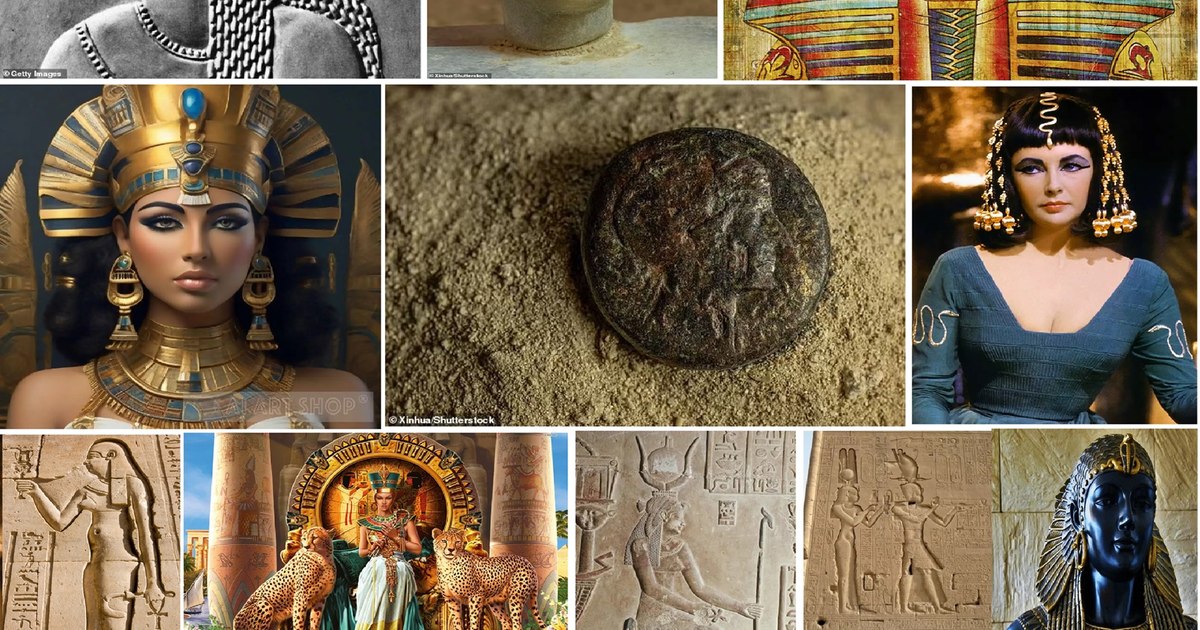
An archaeologist searching for Cleopatra’s lost tomb has made a discovery “significant” in an area believed to hide the resting place of the famous queen of Egypt, which could redefine the perception of her appearance and history.
Depictions of Queen Cleopatra from classic images to new discoveries DMS Collage
Kathleen Martinez, who has been searching for the tomb of the famous Egyptian queen for nearly 20 years, has discovered a statue that may represent the true likeness of the queen who ruled between 51 and 30 BC.
The statue, made of white marble and representing only the head, shows the features of a woman with a small nose, full lips and hair braided around the head, reports Daily Mail.
Martinez and his team also discovered 337 coins with the image of Cleopatra, along with a collection of pottery, oil lamps, figurines and other artifacts in the Temple of Taposiris Magna.
The expert has long believed that the queen’s tomb is hidden somewhere among the ruins of the temple, which lies above a 1,305-meter-long tunnel, located 13 meters underground.
Martinez claims that Cleopatra’s body was moved from the palace through this tunnel and buried in a secret location. However, other archaeologists suggest that the statue may represent another royal woman. Critics of Martinez’s theories also dispute her hypothesis about the location of the queen’s tomb, stating that Cleopatra was buried in the city of Alexandria, not 40 kilometers outside of it.
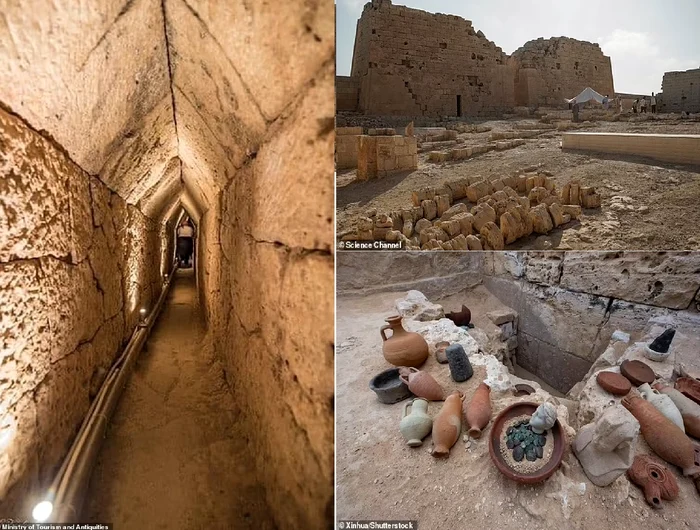
New discoveries from the Temple of Taposiris Magna in Egypt Xinhua Collage Shutterstock
Officials consider the new findings “significant”.
Authorities, such as Mohamed Ismail Khaled, secretary general of Egypt’s Supreme Council of Antiquities, however, consider the discovery as one “significant”. The Egyptian Ministry of Tourism and Antiquities emphasized that the revelations at Taposiris Magna are essential for deepening the understanding of the architectural, cultural and ceremonial practices of that period.
In addition to the possible bust of Cleopatra, Martinez and his team also discovered a limestone bust of a king wearing the Nemes, the ceremonial helmet specific to the pharaohs.
Martinez led a team of Egyptian and Dominican archaeologists in this new research, carried out in collaboration with the Pedro Henríquez Ureña National University.
According to a statement, the researchers found foundation deposits (layers or remains of materials used in construction) under the southern wall of the temple’s outer enclosure.
A bust and over 300 coins depict Cleopatra
The female statue was the most significant find, but some experts doubt that it represents Cleopatra, as Martinez claims.
Other voices have noted differences between the statue’s facial features and those of the ancient queen, suggesting that it may depict a princess rather than Cleopatra.
However, this artifact is not the only discovery that evokes the image of Cleopatra. Martinez and his team also found more than 300 coins, many of them bearing the image of the Egyptian queen.
Other notable finds include an amulet (a talisman) in the shape of a scarab, inscribed with the phrase “Ra’s justice shone forth (triumphed)”a bronze ring dedicated to the goddess Hathor and ancient burial sites.
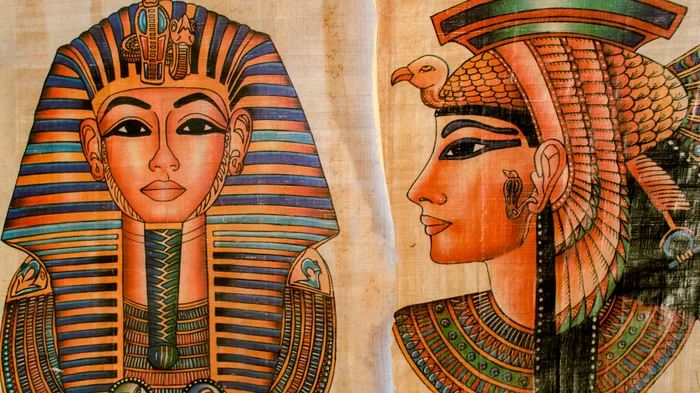
Queen Cleopatra Photo Shutterstock
The amazing tunnel under the temple compared to an engineering wonder of the world
Researchers also discovered a vast cemetery, containing 20 burial chambers, as well as a three-chambered tomb, located beneath the Temple of Taposiris Magna.
The tunnel discovered by Martinez in 2022 has been compared to the Tunnel of Eupalinos on the Greek island of Samos – considered one of the most important engineering achievements of the classical world. Built in 550 BC, this tunnel was intended to bring drinking water from the northern part of the island to the southern part, in the city of Samos, located on the island of the same name in the Aegean Sea. The tunnel, dug under the mountain and having a length of more than a kilometer, is considered one of the first engineering achievements of its kind in history, having a similar importance to the Canal of Xerxes or the Iron Road of Rome. Today, it is part of the UNESCO Heritage.
The tunnels and secret passages that connect Mariout Lake with the Mediterranean Sea
Returning to the new discoveries in Egypt, Martinez declared for Heritage Key in 2022: “If there is even a 1% chance that the last queen of Egypt is buried here, it is my duty to look for her. This is the first time an archaeologist has discovered tunnels and underground passages (and) within the walls of the temple enclosure, so we have changed forever what was known about its architecture.”
The archaeologist believes that after Marc Antony committed suicide following his defeat at the hands of Caesar Augustus (also known as Octavian), Cleopatra would have drawn up detailed plans for both of them to be buried under the Temple of Taposiris Magna, in accordance with the myth.
In addition, the research team also discovered the remains of a Greek temple dating back to the 4th century BC, which was destroyed between the 2nd century BC. and the beginning of our era.
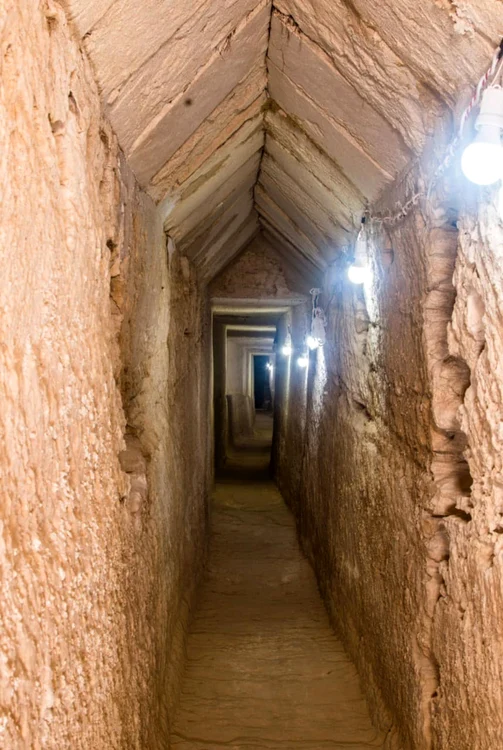
The mysterious tunnel in Egypt that supposedly hides the tomb of Cleopatra Photo Shutterstock
Closer to the tomb of Cleopatra and Mark Antony
The temple is connected to a complex of underground tunnels that connect Lake Mariout with the Mediterranean Sea.
In addition, the analysis of pottery fragments discovered during the excavations confirmed that the Temple of Taposiris Magna dates back to the 1st century BC. Its name means “Great Tomb of Osiris”, suggesting that it was dedicated to the god Osiris and his queen, the goddess Isis, whose reincarnation was believed to be Cleopatra.
Today, Taposiris Magna lies in ruins, due to a series of earthquakes that struck the Egyptian coast over the centuries, collapsing and submerging parts of the temple into the sea. The place has been excavated several times, the first excavation being commissioned by Napoleon at the beginning of the 19th century.
Martinez began investigating the site in 2005, convinced that Cleopatra was buried there after her suicide in 30 BC. She claims that Cleopatra’s death was actually a ceremonial act, part of an apotheosis ritual, in which her mortal body was abandoned to transform her into a goddess. And if this is true, Cleopatra would have been buried in a temple, most likely a temple dedicated to the goddess Isis.
Over the past two decades, Martinez has made numerous discoveries that have strengthened experts’ understanding of the Ptolemaic period (the historical period in Egypt that began after the conquest of Egypt by Alexander the Great in 332 BC and ended with the death of Cleopatra in 30 BC ., when Egypt was annexed to the Roman Empire), including skeletal remains, but has yet to find the tomb of the famous ancient queen of Egypt, Cleopatra.
