
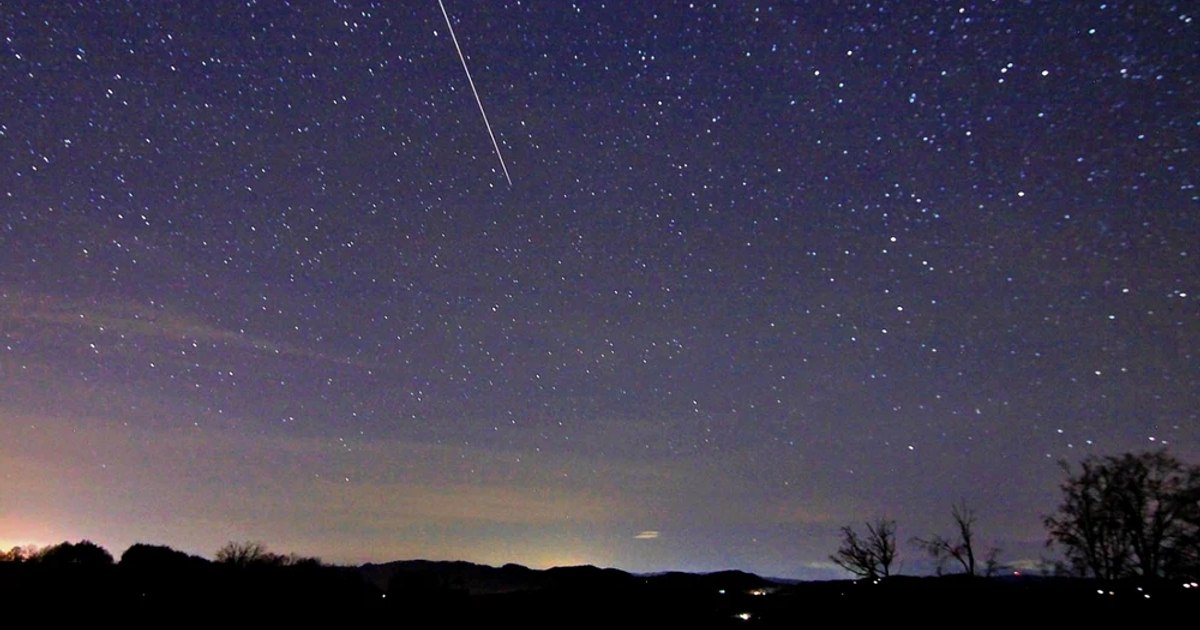
The Geminids are one of the most important astronomical times of the year, creating a spectacular shooting star show every December. Scientists are now beginning to understand where they come from.
The Geminid Meteor Shower PHOTO The Truth (Archive)
It was a period of great convulsions. The Roman Empire was in chaos after the assassination of Emperor Severus Alexander, while China was in turmoil from a series of wars. However, about 1,800 years ago, another dramatic event, the effects of which can still be seen today, was taking place far above the heads of these human machines, according to bbc.com.
Scientists believe that around this time something catastrophic happened to an asteroid called 3200 Phaethon, which broke up and threw pieces of debris in a long ring around the Sun. Every year, our planet passes through this debris cloud, producing one of the most impressive meteor showers – the Geminids.
Look up on a clear night in mid-December and you might just spot them – streaks of light crossing our sky. These are particles of this asteroid that vaporize into our atmosphere at speeds of up to 79,000 km/h.
Geminids are particularly notable for the range of colors they produce, including yellow, green and blue, says Tomáš Henych, an astrophysicist at the Czech Academy of Sciences. They are also very bright, with up to 150 meteors visible to the naked eye every hour. “You usually see beautiful meteors,” Henych says.
Why are they unique?
But the Geminids are also unique for another reason – they are the only known meteor shower to originate from an asteroid. All others come from icy debris emitted by comets when the Sun ejects material from their surface. Asteroids, which are mostly rocky, do not normally form such tails.
However, in 1983 astronomers discovered 3200 Phaethon, a bluish asteroid about 3.6 miles (5.8 km) wide that appeared to closely match the trajectory of debris associated with the Geminids, which are named for that they point towards the Gemini constellation in the sky. This discovery led to the probable conclusion that the meteor shower originated from this object. “It is very likely“, says Henych. This also explains why the Geminids have such a wide range of bright colors – the particles that produce them “are tougher”, says Henych, and they have a higher number of elements compared to those from comets.
Phaethon’s orbit around the Sun is also “very unusual”says Rhian Jones, a planetary researcher at the University of Manchester in the UK. “It comes very close to the Sun, closer than Mercury,” she says, to about 0.14 times the Earth-Sun distance. “So it’s getting pretty hot,” up to about 750C (1,400F).
And this unusual orbit has given scientists some clues about how the Geminids were born.
In March 2024, amateur astronomer Danila Milanov of Russia and colleagues modeled the trajectory of the meteorite debris and Phaethon’s orbit, which today are easily separated by about 20,000 km. They found that 1,200 to 2,400 years ago the two appeared to intersect. “We suggest that a catastrophic event occurred on this time scale.” that formed the meteors, Milanov says, although another study says the event could have occurred as far back as 18,000 years ago.
This event is hotly debated
One possibility is that the asteroid collided with another object and broke off. But Wolf Cukier, a doctoral student in astronomy and astrophysics at the University of Chicago who studied the Geminids, says that’s unlikely because few asteroids are seen near the Sun. This suggests that there is a common mechanism that pushes them apart, and collisions between asteroids are rare. “Surely they cannot all be explained by collisions“, he says. It could be that the extreme heat near the Sun meant that few asteroids managed to survive. Phaethon, it seems, is an exception.
Indeed, the preferred explanation for the Geminids is that Phaethon was pushed toward the Sun from the asteroid belt, perhaps by gradual gravitational interactions with planets such as Jupiter. Then, about 1,800 years ago, its orbit brought the asteroid close enough to the Sun that the heat caused it to break apart.
In 2023, Cukier used data from a NASA space probe called Parker Solar Probe to learn more about this process. Parker had surreptitiously observed another section of the Geminid debris stream in space in 2020. Using these observations, Cukier concluded that the Geminids likely originated from a single violent event, rather than a continuous release of debris, such as a comet.
This event could have been a “low speed blast”, says Cukier. “As asteroids get closer to the Sun, they heat up, and this causes thermal stress inside the asteroid. If they get too hot, that stress could build up to a point where the asteroid breaks into a bunch of pieces.”
Another possibility is that the asteroid broke into pieces due to its rotation. Currently, Phaethon rotates once every 3.6 hours, which is “very fast”says Qicheng Zhang, an astronomer at the Lowell Observatory in Arizona, possibly a result of the Sun heating its surface and imprinting its rotation speed as radiation bounces off the surface, known as the Yorp effect.
In 2023, Zhang observed sodium emission from Phaethon that could be related to this process. “It may have lost much of its surface as chunks of it broke away, exposing fresh sodium underneath.” he says.
Researchers at Johns Hopkins University in Baltimore, Maryland, suggest that Phaethon may still lose small amounts of its surface each time it returns near the Sun. They say the asteroid’s blue hue is due to extreme heating during its closest approach to the Sun, which they estimate causes a microscopic layer of rocky material, iron oxide and pyroxene to sublimate on its surface.
New answers soon
An upcoming Japanese mission called Destiny+, scheduled for release in 2028, may provide answers. The spacecraft will fly past Phaethon, taking images of its surface. If the rapid rotation idea is correct, “you would expect to see landslides and rocks flowing towards the equator, where centrifugal force should be pushing things along,” says Zhang.
Uncovering the mysterious origins of the Geminids will not only help us understand a spectacular annual light show a little better, but could teach us more about the solar system as a whole, says Minjae Kim, a planetary researcher at University College London in the United Kingdom. “It tells us that meteor showers can form through several different mechanisms,” says Kim. There are other asteroids known to be fairly close to the Sun, suggesting that “we might expect similar meteor showers to form in our future.”
Phaethon is expected to eventually fall into the Sun in about 10,000 years, Zhang says, leaving only the Geminids behind. Eventually, they too will be swept away by our star.
“Phaethon shows us how asteroids die,” says Zhang.
But for now, it means that we’re just serendipitously placed in time to observe this meteor shower. “We happen to be at a point in time and space where the Earth flies through the Geminids”, says Cukier.
