
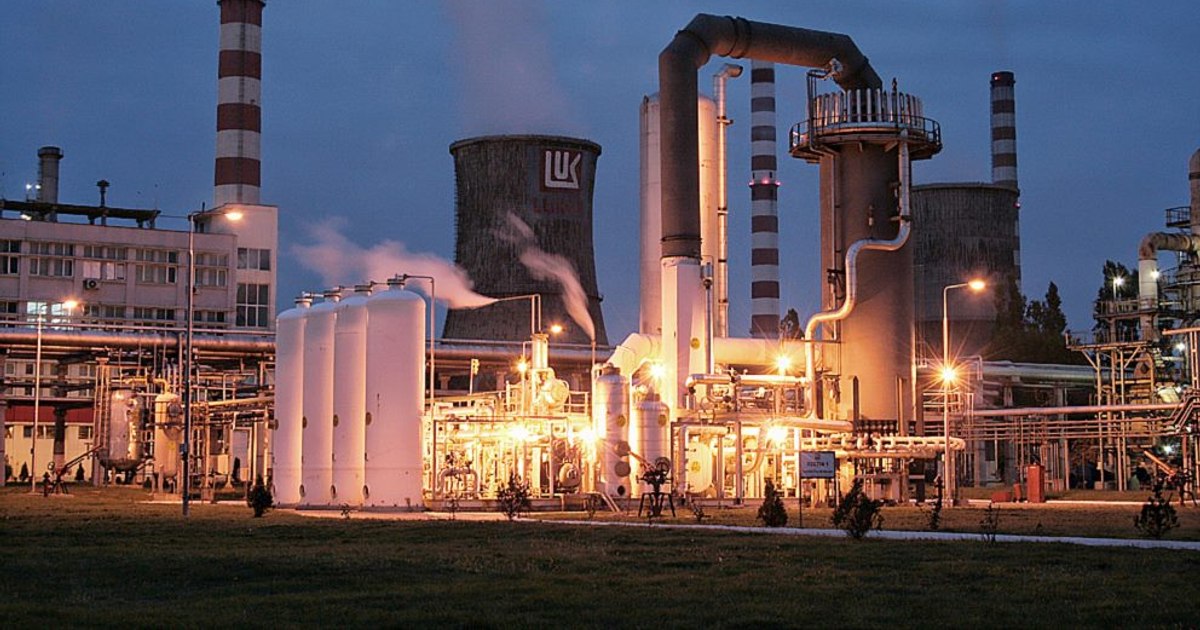
Prime Minister Ilie Bolojan announced that a working group is analyzing several solutions to avoid the effects of American sanctions on Lukoil, specifying that a possible “last option” would be the nationalization of the Russian company’s assets. Invited to a television show on Thursday evening, the prime minister also spoke about the first positive effects of the fiscal measures adopted.
Petrotel Lukoil Refinery PHOTO Facebook
Do Romanians risk paying more for fuel because of the Lukoil situation?
The Head of the Government assured that, for now, there are no reasons for concern regarding the increase in fuel prices and specified that important decisions are expected at the global level during the next week.
Ilie Bolojan spoke about two options: either the United States agrees to postpone the entry into force of the sanctions, or a buyer is found for Lukoil’s assets.
“There is the possibility of delays so that the sanctions are implemented without major disruption, or there is the possibility of trade deals that allow the sanctions to be applied immediately“, said Bolojan, on Thursday evening, during a Euronews show.
The Prime Minister declared that, in the absence of a clear commercial solution, Lukoil could encounter major difficulties in continuing its activity in Romania. “If a commercial solution is not found, operating Lukoil in Romania will be very difficult. Any company that works with Lukoil will be in the position of coming under sanctions, if the financial flows are not separated“, warned Bolojan.
He informed that a working group is currently analyzing all possible scenarios and next week important decisions could be made at the international level.
Asked if there was an option to nationalize Lukoil, the prime minister said that “this would be the last option” and that a working group is working on these issues, pending decisions at the global level next week.
Regarding a possible increase in fuel prices, Bolojan assured that there are no reasons for concern, at least for now: “It shouldn’t, because the Lukoil refinery in Romania is stopped now. Lukoil’s share is important, but not likely to create major disruptions. There are other countries, such as Hungary or the Republic of Moldova, where the company’s influence is much greater.”
About the tensions in the Coalition
Asked about the statements made at the PSD congress, where several leaders talked about a possible government without the USR, Bolojan said that such messages are natural in the political context, but stressed that government stability must remain a priority.
“Always when there is a political event, the launch of candidates, congresses, party events, the political tension is greater and all kinds of things are said. We in this coalition must collaborate because it is a reality that is given by parliamentary arithmetic. And when I was in local and central administration, you don’t always make coalitions with whoever you want, but you make coalitions that are given by a reality that the electorate decided. But today, one of the basic elements which are related to what is happening in Romania, as well as the predictability in this difficult budgetary situation, is given to an important extent by the stability of the coalition”, said Ilie Bolojan, guest at Euronews, on Thursday evening.
“In recent years I have taken loans at too high a speed”
“When a country is evaluated from the point of view of creditworthiness, the political stability, the perspective that the government gives, can have a weight that means 30-40% of the evaluation of that country. And then, we are in a difficult situation, because we borrowed too much. In recent years, we took loans at too high a speed, we have debts of more than 200 billion euros, and even if our debt ratio is not apparently high, it is lower than the average of the countries in the European Union, we are approaching 60%, and, unfortunately, the debt level will increase… Just the interest that Romania will pay and is paying, will amount to almost 60 billion lei next year. So, it is almost 12 billion euros, which means about 3% of Romania’s GDP”. declared Ilie Bolojan.
He warned that instability and unpredictability is affecting the country’s rating, leading to higher interest rates on foreign loans:
“Do we want to lower our interest rates? apart from taking care of the money we collect, we need to project stability. If you don’t project political stability, if when you commit that you will make a budget correction, that you will not waste your money, that you will collect your taxes, that you will be transparent, that you will be predictable, you don’t respect these things, or you constantly make political scandals, you project the image of insecurity, of unseriousness, and that costs you points from a financial point of view.”
The Prime Minister also said that “the only chance for us, no matter who is in government, is to increase our degree of confidence, to increase our rating. to prove that we can manage our money, to stop borrowing so much and only in this way, by reducing this fiscal burden, we will have budget spaces, no matter who is in government, to make investments, to create development. Otherwise, no matter who it is, the problems will remain and they are quite serious”.
The first positive effects of the fiscal package
Bolojan added that in recent months, the first positive effects of the fiscal package have been seen, including a decrease in staff costs in the public sector:
“Think about the fact that we spend around 13-14 billion in a month in Romania on public sector salaries. We decreased by 500 million, because we cut certain allowances, We took measures in education, European funds were limited, the increase in harmful conditions was limited. This year we aim to finish with an 8.4% deficit. Sure, it seems like an abstract target, but it is a serious target.”
Regarding the fiscal measures adopted in recent months, Bolojan said that they were necessary to avoid the suspension of European funds and to correct budgetary imbalances.
“If we didn’t regain the trust of the European Commission in July, our European funds would have been suspended, and that would have meant going into insolvency. Half of Romania’s investments are financed by European money. We managed to avoid this scenario and obtain an extra 10 billion euros for the next period”, he specified.
