
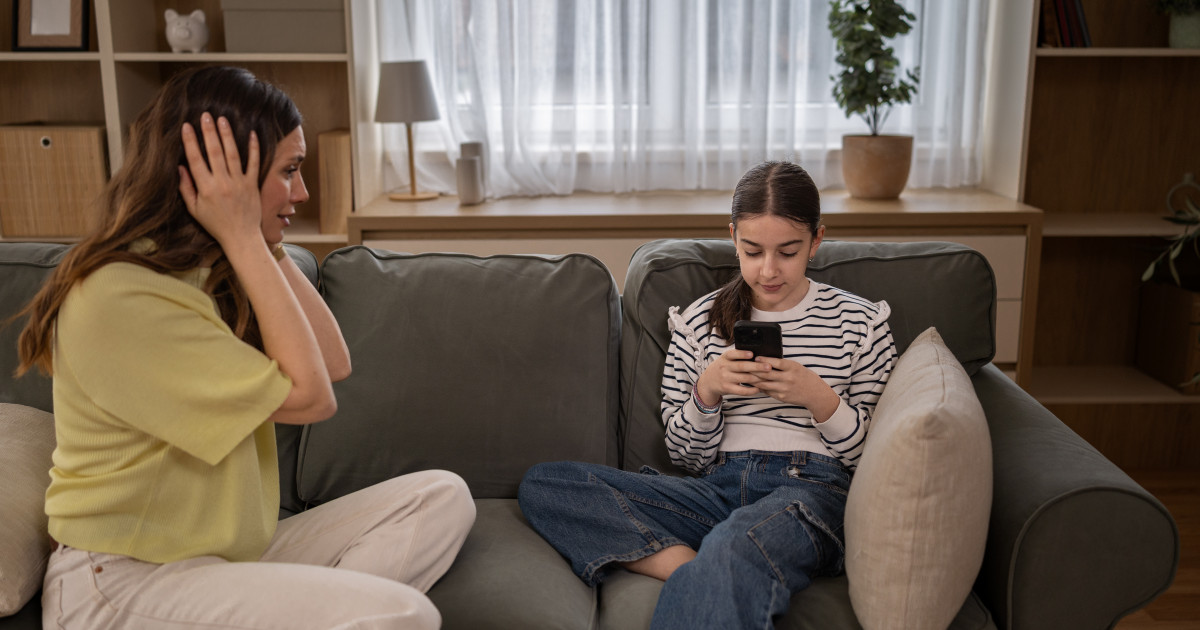
A phrase taken from a song has become a running joke among children and teenagers, much to the bewilderment of parents. The “six seven” phenomenon illustrates how online references can become signs of group membership. Beyond the fun, experts point out the pressure that the constant need for acceptance and validation can create.
The popularity of an expression does not in itself explain the effects on those who use it. The discussion mainly concerns the situations in which the desire for integration comes to influence personal choices and the way in which young people appreciate their own value.
What does “six seven” mean
Literally, the two English words translate as “six” and “seven”. In the usage that has become popular on the Internet, joining them, however, functions as an exclamation, without necessarily conveying information about a quantity. The American Dialect Society describes it as an interjection with little semantic content, that is, having little meaning of its own.
The Cambridge Dictionary classifies the formula as Internet memes: ideas, jokes, or other content that spread quickly and are repeated by many users. In this case, children and young people say it for funny effect without a precise message.
Where does the expression come from?
The origin is related to the song “Doot Doot (6 7)”, performed by the rapper Skrilla. The link between song and interjection appears explicitly in the American Dialect Society communique. The musical fragment thus became the starting point of a formula taken up later in other contexts.
The spread of the expression is also linked to the basketball player LaMelo Ball. The Cambridge Dictionary lists the athlete’s height as six feet seven inches, equivalent to about 2.01 meters. Spoken in English, the two numbers form the phrase “six seven”, which explains the connection to the player without establishing a general meaning of the joke.
What does the hand movement represent?
The exclamation is often accompanied by a gesture: the hands are held in front, palms facing up, then alternately moved vertically. This combination of speech and movement is part of the recognizable form of the meme, also described by the Cambridge Dictionary.
How the psychologist explains the influence of online trends on young people
“In today’s digital environment, online trends have become a tool with a significant impact on the mindset of young people. Beyond their appearance of entertainment or personal expression, many of these trends are designed in a way that fosters social division. And where there is division, there is also vulnerability – people end up suffering, but also spending more, actually contributing to the profit of those who create or promote these trends.
Trends often function as a mechanism of social influence, fueling children’s and teens’ desire for validation—whether social or emotional.
This need for approval is fueled by the imposition of artificial standards or by extreme challenges, promoted by online communities that, in some cases, can have structures with negative effects, either from a psychological or ideological perspective,” Radu Leca, a psychologist specializing in psycho-diagnostics, explained to Digi24.ro
The need for belonging and the role of parents
“In many situations, the obsessive following of trends reflects young people’s deep need for belonging and recognition – a need that manifests itself prominently in the case of adolescents who do not benefit from an active and balanced presence of parents in their lives. Thus, trends become not only a means of expression, but also a form of emotional compensation, with possible consequences for identity and mental health.
This aspect should bring parents “down to earth” and make them aware of the risks to which their children may be exposed. In some cases, these communities are led by people with social or even medical problems, which amplifies the potential negative impact on the mental and emotional balance of the children who follow them,” the Digi24.ro source added.
When self-worth comes to depend on online approval
“The phenomenon of addiction to online validation has become increasingly visible among young people, having roots that can be observed from the first years of integration into the educational environment, whether we are talking about kindergarten, primary school or high school.
In these early stages, children begin to perceive differences and subtle forms of discrimination or social inequity, actions that can later contribute to building a constant need for external approval.
Over time, teenagers between the ages of 14 and 20 come to develop their personality according to the unwritten rules of online communities, based on likes, reactions and current trends. Thus, authentic identity is replaced by an image constructed to conform to the demands of the group, and self-worth becomes dependent on virtual approval, not personal or real benchmarks.
This need is closely related to a psychological mechanism called “self-image externalization,” whereby the individual defines his or her personal worth based on the feedback received from others. In fact, this kind of feedback only feeds a false self-image. Young people come to believe that the approval of others is essential to have value, and rejection – whether through a simple “dislike” – becomes equivalent to personal failure,” added the Digi24.ro source.
The need for validation and the false competition behind online trends
“Many children and adolescents feel compelled to conform to the norms or expectations imposed by these communities in order to gain acceptance and validation from the group. This constant pressure can lead to increased levels of anxiety, stress and depression, as well as a persistent sense of inadequacy.
In an attempt to be accepted, young people may end up adopting inappropriate behaviors or participating in extreme challenges. Trends that go viral online not only influence young people’s behaviors, but can also amplify their need for external validation. Essentially, many of these trends are built around a seemingly harmless idea of competition, but in reality, the competition promoted is fake and superficial.
Young people are constantly exposed to images that reflect a ‘perfect life’, selectively presented and idealized in the digital environment. Compared to these unrealistic standards, adolescents come to evaluate their own lives as insufficient or inferior, which directly affects their self-esteem and self-image. This constant comparison leads to an emotional imbalance and an inner pressure among young people to live up to the expectations imposed by the happenings in the online environment.
The concept of “attachment of the minor to a trend” describes precisely this process by which a teenager ends up shaping his identity according to popular trends, gradually losing his individuality. In such cases, the adopted personality no longer reflects the inner reality of the young person, but an artificial construction, created to obtain the acceptance of others,” added psychologist Radu Leca