
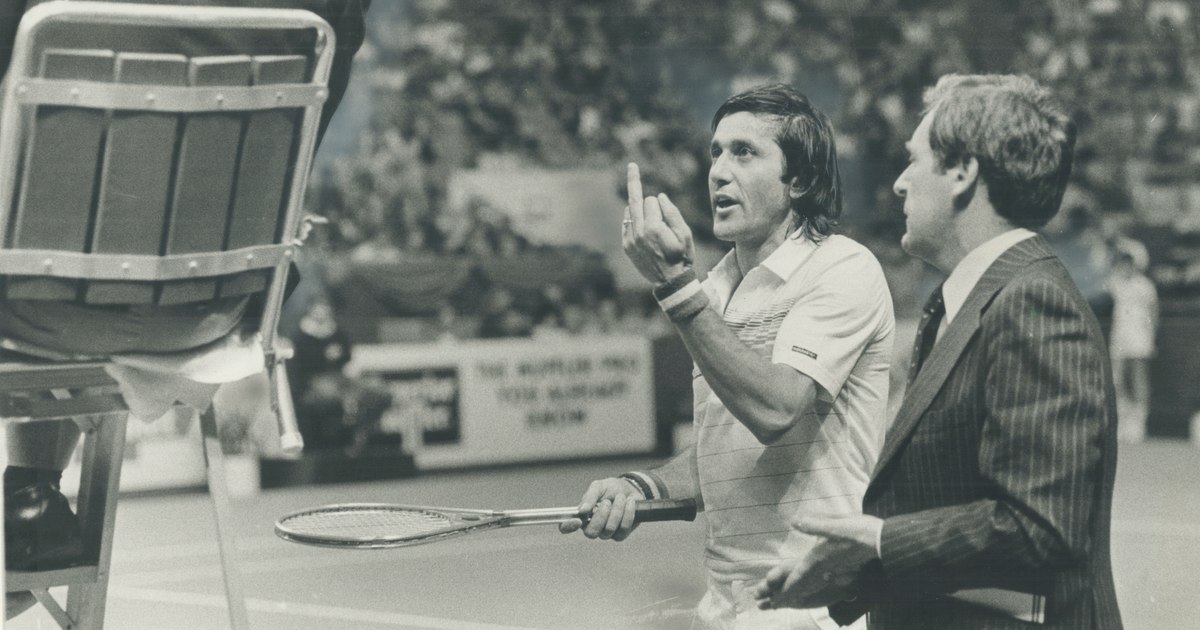
Although criticized for the inappropriate remarks made to some international tennis stars, Ilie Năstase is the first tennis player to accept and respect the gender change of a colleague: he played mixed doubles, in the US Open, with the first transsexual in the history of the competition.
Ilie Năstase became the terror of chair referees at international tournaments. PHOTO: Nasty
“NASTY”, the documentary about the life and career of the Romanian tennis player Ilie Năstase, was included in the selection of the 77th edition of the Cannes International Film Festival. Last month, the filmmakers of the documentary, Tudor Giurgiu, Cristian Pascariu and Tudor D. Popescu, as well as the protagonist of the film, Ilie Năstase, walked the red carpet of the most important film festival in Europe, together with big names in tennis such as Henri Leconte, Boris Becker, Mansour Bahrami and Virginia Ruzici. “NASTY” presents the story of Ilie Năstase's career and his influence on the world of tennis, with appearances by personalities such as Rafael Nadal, Björn Borg, Jimmy Connors, Stan Smith and Phil Knight.
“Weekend Adevărul” spoke with the director Tudor Giurgiu about how he discovered Ilie Năstase beyond the image that the tabloids have outlined for him in the last decades, which made many Romanians not sympathize with him very much. He also tells about what he found in the CNSAS archives, what was stipulated in the agreement with the Ceaușescu regime, which allowed him to lead a dandy life in Europe, but also about the secret of the performances of the athlete who “hated to train”. The documentary can be seen on the big screen at TIFF, on June 16 and 20, but also on the Max online streaming platform.
“Weekend Avevarul”: How did you receive the selection of the documentary in the “Special Screenings” section for Cannes?
Tudor Giurgiu: I was in Iași, with a film in a screening at Cinema Victoria, which has a very large hall. I remember being on stage with my colleagues, answering questions and my phone kept vibrating in my pocket – once, twice, I thought it must be something serious. Then I saw a number with a France prefix and I said, “Wow, this is really something.” I actually ran off the stage, leaving the two colleagues who didn't understand anything, Tudor and Cristi, and that's how I got the news that the film, after all, will be selected. That was on a Friday, Monday was the announcement.
It was extraordinary news because I was not hoping anymore, a serious first row of titles had already been announced, so somehow I was in the second wave. But I think it's great for the film, for Ilie, but especially for the film's distribution chances. In the end, this Cannes gives you. Prizes and attendance are things that satisfy the creator's ego. What Cannes gives you is visibility and the chance to sell the film faster and easier around the world – for NASTY I think that's essential.
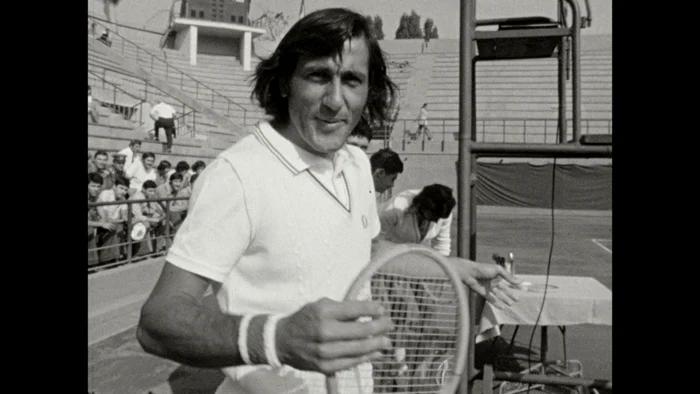
Ilie Năstase delighted the audience. PHOTO: Nasty
You made a tour of force throughout Romania with “NASTY”. What surprised you about the reactions?
What I liked the most was the fact that many of the haters, who don't like Năstase – and I can understand why – still went to see the film. Ok, we're not discussing the character of the past decades, but they've seen what he's done and how he's changed the sport. Many of the viewers only now understand how big it was at the time. That says a lot about how quickly, how easily, in fact, we label some, how easily we write them off altogether, without even having the curiosity to learn more about that person. When we made this film, we did not start from the premise of washing away Năstase's sins or whitewashing him completely, but on the contrary, we wanted to see where he started and how the whole global phenomenon of Năstase was born.
Second, of course, I was very moved to see that at most of the screenings there were people over 60 years old in the hall. Many I spoke to are from the generation for whom Năstase was what Hagi was for us or Halep for others. For them, Năstase was actually the only, but absolutely the only athlete until Nadia appeared, the only athlete who made you proud to be Romanian, which I think is a very necessary feeling for every generation. And these people returned to the cinema halls and you could see how they watched the film with different eyes, with a different perception – they were revisiting their youth.
From shy boy to global phenomenon
From the hundreds of hours of documenting and interacting with Ilie Năstase, did you understand how the Ilie Năstase character was born who practically changed tennis?
Know that even now it is not very clear to me. I mean, it's not clear to me how the shy boy from Bucharest ended up like this…
Was he shy?
Yes, he was shy. It is not very clear to me how he turned into the entertainer who entertains the stands. Probably such abrupt contact with America of the 70s, post-Woodstock, post-hippy movement, that whole period was absolutely mind-blowing for him, and this desire not to be framed and not conform to a certain label or rules, I think that's what made him actually find a character, find an individuality so distinct and so different – this type of personality that he ultimately and fashioned I think without much a lot of thinking. Most of the time, today, in order to create such a character, PR agents, influencers, a whole team must work. With him, everything was absolutely authentic. This seems to me today almost inconceivable, incomprehensible. But, in his words: “That's how I was, that's how I was”.
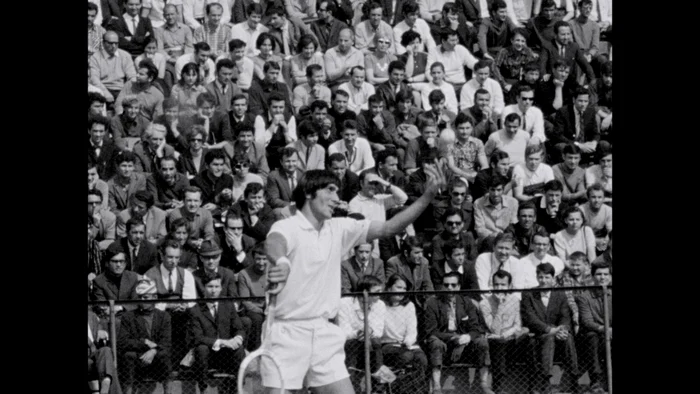
Ilie Năstase became a tennis rock star. PHOTO: Nasty
“He told me he hated working out”
What is the explanation for the very good results he achieved? Did he train a lot or was he very talented?
I asked him and he said, “I didn't like training. I hated this thing”. He was actually training on the court, playing doubles, playing mixed doubles. These were the trainings. Other athletes, like Stan Smith, were people with a rigor he didn't have. It's the paradox of pure talent, as someone says in the documentary, you rarely see something like this. You often find workers easier, people who may not have genius, but who make up for it with hard work. This was not the case with him.
Was there something that impressed you the most of the things you learned about Ilie Năstase during the course of documenting the film?
Yeah, and I'm sorry that didn't make it into the movie because I found out too late. He was the first tennis player on the men's circuit to agree to play mixed doubles at the US Open with the first transsexual in the history of the circuit, with the future Mrs. Renée Richards, who once made this decision sought a mixed doubles partner. Players were quite reluctant to play with her, not sure how they would be played. Or, Ilie consulted with his manager and said: “Why not?”. The highlight is that he is still alive, he is an ophthalmologist, he is 85-87 years old. He is Billie Jean King's ophthalmologist, I am a friend and he gave me the contact, I had a meeting on Zoom with her and she told me, very movingly, how important it was for her that Ilie supported her the moment he assumed the change. The America of the 70s was not at all what we see today in Europe, in the world… different options, there was a very present conservatism. Elijah's gesture made her not feel alone. Elijah also had public reactions in which he encouraged her. I mean, I had no idea about this, because what do we know about Elijah? That he's homophobic, that he's I-don't-know-what. But you see, in fact, that again the generosity and this kind of camaraderie that existed back then were important trademarks of the Nastase character, and I don't think they've changed.
Speaking of which, there was talk of Ilie Năstase's alleged xenophobia when he nicknamed Arthur Ashe “Negroni”… What was his relationship with him, actually?
They were friends. I don't think he was angry.
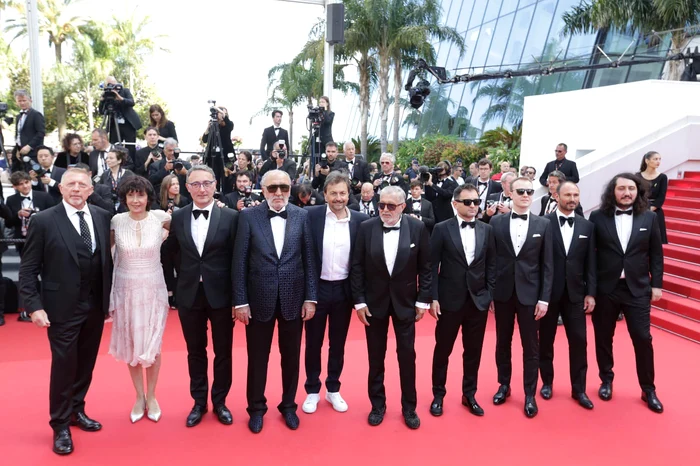
Landing of international stars at the Nasty premiere in Cannes. PHOTO: Nasty
“Elijah's legacy is the joy of the game”
How did Ilie Năstase manage to have such a bohemian life when Romania was ruled by a repressive dictatorship in which the Securitate controlled everything?
I asked Ilie, what's more, I also looked in the archives at CNSAS, because I thought maybe we would find information. Obviously we didn't find anything, because what a big mouth he had, they didn't have anything to do with him either.
Was he followed by Security?
Followers probably were all, but I couldn't find information about him. What he told me, however, is that he accepted a clear understanding with the regime, namely: he and Țiriac could play abroad as much as they wanted, and when they won, they didn't take their money. The only obligation was that three times a year or as many times as the Davis Cup was played, they would play for Romania, and the money paid for the Davis Cup, which was not small, was taken by the State. So it was kind of like that, kind of “we'll let you do what you want, but play for the country”.
Elijah was even allowed to live in Paris…
Yes. He told me: “I used to come to Romania at the end of the year for the Holidays and the rest, maybe for a day or two, but I didn't really stay here”. This is interesting, in the context in which athletes like Nadia Comăneci had to flee the country to have more freedom…
“Man does not change”
Former great athletes want to leave behind a legacy – Ion Țiriac builds sports fields, Gheorghe Hagi founded a football club, Nadia Comăneci founded a sports base for gymnasts. What legacy do you think Ilie Năstase leaves?
Șiriac is a billionaire. Elijah does not have these possibilities, he was a spender, he was not a thoughtful man. What impressed me was the fact that before the premiere at Sala Palatului, he asked me and Cosmin Hodor, the other producer, to bring children, students, in the first rows, from some tennis clubs, because he insisted that them to see the film and talk to them, tell them that sure work is important, but if you don't like what you're doing, there's no point in going any further.
I think, somehow, that's the most important thing that he leaves: the fact that you see in him this pleasure and joy of the game that, if you read Andre Agassi's book, you find out how many dramas, sacrifices and problems brought his career tennis player. We see the same thing in Björn Borg and many others. I think that's what he leaves as a legacy – the pleasure and joy of the game.
Other than that, sure it gives off a trophy feel, but it's actually a certain kind of intimate relationship with the game and how you approach this kind of performance: do you approach it with aplomb, or are you zen and let things happen, accept that you can to lose and in spite of that you can live your life.
Especially today, in a time when tennis has changed a lot, and the emphasis is so much on performance and preparation, that people no longer have life. He also had and lived his life to the fullest. It is fascinating that even now, at his age, he has not changed. He's still that kid who still talks nonsense, makes jokes when he shouldn't. In fact, age is just a number, man does not change.
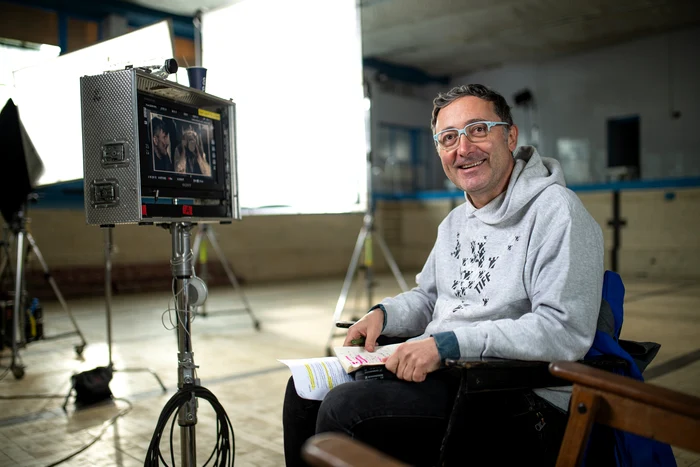
Tudor Giurgiu was impressed by how little we know about Ilie Năstase today. PHOTO: Nasty
How difficult was making NASTY compared to other films you've made?
For me personally it was difficult, because in parallel I was working at “Liberty” and that's why I asked my colleagues, Cristi Pascariu and Tudor Popescu, to join this team which, in fact, was ultimately responsible for the product and the creation of the film. The film is equally theirs, and they spent weeks in editing trying to find the best formulas. They've seen dozens of hours of archival material, tons of material. That's what I think was hard: what do you choose. How to tell the story of a man who was so larger than life (no – outstanding personality). You could also choose what happened in the last 10-15 years, I mean there was so much material that it was difficult, to select what was relevant. In the fiction film, it's much simpler: you have a predetermined scenario, you think about how to shoot and that's it. Here you could do the story in ten thousand ways.
