
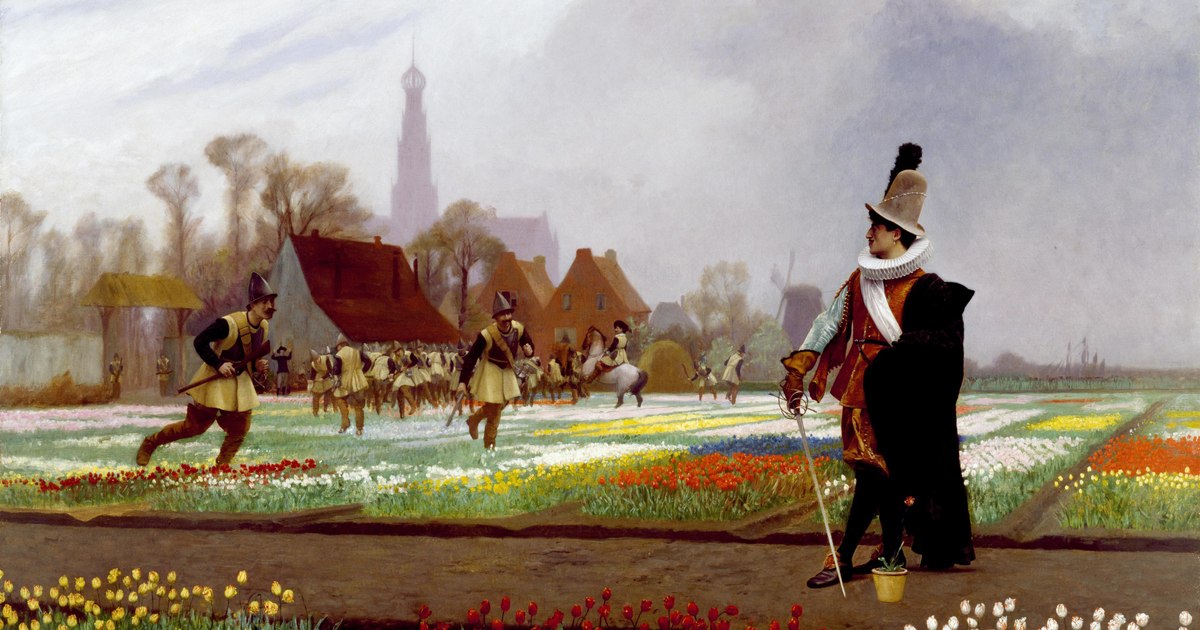
The first thought that comes to you when you leave Keukenhof has nothing to do with history, economy, or even the Netherlands. It is a strange silence that settles after the color. A visual, almost physical void, similar to the one you feel when you leave an overcrowded museum or a movie theater in broad daylight, when the eye is still searching for the frames that are no longer there. The tulips passed before the gaze like a fast-paced film. Stripes of red, yellow, purple and white, drawn with an almost military rigor, but arranged so as to appear natural, spontaneous, inevitable. Everything is calculated, perfect, temporary.
Only then does a movie appear. “Tulip Fever”, released in 2017, proposed a love story set in 17th-century Amsterdam, in a world dominated by an obsession with tulips. The film was received coldly: too slow, too decorative, too concerned with the atmosphere and not the action. But it is precisely this slowness that brings him closer to the historical truth. The tulip mania was neither a sudden explosion nor a spectacular crisis, but a slow accumulation of desire, social status and financial promises. An elegant tension, carried in expensive clothes, well-ordered bourgeois interiors and handwritten contracts.
The flower of the imperial order
Long before the tulip became the national symbol of the Netherlands or a metaphor for the excesses of the market, it belonged to another, self-confident world: the Ottoman Empire of the 16th century. There, flowers were not simple ornaments, but bearers of political, social and cultural meaning. Cultivating a rare flower meant controlling time, space and taste. To expose it was to assert power.
The reign of Suleiman I – “the Magnificent” in Europe, Kanuni (“the Lawgiver”) in the Ottoman world – represents the culmination of this imperial vision. The Ottoman Empire was a dominant military force, and Constantinople – a sophisticated cultural center. Architecture, poetry, miniatures, Iznik pottery and gardening together formed a coherent system of representation of the imperial order. In this system, the tulip occupied a privileged place.
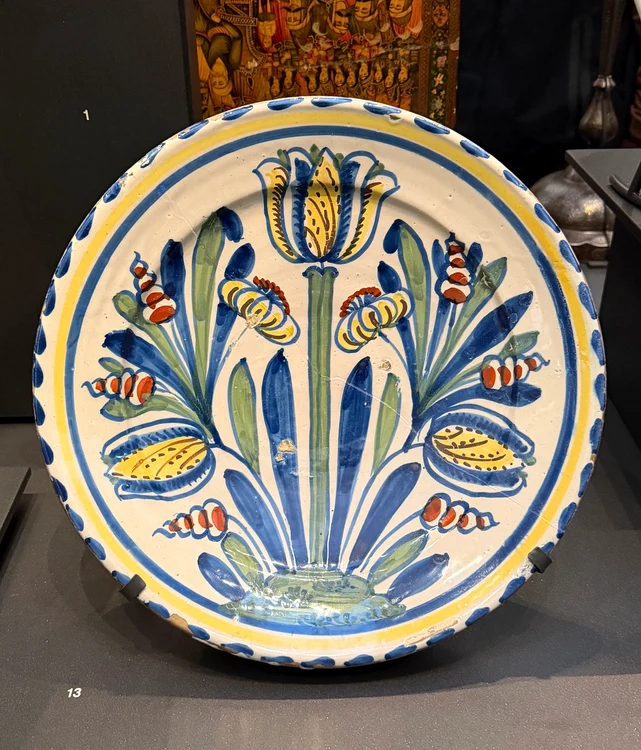
Unlike the rose, a flower associated with emotion and passion, the tulip imposes a control relationship. It grows straight, has a clear shape, does not spread chaotically. In the imperial gardens of Constantinople, tulips were grown in strictly regulated arrangements, often admired at night, by candlelight, to accentuate the color and verticality. These gardens were spaces for relaxation and scenes of representation: a nature subject to order, a disciplined beauty. The tulip thus becomes the vegetable expression of the Ottoman state – elegant, organized, authoritative. It is no coincidence that its stylized form appears frequently in ceramics, textiles, miniatures and manuscripts – the flower is not represented naturalistically, but as a repeatable, recognizable, almost heraldic sign.
The road to the West
Europe discovers the tulip through diplomacy and science. In 1554, Ogier Ghiselin de Busbecq, a 22-year-old Flemish youth, was sent as Habsburg ambassador to Istanbul. Busbecq notes in “Turkish Letters” his amazement at the flowers “that bloomed in the middle of winter”: daffodils, hyacinths and what the Turks called tulips. He confuses the term “tülbent” (fine cloth, headscarf, turban) with “lale” (tulip), probably indicating a tulip pattern on a turban or just getting the direction wrong. Regardless of the linguistic slide, Busbecq takes the tulip to Europe and, with it, the bat.
Its name also tells a story about the circulation of culture: in almost all European territories influenced by the Ottoman world – from Greeks and Albanians to Serbians and Romanians – the name comes from the Turkish “lâle”, not from a deformation of “turban”. In countries shaped by Persian culture, the same word is found in Azeri, Turkmen, Uzbek, Uyghur, Urdu or Hindi. And in Kazakhstan, the tulip is called тышгелдак (“red flower”), recalling that Central Asia is considered by botanists to be the wild homeland of tulips – from the Pamirs and the Hindu Kush to the steppes of the Kazakhs. That’s why the tulip has remained, beyond borders and languages, a universal metaphor of beauty, something ethereal, but constant.
Semper Augustus
In the 17th century, in Holland, tulips become not only botanical rarities, but also objects of prestige. It is said that a Flemish sailor, rewarded by a prosperous merchant with a smoked herring, “completed” the meal by taking an “onion” from the table in an opulent room of the house. The onion turned out to be the bulb of the famous Semper Augustus – the tulip so prized that a single bulb fetched prices comparable to the annual maintenance of a crew. The anecdote, noted later (in 1841) by Charles Mackay in “Memoirs of Extraordinary Popular Delusions and the Madness of Crowds”, fixed the idea of floral madness in the European imaginary. And Alexandre Dumas, in “The Black Tulip”, inserted the knife with moral irony: “to kill a tulip is a terrible crime in the eyes of a gardener; to kill a man – less terrible.”
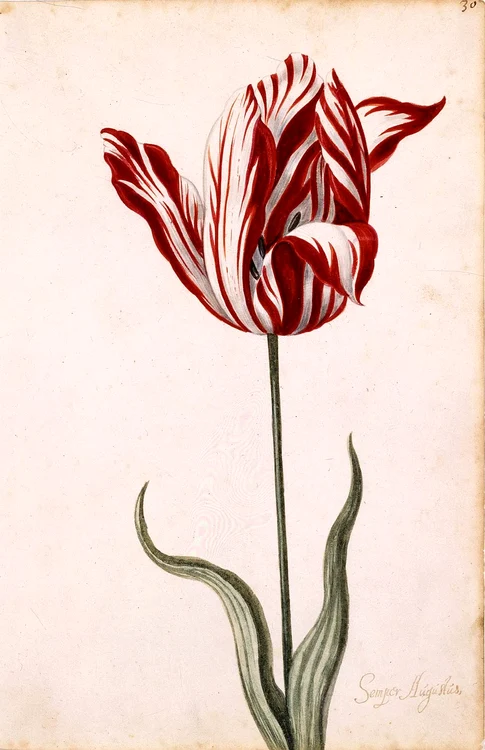
Mackay also notes prices that cause vertigo: for a small bulb of Semper Augustus quoted at 5,500 guilders, you could have bought, in bulk, wheat, rye, cattle, wine, beer, butter, cheese, a bed with mattress and linen, a complete set of clothes and even a silver goblet. Even if the liquid measures of the era are difficult to translate exactly, the proportion remains: rarity becomes currency, fragility – value.
The United Provinces: cities, contracts, the future
At the beginning of the 17th century, what we call the Netherlands today was not a kingdom, but a federation of United Provinces – city-states, ports, banks, printing houses, a functioning stock exchange and a literate urban society. Amsterdam is quickly becoming a center of global trade. The Dutch East India Company operated on the basis of shares and dividends, and financial instruments – forward contracts, marine insurance, capital markets – became sophisticated.
The tulip fits perfectly into this universe: it does not come easily, it does not grow spontaneously, it blooms briefly, it requires time and anticipation – exactly the type of object that excites a society accustomed to investing in the future. Initially a botanical rarity, then a sign of prestige for the urban elites – merchants, doctors, lawyers, luxury craftsmen. The most desired are the “broken” tulips, with stripes and flames, spectacular models born (unbeknownst to people at the time) from a virus. Perfection seemed to mean instability; precisely fragility creates desire.
From passion to speculation and back
The rise in prices does not start as collective madness, but as a logical process: demand increases, supply is limited, prices rise. The bulbs are sold and resold, sometimes several times before they are taken out of the ground. Contracts for future harvests appear, traded not on the stock market, but in taverns, between glasses of beer and calculations on the corner of the table. The Dutch call this windhandel – wind trade. It’s not irony: everyone knows that they negotiate promises. But as long as the consensus exists, the value is real.
In February 1637, at an auction in Haarlem, the buyers no longer appeared. Then not the next one either. Prices collapse without noise, without panic, without generalized collapse. The authorities try compromise solutions, contracts are renegotiated or abandoned, and the economy of the United Provinces moves forward. What is breaking down, however, is the consensus.
Only in the 19th century, the episode was transformed into a moral parable. Mackay makes tulip mania the ultimate example of “crowd madness,” and his book becomes influential. The anecdotes are tasty, but often exaggerated; modern historians will show that the participants were relatively few, well-informed and wealthy. But the myth was too good to be abandoned.
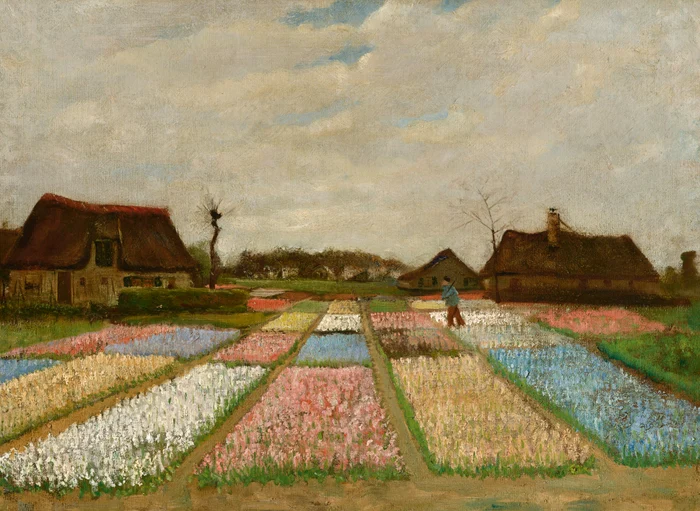
Over time, the tulip detaches itself from the story of speculation and becomes a national symbol. Holland assumes the flower not as a failure, but as an identity brand. The tulip fields, the exports, the festivals, Keukenhof itself are the expression of a reconciliation with the past. Today, the Netherlands produces nearly three billion bulbs annually, accounting for around 81% of world tulip exports – including to places where the flower once grew wild.
After the colors fade
Perhaps that is why Keukenhof impresses and unsettles at the same time: beauty without risk. The tulips are there, at a fixed price, blooming on schedule. No more bets, just photos. And yet, under this perfect decoration, remains the memory of an era in which a flower was more than beauty: it was a promise, status and investment. And the silence that follows the color – that pause in which the eye is still looking for its film – is, perhaps, the very space in which the tulip story sits between two worlds: the sultan’s disciplined gardens and the calculated freedom of Amsterdam merchants. The tulip remains the same: vertical, clear, intense. A sign. A reason. A memory.
