
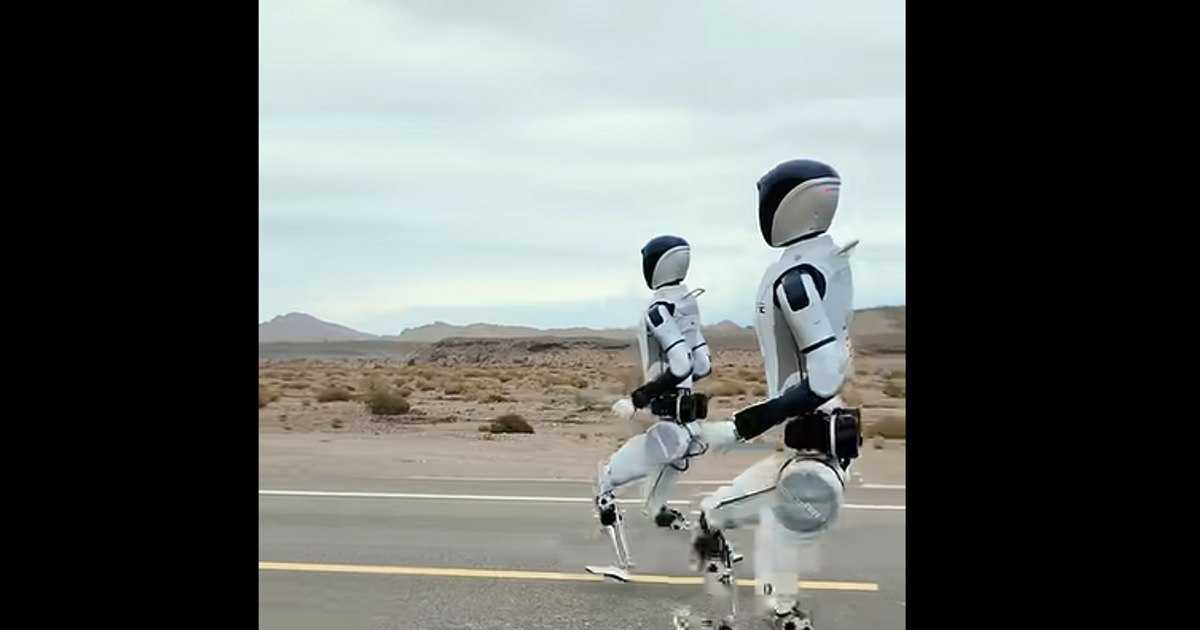
A team of Chinese engineers has managed to build a variant of a bipedal humanoid robot, called STAR1, which it claims is the fastest in the world, according to the performance achieved in a race through the Gobi Desert.
STAR1 managed to maintain a maximum travel speed of approximately 13 km/h (3.6 m/s) for 34 minutes, reports Live Science magazine on Friday.
STAR1 robots raced through the Gobi Desert. PHOTO capture YouTube Robort ERA
Built by the Chinese company Robot Era, the biped robot STAR1 is 171 centimeters tall and weighs 65 kilograms, notes Agerpres.
In a promotional video of the company, two STAR robots are shown competing with each other in a race through the Gobi Desert (northwest China).
One of the robots was given a pair of sneakers to see if the shoes would help him run faster.
The STAR1 robots, which use high-torque motors and AI algorithms, navigated through different types of terrain – from grasslands to gravel, paved roads and beaten earth.
They reached a maximum speed of 3.6 m/s with the STAR1 robot, breaking the speed record held by the H1 robot built by the Unitree company, which was set at 3.3 m/s in March of this year.
STAR1 uses hardware systems controlled by AI
The STAR1 robot uses AI-controlled hardware systems that have a computing capacity of 275 trillion operations per second (TOPS), according to the specialist website Robot Era, far exceeding some of the most powerful laptop models that have a power calculation that varies between 45 and 55 TOPS.
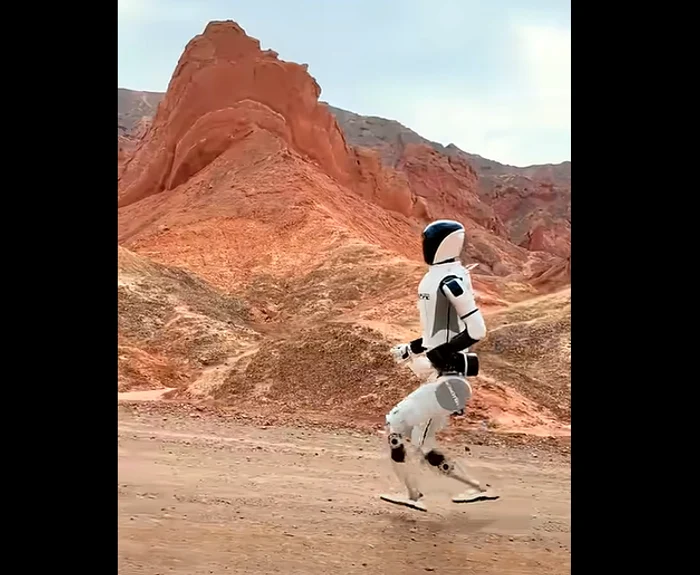
One of the STAR1 robots in the race. PHOTO capture YouTube Robort ERA
STAR1 is just one of the many models of humanoid robots presented by different companies in recent months, among them Optimus Gen-2, produced by Tesla, the robot Figure 01 or Atlas, built by Boston Dynamics.
