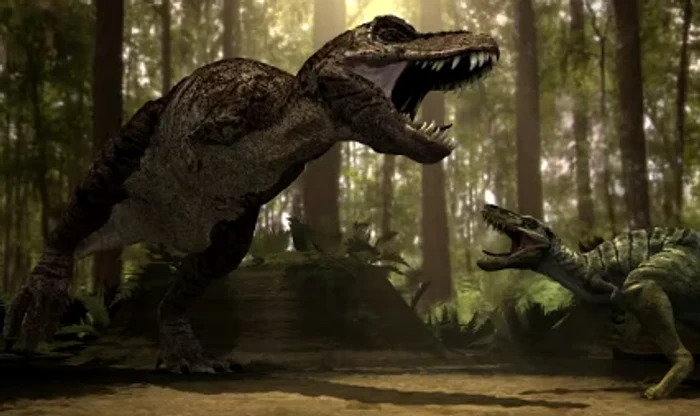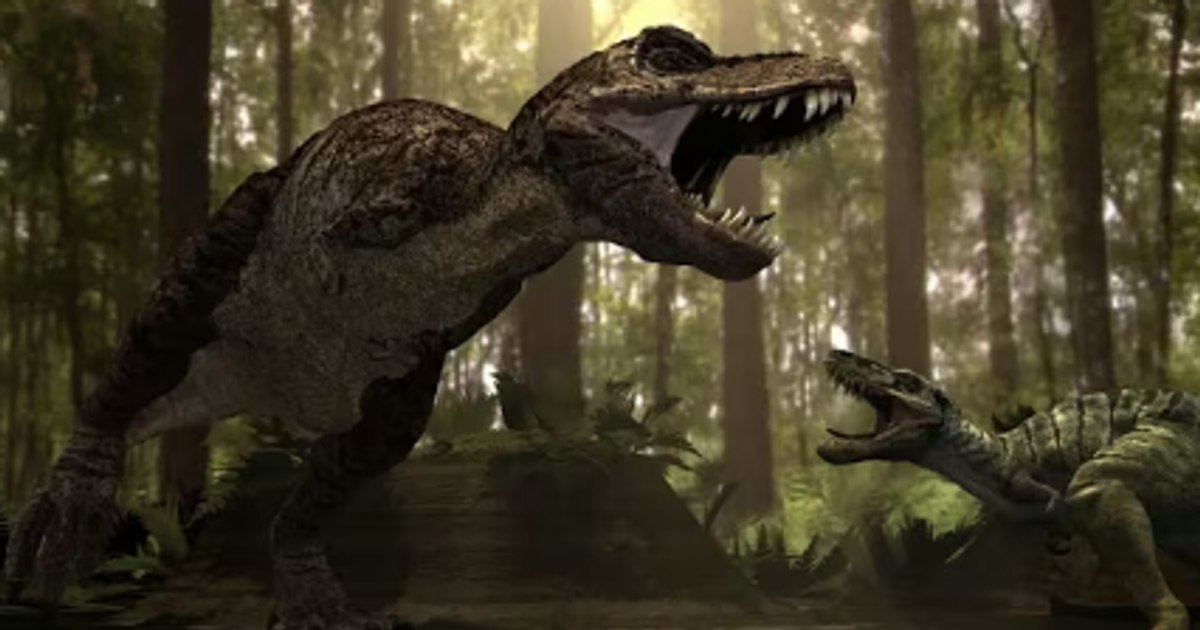
A huge tibia discovered in the 1970s in an isolated region of New Mexico has been found, following a new analysis, to belong to a close relative of Tyrannosaurus rex, a predator that lived several million years before the famous T‑rex. The fossil, nearly a meter long, suggests the existence of a 4.7-tonne tyrannosaurus, possibly the largest predator of its era and a potential direct ancestor of the T-rex, according to researchers, according to Reuters.
The giant tibia dates back 74 million years during the Cretaceous period. It has a length of 96 centimeters and a width of 13 centimeters, representing about 80% of the dimensions of the same type of bone found in the skeleton of the largest known specimen of T-rex, the specimen named “Sue”, which is exhibited at the Field Museum in Chicago, reports the international agency, cited by Agerpres.
The size and shape of the tibia indicate that it belonged to a group of carnivorous dinosaurs called tyrannosaurs. This group reached its peak with the T-rex, which appeared on Earth 67 million years ago, at the twilight of the age of dinosaurs.
No other bones from that dinosaur have been discovered. A single bone provides insufficient information to permit the assignment of a scientific name. The researchers named that dinosaur the “Hunter Wash tyrannosaurus,” referring to the rock formation where the tibia was discovered by students from the University of New Mexico in the Bisti-De-na-zin Wilderness area of San Juan County in the same US state.
“You’d expect to find animals that aren’t that big”
The measurements of the tibia, according to the scientists, indicate that that dinosaur weighed 4.7 tons, about half of Sue’s mass, but was twice the size of Daspletosaurus and Gorgosaurus, other large North American tyrannosaurs that were roughly contemporary with the Hunter Wash tyrannosaurus. The latter may have been the largest tyrannosaur that had ever lived up to that era.
“The enormous size of T-rex is a specialization that appeared relatively late in the evolution of tyrannosaurs. As you go back in time, you would expect to find animals that are not that big, so such traces”said paleontologist Nick Longrich of the University of Bath in England, lead author of the study published Thursday in the journal Scientific Reports.
This dinosaur could have been 10.5 meters long, compared to Sue’s length of 12.3 meters.
“The fossil is consistent with the hypothesis that this species is directly related to T-rex, but we would really need a complete skull to know if it is a direct ancestor or a close cousin of T-rex. It may have been an early species of tyrannosaurus, but again, we would need complete material.” added Nick Longrich.
Scientists have discovered a new species of dinosaur, and it could rewrite the history of T-Rex evolution
A genus is a group of closely related species that share similar traits. For example, lions and tigers are part of the same genus but represent different species. There is debate among paleontologists as to whether various tyrannosaur fossils deserve to be recognized as different species of T-rex.
“This tibia matches the tibia of Tyrannosaurus very wellr,” said paleontologist and study co-author Anthony Fiorillo, executive director of the New Mexico Museum of Natural History and Science.
The paleontologist added:
“Given the remarkable similarity of the tibia in our study to the T-rex tibia, then yes, we believe the two animals were very closely related. We’ll know more when we find more fossilsAnthony Fiorillo also said.
According to researchers, there were various lines of carnivorous dinosaurs, many of them reaching large sizes. The T-rex is the largest of the known dinosaurs.
With knowledge of tyrannosaur growth based on the discovery of new fossils, scientists re-analyzed that tibia, stored in the museum run by Anthony Fiorillio.
Hunter Wash lived in a coastal floodplain alongside numerous horned, flat-snouted, plant-eating dinosaurs.
At that time, North America was divided in two by a vast sea channel. The T-rex lived on the stretch of land called Laramidia, which comprised the western part of the continent. It was the apex predator, known from fossils found in the northern and southern areas of Laramidia.
Scientists say more and more evidence is emerging to suggest that the genus of tyrannosaurs evolved in the southern parts of Laramidia, probably in Nex Mexico, Texas and Mexico. Nick Longrich notes, for example, that a single tail bone from one such prehistoric animal, dating back 69 million years and discovered in Texas, appears to have come from a T-rex-sized tyrannosaur.
For now, the Hunter Wash Tyrannosaurus is only known from a single bone.
“We are developing our plans to expand the search with the aim of finding more fossil materialAnthony Fiorillo added.