
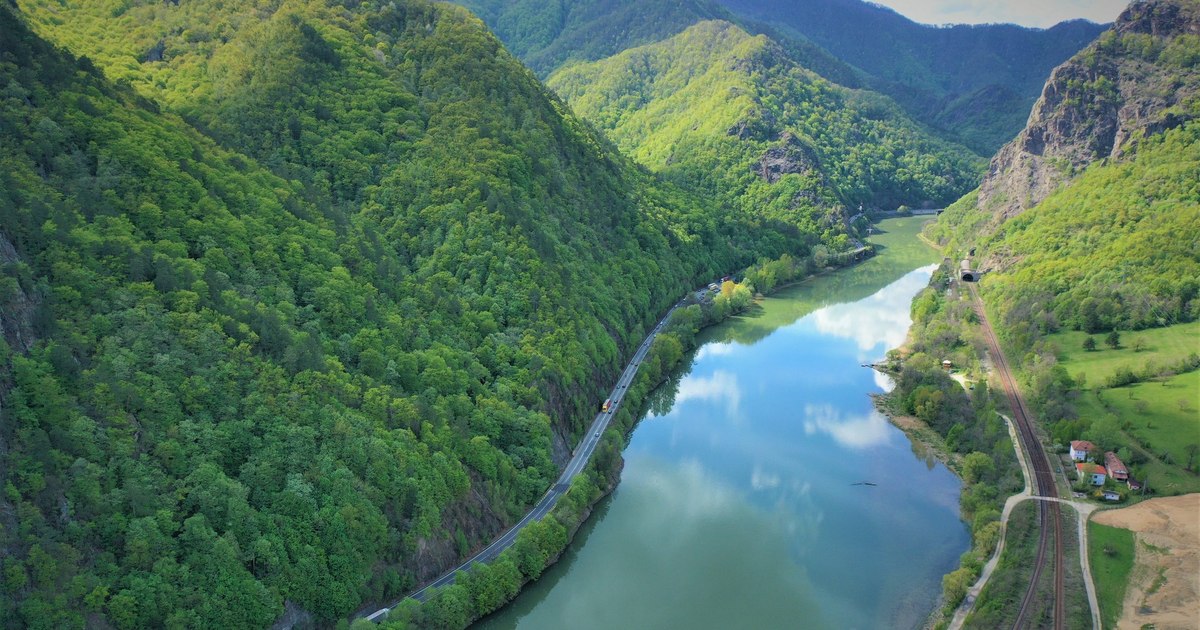
The longest gorge in the country and the national park it runs through, in addition to incredible attractions and sights, also house an impressive number of birds of remarkable diversity, as well as virgin forests.
Divided between the counties of Vâlcea (most part) and Sibiu, the Olt Gorge represents one of the most spectacular areas in our country. Beyond the well-known and controversial DN7 / E81 that transits it, the area between the Făgăraș Mountains and the Lotrului Mountains hides unsuspected treasures.
“Cozia National Park, located in the south of Romania, is a real natural treasure, offering a rich variety of bird species. Here you can meet a remarkable diversity, from majestic birds of prey to smaller and more discreet species”it is mentioned in a video documentary intended to promote the park and its natural diversity.
The Olt Valley seen from the Cozia National Park in Vâlcea Photo Vâlcea Tourist Promotion Center
Thousands of hectares of virgin and semi-virgin forests
Cozia National Park (PN) is one of the two existing national parks in Vâlcea county. Due to its location, in the central-southern part of the Southern Carpathians, being crossed on its median line from north to south by the waters of the Olt River, between the localities of Cornet and Căciulata, for a length of approximately 25 km, out of the approximately 50 km has the gorge, but also its accessibility, PN Cozia is one of the most sought after and appreciated national parks in our country.
Along with Valea Oltului, it was also praised by journalists from the Washington Post who wrote, several years ago: “Romanian Rhapsody, foray into an unpraised land in Eastern Europe”. They mentioned after a visit to the area that, although it is neither the largest nor the best known of the national parks in Romania, PN Cozia has “an exceptional diversity of plants and animals, in a small area“, also mentioning the virgin and semi-virgin forests that, at the time, were proposed to be included in the UNESCO World Natural Heritage list. What has happened in the meantime – the beech and mixed beech and deciduous forests are today a UNESCO site. Near them is the area known as “the wildest valley in Europe”, in the Făgăraș Mountains.
“Within the radius of this national park is the UNESCO natural site with an area of 3,389 ha bordered by a buffer zone of 2,408 ha consisting of virgin and semi-virgin forests”it is also mentioned in the footage dedicated to the incredible wealth of the Olt Valley and Cozia PN.
Eagles, vultures, voles and wasps, among the raptors on Cozia
“The upper course of the Olt River in the Cozia National Park is a refuge for many species of birds, due to the diversity of its habitats, which include deciduous forests, conifers, subalpine meadows and rock formations. These environments provide favorable conditions for a wide variety of birds, both sedentary and migratory.”is also mentioned in the documentary about the avifauna of the Cozia Mountains.
What stands out in particular in the Cozia National Park is the diversity of raptors: “These include: The Bald Eagle (Gyps fulvus) – an impressive species that can be seen soaring at high altitudes. Bald eagles feed mainly on carrion, having an important role in the ecosystem as decomposers Common buzzard (Buteo buteo) – common, this medium-sized raptor is easily recognized by its gliding flight and distinctive calls when in the air. Wasp (Pernis apivorus) – although less often, the wasp can be seen in Cozia during the summer. It feeds on wasps and bees, having a preference for their nests. Mountain eagle (Aquila chrysaetos) – one of the largest and most impressive birds of prey, the mountain eagle is a symbol of mountain areas and is frequently associated with wild and unspoiled habitats.
Noisy 'tenants': woodpecker, blackbird and tit, for birdwatchers
In addition to raptors, there are other bird species specific to mountain and forest areas, such as the mountain woodpecker (Dendrocopos leucotos) and the great spotted woodpecker (Dendrocopos major): “Both are key species for the ecosystem in the way they help maintain forest health. Blackbird (Turdus merula), blackbird (Sylvia nisoria) and black grouse (Garrulus glandarius) are also common and add to the acoustic diversity of the park with their varied songs.”
Due to the extremely high number of birds found both in the Olt Valley and in the national park, the area is suitable for an activity known more recently as “bird watching”which it was called until now “bird watching”. The form of recreational tourism is particularly indicated during periods of migration or during the nesting season, when birds are more active and visible.
“For birdwatchers or those interested in nature, a visit to Cozia National Park can be a particularly enriching and educational experience”, representatives of PN Cozia also recognize.
Ideal place for nature and hiking lovers and history and spirituality enthusiasts
“Cozia National Park thus remains one of the most valuable and impressive protected areas in Romania, representing a point of major interest both for nature and hiking lovers, as well as for those passionate about history and spirituality”, remind the representatives of the park.
Related to spirituality, let's remember that in this area there are some of the most famous secular places of worship such as the Cozia Monastery – located right at the entrance to the gorge, respectively the Cozia National Park, in the southern part – foundation of ruler Mircea the Elder, who – he sleeps his eternal sleep here with the mother of Mihai Viteazul; Turnu Monastery – where among the oldest grottoes, unique in the country, dug by the hermits who lived here five centuries ago, the Stânișoara Monastery, or the Cornet Monastery (located in the northern part of the park, right on the Olt Valley) – known as the only holy place in the world under which the railway passes.
Linked to the traces of history through this area, we should remember that at the southern entrance to the Olt Gorge, a Roman fort – Arutela – erected by Syrian archers two millennia ago can still be admired today. In fact, the Romanians built in the Olt Valley, also 2,000 years ago, a road – Autostrada Antichității – in some places suspended on beams (most of it is now swallowed by the waters), as can still be seen today in the Racovița area ( Cornet) at the exit from PN Cozia. Because traces of the old Roman fortifications are found throughout the gorge, being part of what was once known as the Limes Alutanus – the eastern borders of the Roman Empire.
The protected area on the Olt Valley is one of the 22 national and natural parks managed by the National Forestry Authority – Romsilva: “For the most part, PN Cozia is a mountainous area made up of the Cozia massifs, the eastern part of the Căpățănii Mountains called Narățu and the Doabra-Călinești massifs of the Lotrului Mountains. The park has an area of 17,100 ha, of which 16,070 ha are forests, 8,134 ha of forests being included in the integral protection zone”.
