
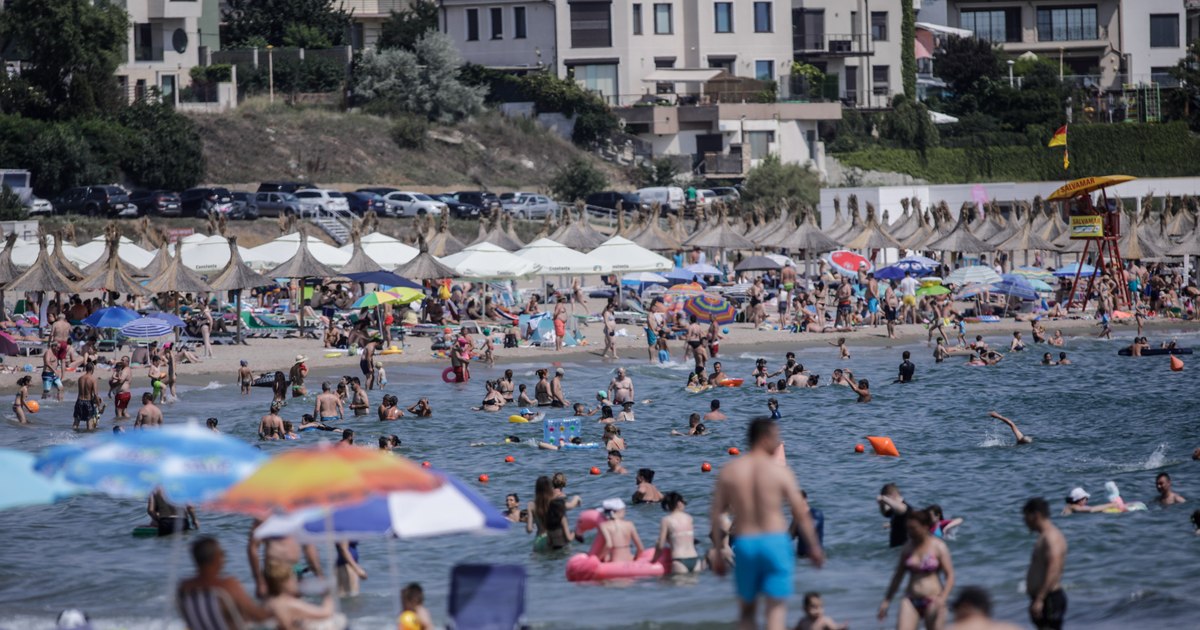
The UV index has reached a record high in recent years, and dermatologists warn that even high-protection sunscreens cannot effectively deal with this dangerous radiation. Specialists recommend avoiding exposure to the sun between 10 a.m. and 4 p.m., but beachgoers continue to stay on the beach, fearing they will lose their favorite spots.
Tourists refuse to leave the beaches between 10-16 – PHOTO Inquam Photos George Călin
The coast is on alert for ultraviolet radiation, with the UV index reaching level 8 out of 15, one of the highest thresholds in recent years. In such conditions, even creams with the highest sun protection factor can be ineffective.
Tourists stay on the beach from morning until after noon to secure their places, despite the danger caused by the very high UV index, amplified by the breeze that gives a false sensation of coolness. UV index values above 6 are extremely dangerous, experts warn, according to Antena 3.
In these conditions, sunscreens, even those with factor 50+, do not provide sufficient protection. Sun exposure can lead to serious health problems, including burns, allergies, and the risk of skin cancer.
“In the case of exposure to the sun, medical problems, lesions leading to skin cancer, sunburn, redness, allergies after exposure to the sun may occur during this period. In the case of children, heat stroke with vomiting, headaches, dehydration can occur and in severe cases it can also lead to cerebral edema and death“, warns Diana Tatarici, SAJ Constanța spokesperson.
Despite warnings, tourists ignore the risks of ultraviolet radiation, relying on sunscreen and water for protection. Dermatologists point out that no cream completely blocks UV rays, and exposure can lead to burns and severe health risks. On the seaside, tourists can have free dermatological consultations, where last year more than 30 cases of skin cancer were detected.
Risk of skin cancer
Romanian doctors are increasingly worried about the increase in the number of cases of melanoma, the most aggressive form of skin cancer.
More than a quarter of patients discover the disease in advanced stages.
“Cutaneous melanoma is an important public health problem, as over 25% of patients with this diagnosis are already in advanced stages of the disease”it is stated in a press release of the Federation of Associations of Cancer Patients.
Excessive sun exposure, especially in the first 15 years of life, and family history are major risk factors. Also, those with light skin, blue eyes and red or blonde hair are more vulnerable.
Specifically, more than 90% of melanoma cases are closely associated with exposure to ultraviolet rays, either from natural sources such as the sun or from tanning devices.
In 2022, more than 2,200 new cases of melanoma were diagnosed in Romania. Although the state bills immunotherapy, the treatment fails to save all patients. Regular mole checks and proper use of sunscreen are essential for prevention.
“Melanoma is more common in the elderly, but young people are also at risk. Melanoma is the most common form of cancer in people under the age of 30 (especially women).“, according to the Stop-Melanom website.
In 2020, skin cancer accounted for 4% of all new cancer cases diagnosed in the European Union and 1.3% of all cancer deaths, according to the European Cancer Information System.
Protection methods
“Exposure to ultraviolet radiation (from the sun or from artificial sources, such as tanning beds) is considered a risk factor of a similar magnitude to the risk represented by smoking for lung cancer. (…) Always make sure that both UVA and UVB radiation are written on the packaging of products with SPF protection and reapply every two hours especially when you are at the beach or pool, because the exposure increases dramatically and thus the risk of developing melanoma. Sun protection is essential not only on the beach, but also in daily activities, as UV radiation can penetrate clouds and windows“, explained Delia Nicoară, specialist in public health from the Oncological Institute “Prof. Dr. Ion Chiricuţă” Cluj-Napoca, according to Agerpres.
To protect yourself from excessive sun exposure, follow these methods:
1. Look for the shade: Between 10 a.m. and 4 p.m., sit under trees, shades or canopies.
2. Wear a hat: Opt for a wide-brimmed hat (5-7cm) to cover your face, head, ears and neck.
3. Protect your skin: Choose clothing with compact fabric; avoid transparent materials.
4. Use sunscreen creams: Apply an SPF of at least 30, broad-spectrum and waterproof.
5. Wear sunglasses: Choose glasses that block almost 100% of UVA and UVB radiation.
