
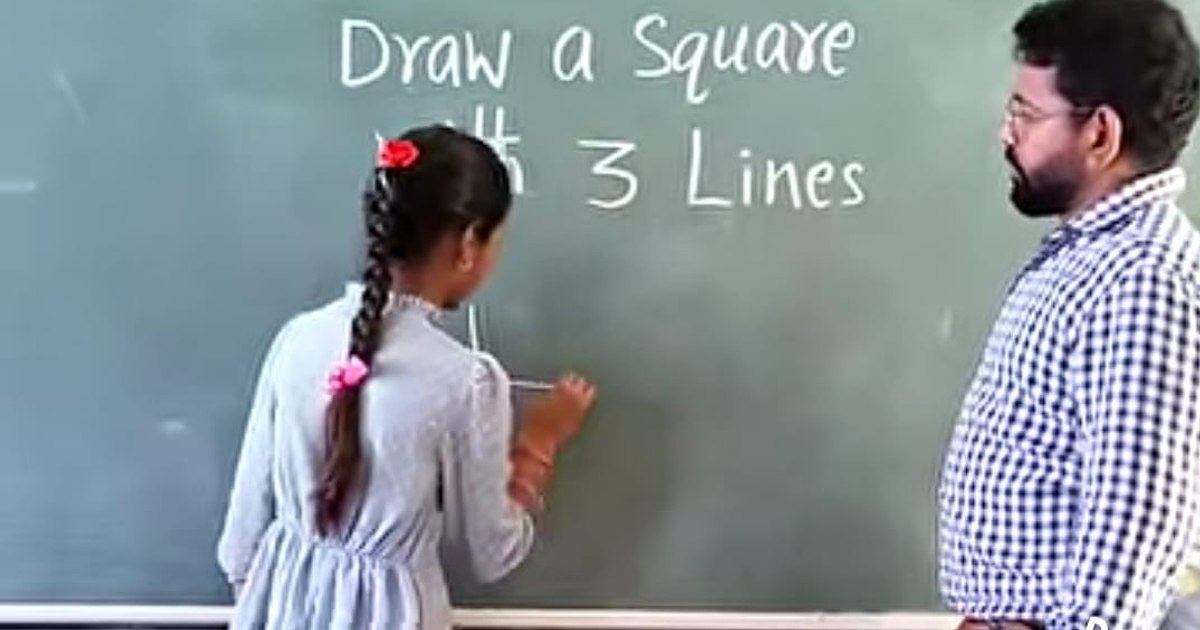
A teacher in India, Raviraj Master, posted a seemingly simple but impossible problem for his students.
The children took turns at the board to try to solve the problem. One by one, the students drew three lines, which of course did not form a square. One student ingeniously drew three sides of a square with lines and the fourth side with a dotted line. This move demonstrated creative thinking, but it was not the solution.
Finally, a student approached the board, drew a square with all four sides, then drew three lines inside it. That was all. He had drawn a square with three lines. The problem was solved.
Critical thinking about wording
The solution is so simple that most people miss it. It’s not that it’s difficult, it’s that our brain interprets the cue in a certain way and goes ahead with that interpretation. It’s an excellent lesson in critical thinking about how a requirement is formulated and what is being asked for
For example, “Draw a square using three lines” would be a totally different request from “Draw a square with three lines”. Just that one word difference changes the possible meaning of the question. What if the teacher had asked, “Is there another way to interpret these words?” Proactively analyzing each word to see if it might have a different meaning makes puzzles like this a little easier, Upworthy writes.
However, the lesson goes far beyond simple riddles.
The logical fallacy of equivocation or ambiguity
Take, for example, the logical fallacy of equivocation, also known as the fallacy of ambiguity. The use of words with multiple meanings can lead to multiple interpretations of statements.
In the given riddle, the word “with” could mean “using”as most students interpreted it. But “with” can also mean “accompanying” as used in the actual solution.
Politicians use ambiguity very often. Philosopher Justin D’Ambrosio called it “manipulative sub-specification”. Using terms that can be interpreted in multiple ways gives politicians plausible deniability if you disagree with them. They may simply say they meant something else. Even important concepts like justice, equity and democracy are under-specified terms, which allows politicians to easily use them in slogans or short phrases without elaborating on what they mean.
Ambiguity can also be used to manipulate people through the media. Brochure “Propaganda techniques in mass media” by Sharon Haigler and C. Anneke Snyder of Texas A&M University lists 12 media propaganda techniques. Look at number 10:
Understanding ambiguity can help us understand each other
It is wise to think critically when it comes to wording, whether we are trying to solve a simple logic puzzle or serious social and political issues. Pay attention to vague words. Ask yourself what different definitions or interpretations there might be for ambiguous terms.
On the positive side, being aware of words with multiple meanings can sometimes help us understand the point of view of others. Sometimes disagreements are due to different definitions of a word rather than a real problem. So many words in our social and political discourse require definitions before we engage in discussion. Otherwise, we risk talking without listening to each other instead of having a meaningful discussion.
