
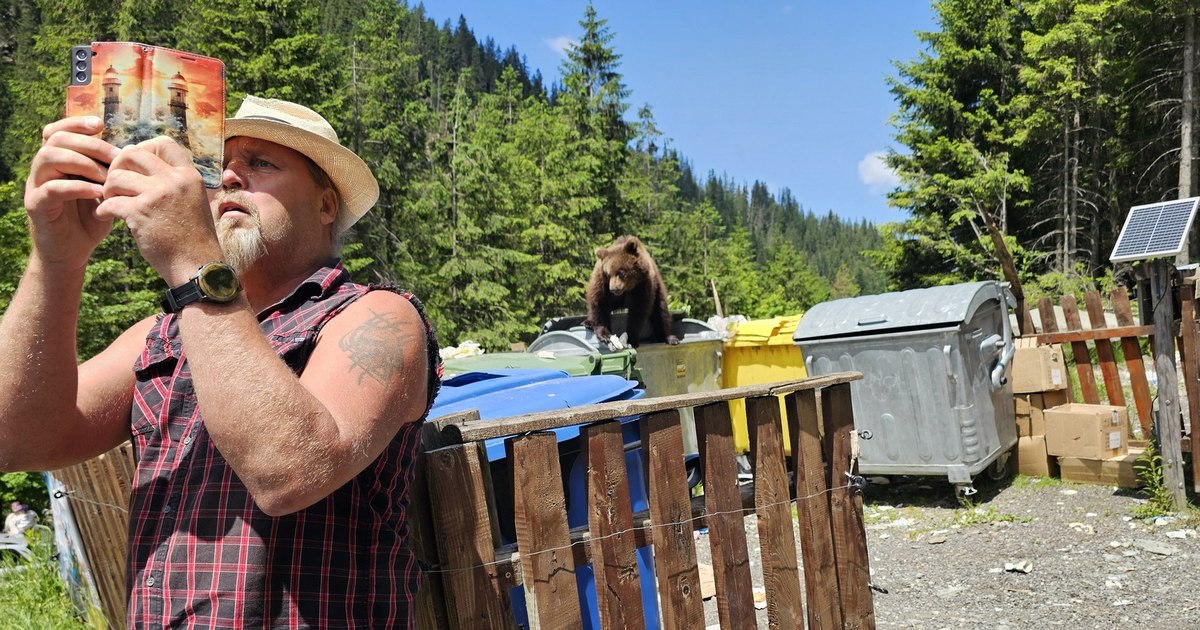
Along with his belvedere points and Bâlea Glaciar Lake, the bears remained one of the great attractions of Transfagărășan, the mountain road that connects the counties of Argeș and Sibiu, crossing the Făgăraș mountains at heights of over 2,000 meters.
A foreign tourist taking pictures of a bear. Photo: Daniel Guță. TRUTH
Although the entire route of the national road 7C is crowded with informative panels by which tourists are warned not to feed the bears and not approach the wild animals, many of the travelers cannot refrain from such gestures.
Bears, masters of tomb
Even when they do not receive foods directly from tourists, bears manage to get food, either invading crowded parking lots on the edge of Transfăgărășan, where tourists leave food scraps and packaging, or giving the garbage dumps, passing over the electric wire fences.
In the Bâlea Cascada area, often crowded with tourists, a wild animal has gathered around it a lot of curious (video – truth), while he was scouring through the dumps. For a few minutes, the bear descended from the forest researched each tonet with garbage, removing from some bags with altered food, yogurt boxes and other processed foods, considered harmful to animals.
Some tourists have tried to make selfies with the bear, even though, recently, other travelers suffered, being injured after approaching the wild animals on Transfăgărășan. After finding some “supplies”, the bear from Bâlea Cascada slipped among the cars, returning to the forest.
For many of the guests of Transfăgărășan, the bears remain the main attraction of the trips, along with the panoramas in the Făgăraș Mountains.
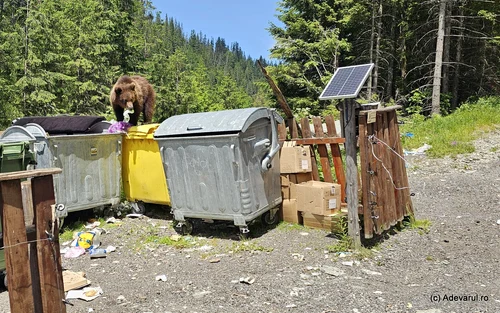
Image 1/15:
Bear on Transfagărășan photo Daniel Guță Adevărul (156) JPG
“On the motorcycle, this road must be dreamy! I and my wife I went with a car with a manual transmission and it was a great experience-spectacular landscapes and a lot of bears along the route. We have often stopped photographing bears. It costs a lot of lives, but we, the 21st century, can now enjoy a spectacular mountain road, which rival the best in Italy and Switzerland ”, He writes a Canadian tourist, in a review on the Tripadvisor online platform.
Another tourist from Germany notes the ingenuity of wild animals, advising travelers to keep the windows of cars closed.
“For bears, an open window is like an invitation. They are already so clever that they block the road and one of them comes to the window after food. We have not given them anything, because they get used to it. And so they become permanent ‘researchers.”he says.
And other foreign tourists notice the beauty of the road, but they ask those who go through the bears.
“One of the most beautiful roads. If you go from north to south, the view is absolutely amazing, but if you want to see the bears first, then you have to go from the south to the north. Please do not feed the bears!”was the message of another foreign tourist.
Transfăgărășanul, the road built by the military
Transfăgărășanul (DN 7C) was built in just four years, through the considerable efforts made by thousands of people, most of them military, mobilized by the communist regime for works of public interest. In order to reduce the costs of the investment, the state leadership in charge of the Romanian army with the realization of the road.
The road (video – truth), with a length of over 150 kilometers, crosses the Făgăraș Mountains from north to south, linking Bascov (near Pitești, in Argeș county) to Cârțișoara (in Sibiu county). In the alpine area, over 30 kilometers, the road crosses the Carpathians through the Bâlea Calărea in the Făgăraș Mountains, ascending to an altitude of 2,042 meters, near Lake Bâlea. It was inaugurated in September 1974 by Nicolae Ceausescu and is considered one of the most complex road infrastructure works carried out before 1990, the difficulty being given by the injured mountain relief.
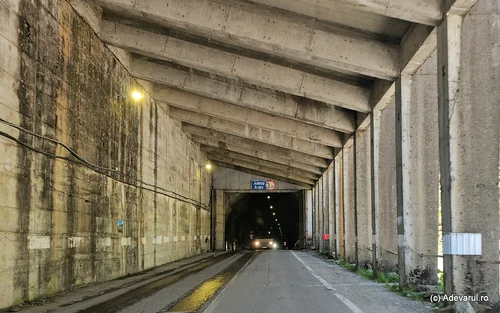
Image 1/15:
Transfagărășan photo Daniel Guță Adevărul (85) JPG
For the construction of Transfăgărășanului, four million cubic meters of rock were excavated, 28 bridges and viaducts were made, as well as 550 bridges. Bâlea – Capra tunnel, with a length of 884 meters, was made between 1972 and 1974, near Lake Bâlea, being one of the most difficult art works on the route.
For its completion, over 41,000 cubic meters of stone were dislocated and 20 tons of explosive were used, the workers having to work under difficult conditions, including in winter. Snow and viscol frequently caused papers. In the winter of 1973, 180 people remained blocked in Bâli’s boiler due to the blizzard, the intervention of the heavy machines to save them.
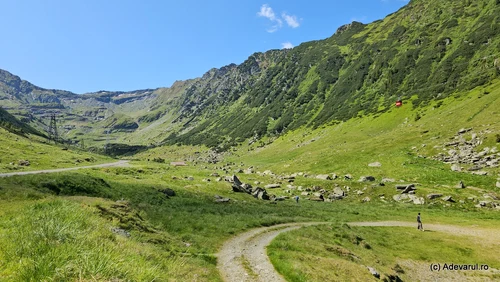
Image 1/15:
Transfagărășan photo Daniel Guță Adevărul (28) JPG
Transfăgărășan was inaugurated in the autumn of 1974, and in the coming years it was fully asphalted. The road remains closed to traffic most of the year, except for the summer period.
