
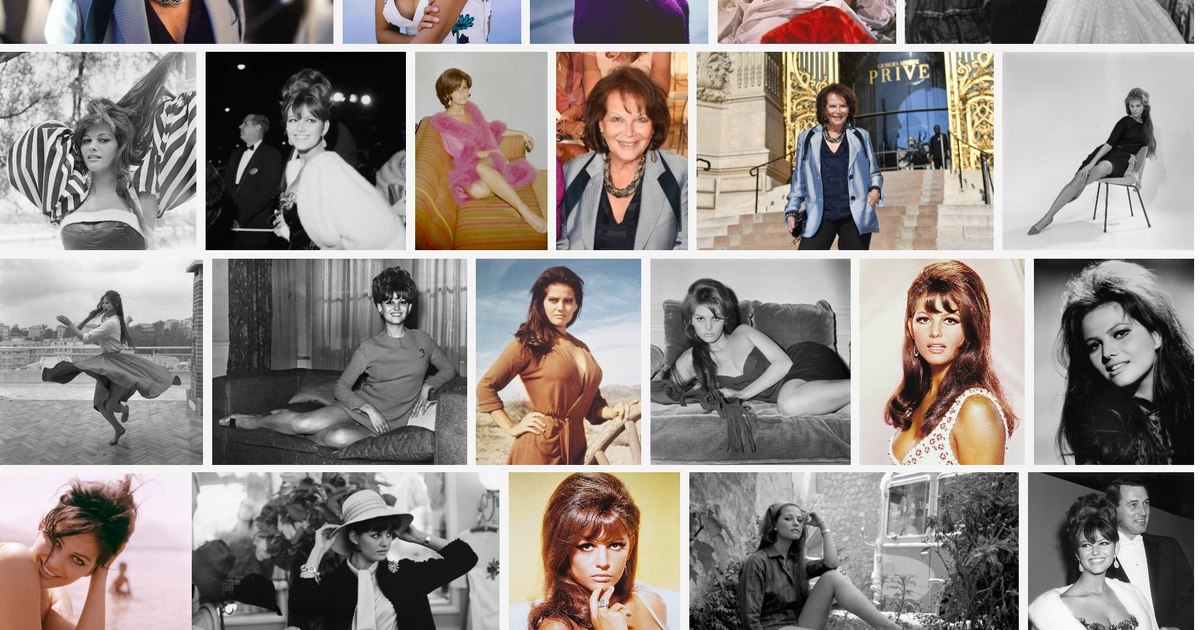
Claudia Cardinale, one of the last great gods of world cinema, died on Tuesday, September 23, 2025, at the age of 87, in Nemours, near Paris. The actress with an unmistakable smile and magnetic grace was more than a reachable appearance on the screen: she embodied the charm of a golden age of the film.
Born in 1938, in Tunis, in a family of Italians, originally from Sicily, Claudia Cardinale entered the fascinating world of the cinema almost by chance. After winning a local beauty contest was sent to Venice Film Festivalwhere the great studios immediately noticed its exotic allure, different from everything that offered to Italy. From there, her fate was quickly written, in the most spectacular way possible.
Throughout his career, the cardinal has fascinated by a unique elegance, different from the direct passion of Sophia Loren or the intensity of other Italian dives. It has always remained the symbol of discreet refinement and mystery, turning every appearance on the screen into a memorable experience.
Claudia Cardinale in Getty Images collage images
The cheetah – the emblematic role of the Cardinal Claudia
In 1963, Luchino Visconti offered the role of life when he distributed it in Il Gattopardo (cheetah)next to Burt Lancaster and Alain Delon. Cardinals, in the role of young Angelica, became the image of an Apuse era – the Italian aristocracy – and the symbol of a reborn beauty. cheetah She is the masterpiece that wrote history – she crowned Claudia Cardinale as a queen of Italy.
The chroniclers wrote then that no other actress could have transmitted, through a simple look, the mixture of strength and fragility that marked the character’s destiny.
Washington Post notes that his presence in the film “It radiates energy and vitality”turning each scene into a visual work. For many, that great waltz between cardinals and Delon remains one of the most beautiful sequences in the history of cinema.
It was once in the West – the peak of the European Western – Claudia Cardinale, femininity and force
In 1968, Sergio Leone offered the role of Jill in Once Upon a Time in the West / C’era one Volta Il West (once in the west). Claudia Cardinale embodies “The only woman in a world of hard and violent men”suitable Reutersbut also dust and weapons – and that is why its role has gained a historical force.
Her character remains a manifesto for the strong and independent femininity, which conquers not through the gun, but through intelligence and mystery. It was the moment when Cardinals became a global star, with a colossal success in America.
“8½” – Claudia Cardinale, Fellini Muza
Federico Fellini has always known to bring to light the hidden faces of its actors, and Claudia Cardinale turned it into a cinematographic dream 8½ (1963). It appears more as a vision, an idealized projection of femininity, than as a character.
Entertainment Weekly write that for Fellini she embodies “The image of the inaccessible woman, a mixture of strength and fragility, reality and reverie”. As a result, the film became one of the absolute masterpieces of world cinema, and the cardinal remained the eternal museum.
Claudia’s Claudia’s career, between art and legend: a world of world cinema
Over over five decades of career, Claudia Cardinale has played in Over 140 productionsspeaking fluently three languages - French, Italian and English – and always remaining a hypnotist presence. He built a unique career, often refusing roles that did not respect his dignity or that would have reduced his status to simple “Screen diva” -a rarity in an industry dominated by compromises. Reuters notes that this verticality precisely brought the respect of the industry.
In an era of manufactured dives, Cardinals remained authentic. “I never wanted to be a star. I just wanted to be an actress”the Italian diva said in an interview. And that was exactly: an actress who went beyond time and screen.
Today, the world celebrates it more than ever. His films did not die, but live more intensely than ever.
Great actors next to whom Claudia Cardinale shone
On the screen, Claudia Cardinale was not just a charming presence – she was a magnet for the cinematic talents of her time. In cheetahevery step of her on the dance floor with Alain Delon the pulsing of elegance, while Burt Lancaster was looking at her with admiration – a scene that remained emblematic for the history of the film.
In Was once in the westthe dust and the scorching sun merged with Jill’s mysterious gaze, and Henry Fonda and Jason Robards seemed eclipsed by the subtle force of Claudia’s character. Each silhouette, each movement transmitted more than the replicas – power, intelligence, pure femininity.
And then 8½, Where Fellini turned each frame into a dream: Claudia and Marcello Mastroianni, face to face, their silence speak more than words, and their chemistry made each scene printed in memory.
Jean-Paul Belmondo, Peter O’Toole, Charles Bronson-the list of big screen partners is long, but each was just a frame in which the cardinals shone with its unique charm. With each collaboration, she not only divided the scene, but turned it into cinematic magic.
Cardinal Claudia’s inheritance in cinema
Claudia Cardinale is no longer among us, but her films continue to pulsate on the big screens and in the hearts of cinema lovers.
From Rocco her Suoi Fratelli (Rocco and her brothers, 1960) and The Pink Panther (pink panther, 1963), up to At Ragazza con La Pistola (girl with Pistol, 1968) and Fitzcarraldo (1982), Cardinale has shown that he can navigate any genre – from sophisticated comedy to historical drama and adventure film.
It was not only a beauty of Italy, but a symbol of universal elegance, a legend that wrote its name in the history of world cinema. Claudia Cardinale was more than a beautiful face: she was a woman who redefined femininity on the big screen, a presence that shone beyond time.
Today, Romania – just like the whole world – cries and celebrates it. Because, in fact, Claudia Cardinale did not die: she lives in every frame, in every reply, in every look she has left us.
