
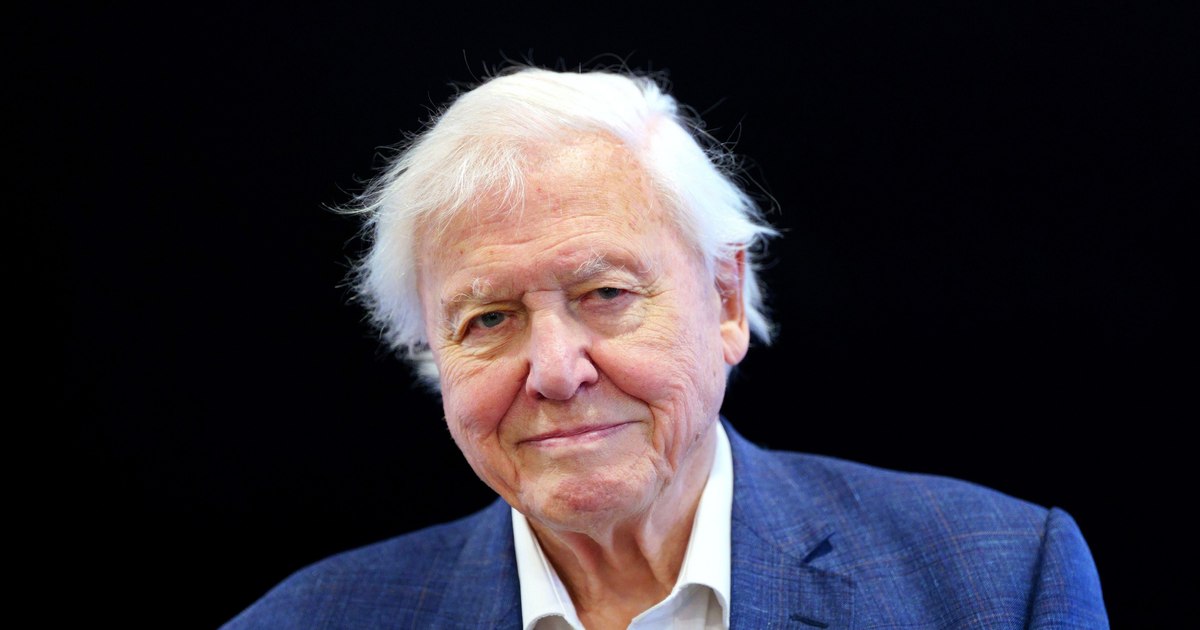
The legendary Sir David Attenborough made an emotional statement about the approach of the end of his life, at a prominent moment that accompanies the launch of his new documentary “Ocean”, broadcast on the occasion of 99 years, on May 8.
Sir David Attenborough Photo Profimedia
Arrived at a venerable age and with a career of over seven decades in television, Attenborough, the voice of the planet, reflects lucidly on the fragility of marine ecosystems and on one’s own mortality.
“When I first saw the sea, as a boy, was considered a vast wildness that had to be mastered for the good of mankind. Now as I approach the end of life we know it’s exactly the opposite”, Said the parent of documentaries about wildlife.
After almost a hundred years live on this planet, I came to understand that the most important place on Earth is not the land but the sea
He stressed that oceans are essential for life on Earth and has drawn an alarm about their critical state. Attenborough retains its hope, stating that the regeneration of oceans is possible if humanity acts immediately:
“I would lose any trace of hope, if there was no one of the most extraordinary discoveries – the fact that the sea can recover. If we save the sea, we save the planet. ”
https://www.youtube.com/watch?v=cizadctkt_g
The documentary presents spectacular images and recent discoveries in the marine world, but also the hard reality of current degradation. The series also includes historical sequences, such as its first diving in the great coral barrier, in 1957.
“My life coincided with the era of great ocean discoveries. I witnessed the disclosure of undead species, of complex epic migrations and ecosystems, of amazing beauty“Says Attenborough.
Although almost every state in the globe has signed an agreement to protect one third of the oceans, Sir David draws attention that paper commitments are not enough:
“Now the real challenge begins – let’s turn those promises into facts.”
The Ocean series: With David Attenborough is broadcast on Discovery+ and reiterates the deep message that the naturalist transmitted throughout his entire career: nature is a miracle that we can lose, but also save, if we choose to act.
The beginnings of a legendary career
Sir David Attenborough became known in the 1950s, when he was chosen to present the documentary series “Zoo Quest”, after the initial filmmaker became ill. The series, broadcast until 1963, transported British viewers in distant corners of the world and launched the career of the young naturalist.
The consecration came in 1979, along with “Life on Earth”, a revolutionary documentary that transformed into a global name. They followed iconic series such as “The Living Planet”, “Planet Earth” and “Frozen Planet”, all benchmarks in the history of nature television. His work inspired generations of presenters and documentation filmmakers.
Beyond his career, the great love of David Attenborough was his wife, Jane Oriel, who was married for 47 years. The two had two children together, Robert and Susan, both now around the age of 50.
Jane died in 1997, at the age of 70, following a brain bleeding. At that moment, Sir David was filming the series “The Life of Birds” in New Zealand, but managed to reach her head before it was extinguished. In his memoirs, Life on Air, Attenborough described the pain of loss:
He shook my hand. The center of my life, my anchor, disappeared … I was lost
In an interview with The Guardian in 2017, he confessed the regrets to the time spent away from the family because of the filming:
“I was leaving for three months. If you have a six or eight -year -old child and you lose three months of his life is an irreplaceable time. I missed something. My dear wife always understood this. ”
