
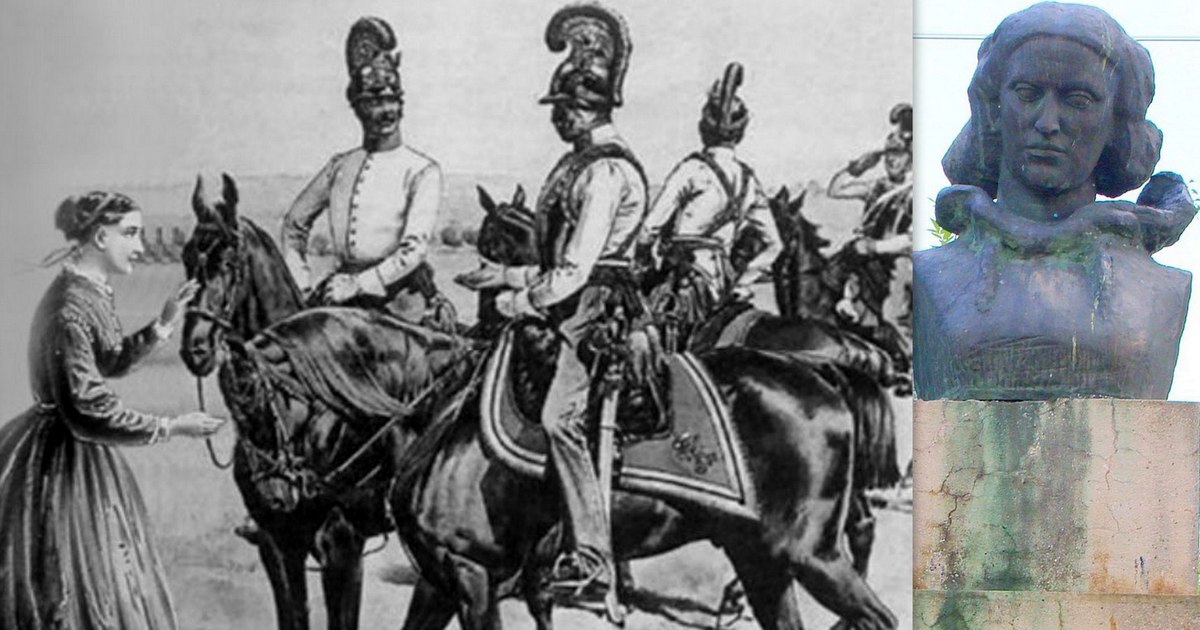
Ecaterina Varga, the woman who entered the legends of the inhabitants of the villages in the Apuseni Mountains, was Hungarian and was contemporary with Avram Iancu. Her controversial story had a disturbing end.
Ecaterina Varga. Source: illustrated by the time / wikipedia.
Tranapusean (video), the new mountain road that crosses the Apuseni, linking the area of Abrud and Roşia Montani to that of Aiud and Mureș Valley, offers the opportunity to travel through one of the archaic lands of the Moors, endowed with numerous monuments of nature.
Apuseni Mountains, Legendary Places
Detonates and Gorges of Râmețului are the most famous tourist attractions of the route, but its charm is also complemented by the traditional villages of the Apuseni.
The picturesque settlements have brisked households on the peaks, with old houses covered with straw, which adorn the hills of the rocks or the wide horizon of the Mureș and Abrud valleys. The road between Aiud and Bucium, recently entered the tourist circuit with its modernization, reveals not only picturesque landscapes and settlements, but also places loaded with legends.
One of these is Bucium, a commune in the vicinity of Abrud, with about 1,200 inhabitants and 30 villages – natives of the Apuseni. These are: Anghelești, Church, Bucium, Bucium-Sat, Cerbu, Ciuculești, Coleșeni, Dogărești, Ferești, Florești, Gura Izbitei, Helești, Izbicioara, Izbita, Jurcurești, Lupulești, Măgura, Munari, Petreni, Poiana, Poiana Negrilesii, Poienii Valley, Valea Sessii, Văleni and Vâlcea.
Famous for his gold mines, exploited since ancient times, Bucium commune was also a landmark of the roller led by Horea, Cloșca and Crișan. In the tradition of the place it is said that, in the late autumn of 1784, here, in Fericet (Bucium-Sat), Horea, the captain of the rebels, would have ended in Alba Iulia.
The woman who conquered her on the moths
In the villages of Bucium commune served the Greek-Catholic priest Ion Agârbiceanu (1882-1963), known by his novels that realistically describe the life of the Moors in the harsh lands of the West. Also here he was a teacher Ion Pop-Reteganul (1853-1905), a publicist and folklorist who sensitized the life and traditions of the Moors.
Along with Horea and Avram Iancu, the most famous character in the legends in Bucium is Ecaterina Varga (1802-1852), also nicknamed “Mrs. Moților”, the noble established here from the Brasov lands, which became before the 1848 revolution of the communities in Apuseni at the Imperial Court in Vienna.
Ecaterina settled in Bucium around 1840, and until the outbreak of the Civil War of 1848 was the man who gathered the petitions and memories of the locals to present to the Government of Transylvania and the Emperor.
“She was a beautiful lady, in the power of her age, with her right and honest gaze. On the day after her arrival in Bucium, the” lady “, after the holy service, spoke in the church. He told the people gathered there that she has long knows the sad fate of the Moors, that she lived in her childhood in these places, and then, enlarging with a lawyer in Vienna, where she had spent more than twenty years, she knows that there, at the kingdom, the Moors are loved and that, indeed, from above. There, but in Vienna, the emperor had to be sought and demanded! She came now in the midst of the people to guide him: how and in what way to reach the emperor ”, the publicist Ion Rusu Abrudeanu reported.
The lady of the moths, guarded by the locals
Ecaterina Varga lived in a cottage in Bucium-Izbita and quickly gained the appreciation of the locals. He taught the people to have patience, not to despair, for justice will rise like sunlight, the historian Ion Rusu Abrudeanu.
“Then he started through the villages in the mountains to investigate and gather documents about the situation of each: what lands, pastures, me and forests were taken from the villagers by the state servants – Germans and nourished Hungarians. Where he met a man too much, he helped: He taught them how to take care of them, how to cure them of diseases through the right cleaning and food. the publicist who lived in Abrud described plastic.
Ecaterina managed to obtain audiences to the Habsburg Emperor Ferdinand I of Austria, in which he exposed to him the troubles of the Moors and the rights requested by the locals on the lands, pastures, forests and mines. He returned to Apuseni with promises, which were no longer respected by the Vienna Court. However, his steps have transformed it into an authority cherished by the locals.
“This extraordinary woman exercised a charming power over the population of Bucium. The people here, although they had priests, teachers and other wise people, out of his breast, still did not listen to the stories of any of the leaders, but only by Varga Caterina. This personality was regarded as the only one,note Ion Rusu Abrudeanu.
The house where he lived was guarded by the locals, and people offered them protection in front of the enemies he had made representing the interests of the Moles.
“He was a 40-year-old woman, a medium stature; her face was red-brown. She often changed her clothing, bearing when she reigns, when in peasant clothes, traveling either on foot. They loved that they were able to sacrifice their lives for its defense ”, Hungarian writer Iakab Elek (1820-1897) described.
Abducted from Apuseni
In 1844, the Transylvanian authorities decided to arrest the “lady of the Moors”, but their steps were stopped by the opposition of the locals. Meanwhile, Ecaterina continued to travel to Vienna to represent them. Finally, through a siretlic, the nobleman could be arrested.
On January 6, 1847, the priest Andrei Șaguna, the Orthodox Vicar of Sibiu, and George Pogány, the sub-prefect of the lower Alba county, reached Bucium-Izbita, where the community celebrated Boboteaza, in the village church. After officiating the job, Andrei Șaguna invited Ecaterina for a four-horsepower ride.
“The population followed from a distance, so that the vicar can speak quietly with the” lady of the mountains “. The people were happy to see Caterina Varga as honest, especially since the authorities were looking to catch her. Arrive in the sled, the bishop invited her to take place, saying that she was going to be at the table prepared by the priest Suciu. The woman, unable to suspect anything, climbed the sled, and the horses started. However, after a while, the horses followed the road to Abrud, and not to the priest’s house. The people realized the race and began to shake. Caterina Varga tried to escape, jump from the sled. Vain. Desperate, she began to shout, “My children, do not leave me!” The horses in the crazy chase were crossing the road to Abrud and then to Zlatna. The buzzers, riding their sprints, were trying to get out. All the efforts were futile: Caterina Varga was lost forever ”, informs the historian Ion Rusu Abrudeanu.
The newspapers of the time of 1847 reported on its arrest.
“Catrina Varga, which still in 1840 was shown in the village of Bucium, from the county of Alba de Jos, said that it had been the emperor, then had been sent to ease the inhabitants of the task of the tasters. By its tools, she made a kind of people of the people, and she was attracted to the village, and they were attracted to the village. to the owners and had drawn on his side even on the priesthood.noted the Romanian Albina newspaper, in 1947.
The authors of the article added that seeing that its influence could be harmful to public peace, especially in an era in which the peasants’ duties were lit, and assuming the arrest of this woman could bring even a disorder, a path, through a stratagem. “Thus, she was taken to the prison in Alba, where she was waiting for her fate decision,” added the newspaper.
Ecaterina was sent to the prison in Alba Iulia, then to the one in Aiud, where time was held without being judged. Some authors claimed that it was released in November 1849 and forced to return to its native place the village of Hălmeag, from Brașov county, and not to step through Apuseni.
Ecaterina Varga, unknown fate after release
Other historians claim that it had been imprisoned until 1951. In the meantime, the 1848 revolution had elapsed, which would make thousands of victims in Transylvania.
“” The lambs forgot about her. Who to think about in the vifor of such days, at a lost maid in prayer. Maybe they forgot it altogether, if after the bloody days the authorities would not need every corner of the prisons. With her. informs Hungarian historian Victor Aradi (1883–1937).
According to him, the documents were lost and only after long research the authorities could find out what had been arrested.
“A long correspondence between the Troops Command, the Fortress Command, the Șaguna and the provisional court in Alba Iulia. prison. On February 10, 1851, the Court of Appeal approves the decisionshe, ”informs Hungarian historian Victor Aradi (1883–1937).
After being released from prison, the fate of Ecaterina Varga is not known.
“Hungarian writer Aradi Victor, who gives the most exciting pages about the sufferings of the martyr in prison, claims that she would have lived for more than six years. note Ion Rusu Abrudeanu.
Other authors showed that he had returned to his native village, Hălmeag, from Brașov county, where he would have lived until 1858.
