
The way we look, the way the skin and hair, the appearance of the eyes or neck look can sometimes indicate that we suffer from a thyroid problem. Endocrinologist Ruxandra Dobrescu explains what to pay attention to.
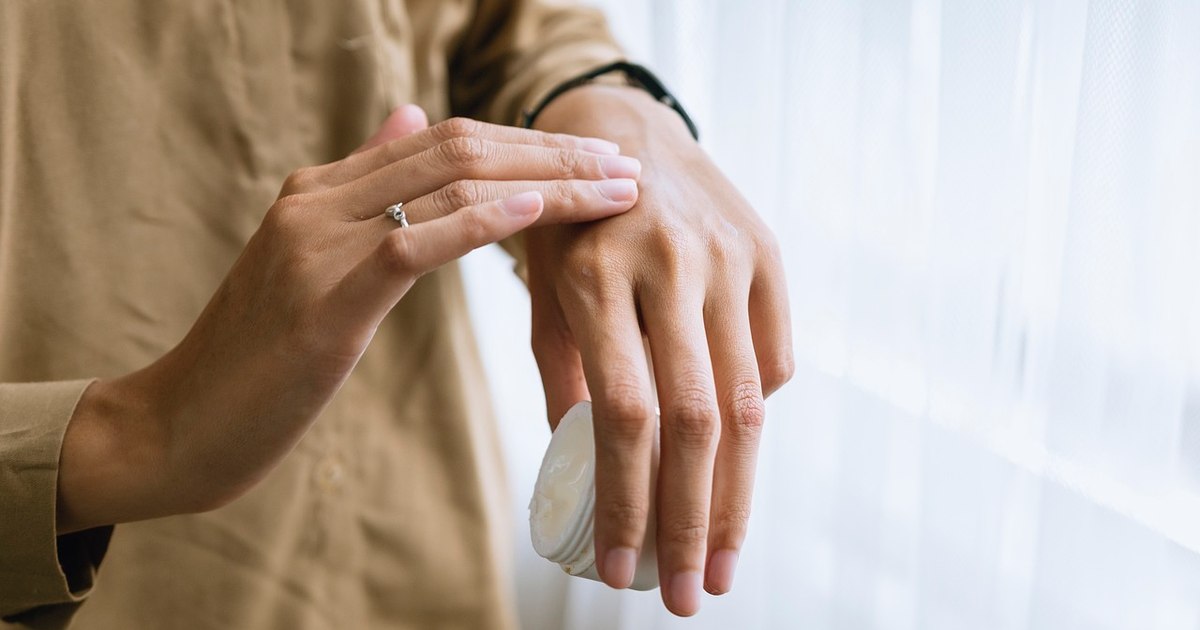
Dry skin can be a photo alarm signal: Pixabay
Sometimes the disease can be read on the face, we hear this saying, and in the case of certain conditions there are really obvious signs. Endocrinologist Ruxandra Dobrescu explains, in a video posted on his YouTube channel, how we can notice that something could be wrong. In people with thyroid dysfunctions, explains the doctor, changes in the skin, hair, heart, general, psychic level, and all these things can lead to certain suggestive characteristics for hypothyroidism or hyperthyroidism may occur.
Changes in the skin and hair level
People with hypothyroidism, ie a thyroid hormone deficiency, also have changes in the skin, which has a lower regeneration rate. “The skin tends to become dry and cold, including because of vasoconstriction, it is a low blood flow to the extremities and the skin is cold. It is dry, because it decreases the secretion of sebum and sweat, that is, sweating, and can be pale or even yellow, especially in people who associate a degree of anemia that can also occur in the context of hypothyroidism ”explains the doctor. In the case of the same condition, the skin tends to be dry and rough. By thickening the keratin layer, a hyperkeratosis can occur in the skin, especially at the extension areas, such as the outer face of the palms, shows the doctor Ruxandra Dobrescu.
The skin can thus gain an ash appearance and sometimes a specific aspect of “scales”.
In the case of hyperthyroidism, which is the opposite situation, due to the excess of thyroid hormones the skin is very warm, wet, sweaty. It happens because the metabolic processes are accelerated, the blood flow to the skin is increased, and the skin has a typical appearance. It is warm and soft, like baby skin, detailing the endocrinologist. A person with hyperthyroidism sweats a lot to try to maintain a normal body temperature.
Changes occur, both in the case of hyperthyroidism and hypothyroidism, and in the hair and scalp.
“The hair can be dry, fragile and can have a tendency to fall, sometimes very important. We can speak of a diffuse alopecia, in which the hair tends to fall everywhere from the level of the scalp, but we can also have situations of alopecia, ie areas that run out of hair, in which case a visit to the dermatologist deserves, because they can appear in an autoimmune context. Also, if we talk about a person with thyroid dysfunction, that is, hypothyroidism or hyperthyroidism through autoimmune mechanism, that is, we speak of an autoimmune or thyroiditis hashimoto, or a person with Basedow disease, which is the variant of hyperthyroidism through autoimmune mechanism, in these situations we can have some typical changes to another level Autoimmune diseases, such as vitiligo – and these are those white spots on the skin, which do not color in the sun ”, the doctor explained.
When the hormone deficiency is extremely, it may seem edema, that is, infiltration of the subcutaneous tissue, at the skin, at the level of the dermis, giving a shepherd appearance of the skin. The appearance of edema can be seen at the level of the face, at the level of the eyelids, at the lower limbs.
Many years ago they were more common, the doctor Ruxandra Dobrescu also revealed, situations of hypothyroidism so severely that the voice was thickened. “It was said by the classic endocrinology books that a hypothyroidism in this severe can be diagnosed by the phone, that is, only after the patient’s voice ”the doctor pointed out. Today, such cases are rarely encountered because patients are presented early at the doctor, an advice that doctor Ruxandra Dobrescu gives to those who have the suspicion that something is wrong.
When double vision may occur
Thyroid dysfunctions can show signs, some of them very suggestive, and at the level of the eyes.
“I was saying that a person with severe hypothyroidism can have edema even in the eyes, in the eyelids. On the other hand, a person with hyperthyroidism has a characteristic appearance of the eyes, with a palpebral retraction of the upper eyelid, that is, the eyes seem big, because the excess of thyroid hormones leads to the stimulation of the sympathetic nervous system that leads to this feature of the gaze, which becomes, with great eyes and a fixed look. In addition, a person who has hyperthyroidism through autoimmune mechanism, ie by Basedow disease, can have a specific manifestation in the eyes that is called Graves ophthalmopathy ”, Dr. Dobrescu also explains. Complications can sometimes be serious and require a consultation with an ophthalmologist competent to treat such pathology.
“In the very severe situations diplopia may occur, that is, the musculature that moves the eyeballs is so inflamed that they do not move properly and then the person cannot synchronize the eyes through the two eyes and a double view appears. Also, in severe situations this exophthalmia may be so severe that the eyelids are no longer close and this becomes an ophthalmological emergency, because it leads to corneal dryness and together with the changes that appear in the optical nerve, that is, the nerve that ensures our vision, can lead to the severe phases until blindness. warns the doctor.
Changes can be observed, by simple examination, in the mirror if it is their own person, and at the neck. We can see a much increased volume thyroid or we can notice a distinct formation, a knot. Such findings can be done by themselves, examining us in the mirror, or a situation often encountered, someone from our entourage notes a change.
“As an idea, we can see at least an eye if it is a problem with the thyroid looking in the mirror, with your head a little back. We try to swallow and swallowed we should see how a little thyroid ascension and can become visible, a thyroid formation ”indicated the doctor.
Thyroid imbalances can also give us mood changes. A person with hypothyroidism often has a state of lack of energy, fatigue, apathy, focuses hard, forgets things, has no desire and can be noticed a tendency to depression. “On the other hand, someone with hyperthyroidism, because of this accelerated metabolism, often has precisely opposite states, agitation, nervousness, sometimes with panic attacks, tremor of extremities, things that can also suggest a problem. the doctor says.
Dr. Ruxanda Dobrescu draws attention that many of the aforementioned changes (dry skin or hair loss, for example) are nonspecific, and the simple fact that we notice is not equivalent to having a problem like thyroid dysfunction.
“We do not diagnose only what we see in the mirror, of course, but if we have suspicion it is important to go to the endocrinologist, it is important to do some analyzes; If we suspect a very important thyroid nodular formation is to do a thyroid ultrasound, because thyroid nodules are very common and it is important to know about them, especially because, although this happens, a node can hide a thyroid cancer. So let’s be a little vigilant and when we suspect a problem, we are not, we are going to look for! ”the doctor advises us.
