
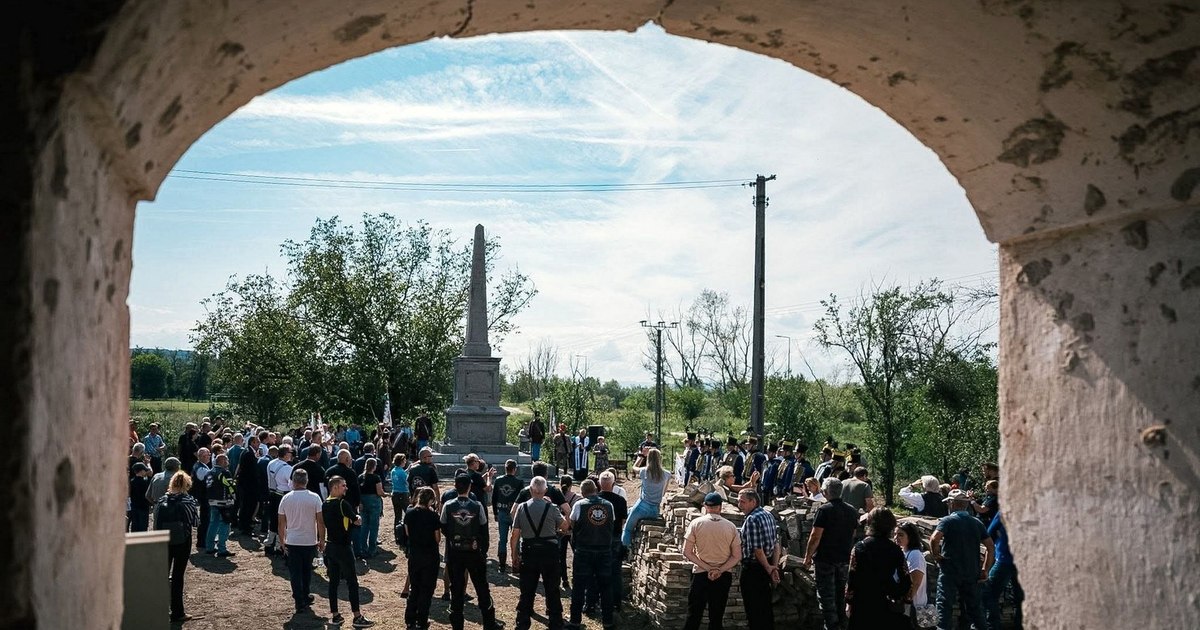
The Hungarian community in Transylvania gradually recovers its historical vestiges, abandoned in recent decades. Several important monuments for Hungarians, ruined in the 20th century, were restored. A deep -meaning obelisk was rebuilt from the foundations.
The monument from Simeria. Photo Budai Honvédek. Facebook
The monument erected in Simeria Veche in memory of the hundreds of soldiers fallen in the battle of the bridge over Strei in Simeria Veche was rebuilt by the Hungarian community after more than a century since its ruin.
The Hungarian soldiers’ monument, restored to the grounds
The obelisk, almost ten meters high, had been erected in the 19th century to pay homage to a dramatic episode of the Transylvania Revolution 1948 – 1949.
“If the bridge is lost, Transylvania is lost,” General Józef said before the battle of Piski in 1849, and then, together with his soldiers, defended Transylvania. The decisive collision between the Honvéd army and the imperial one took place on February 9, 1849, in the area of Simeria Veche. Polish Józef Bem, the Honvéd army defended the bridge with great sacrifices, preventing the troops commanded by General Puchner to cross him.“, Informs” Budai Honvédek “, the page of a Hungarian historical reconstruction association, present at the inauguration of the monument.
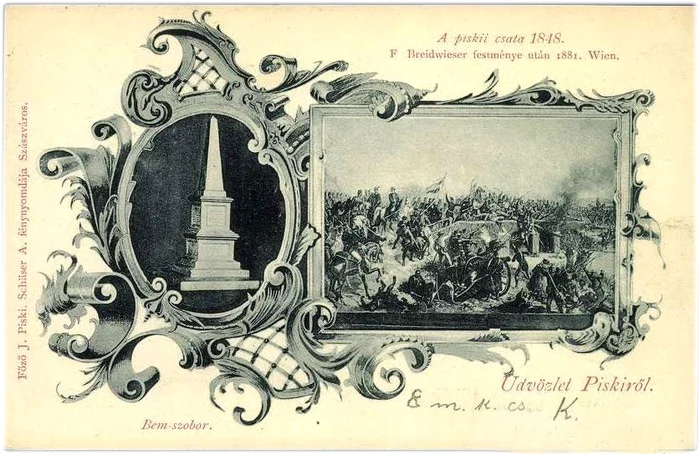
Illustrated with the monument in the 1900s. Wikipedia
The confrontation between the Austrian troops supported by the Romanians loyal to the Imperial Court, who wanted to advance on the Mureș Valley to Timișoara, and the Hungarian troops of Polish General Józef Bem, who were trying to withstand the assault, carried out around the bridge over the River Strei, a wooden bridge at that time, about 35 meters. A few hundred meters below, Streiul is poured into the Mureș River.
The battle of Simeria Veche
Following the fights at the bridge over Strei, according to historians, between 600 and 1,500 people, from both camps, died.
However, the troops led by General Józef Bem forced the Habsburgs to withdraw and advanced on the Mureș Valley, towards the center of Transylvania. General Bem was to be defeated on July 31, 1849, in the battle of Albeşti (near Sighisoara), by the Austrian armies supported by Romanians and Tsarist forces, and on August 13, 1849, his army surrendered to Syria, near Arad.
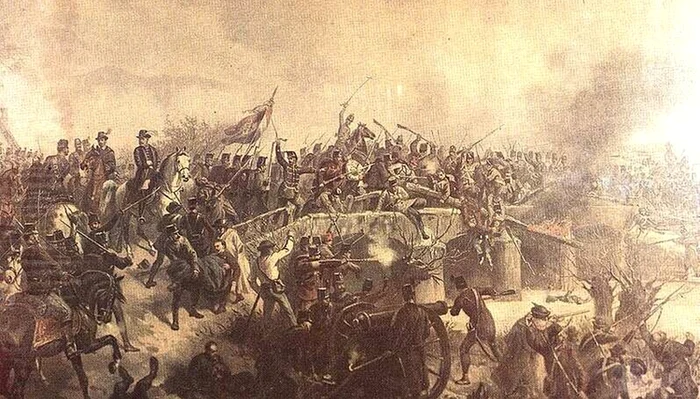
The battle of Simeria Veche. 1949. Illustrated by the time
Shortly, Emperor Franz Joseph and Austrian commander Julius Jacob von Haynau decided exemplary punishments for the Hungarian leaders. 13 generals of the revolutionary army were convicted of high treason and executed in Arad, on October 6, 1849. They are considered in Hungary Martyrs of Freedom, and the date of their death is a national day.
Their leader, Józef Bem, fled to the Ottoman Empire, where he converted to Islam, together with 72 officers and 6,000 soldiers, subordinated, according to historians. He took his name as Amurat Pasha, in honor of the Sultan in which he had entered and was appointed governor of the Syrian province. However, he died, a year later, at the age of 55.
The “Budai Honvédek” Association recalls that the monument erected in honor of the soldiers fallen in the battle of Simeria Veche was torn down in 1919, and the stone blocks have been buried until today, kept by locals and subsequently handed over for restoration. Many of them weigh over several thousand pounds.
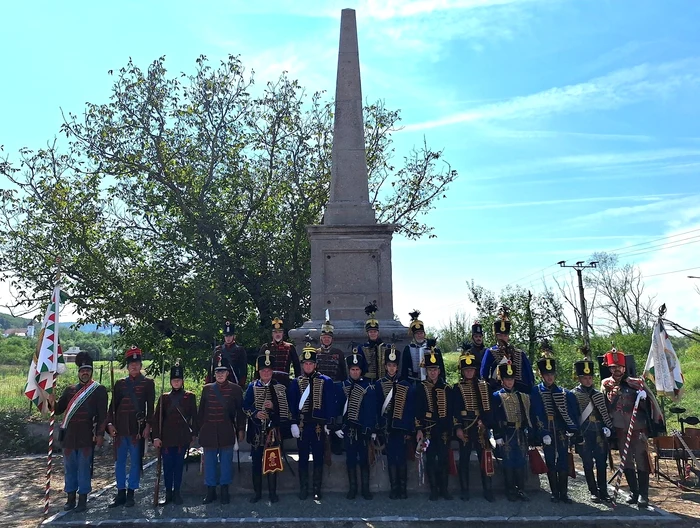
Simeria Old Monument Source Budai Honvédek Facebook
“Obtaining the authorizations lasted for years, but in the end the 59 stone blocks could be restored, replacing the missing parts and the monument being reassembled. On the top of the obelisk were placed the four crown stones, and the nine-meter high monument goes to the sky, to the god. The official inauguration of the complete monument is scheduled for February 7, 2026 ”, shows “Budai Honvédek”
Franciscan Father Csaba Böjte, the leader of the Saint Ladislau Foundation and the promoter of the redevelopment of the battlefield from Simeria Veche and the restoration of the monument, called the revived obelisk “Pillar of Hope VII”, adds the representatives of the association.
The old inn, become a memorial park
The monument is located in the park of the former inn on the banks of Strei in the places where the victims of the 1849 fights were buried. The “Piski” In the Simeria Veche worked since the eighteenth century. He was consumed by the servants, together with the rest of the rods on the banks of Streiului, during the peasantry led by Horea in the autumn of 1784 and devastated once again during the 1849 battle. Later, the building used as a customs Habsburg.
On February 9, 1849, the Austrians were then stopped to continue their way to the city of Deva and Arad, from the Mureș Valley, by the Hungarian troops led by Józef Bem.
“Around the bridge was a terper body fight, with large losses on both sides. The Württemberg Hussars collided with the Szekler Hussars, and the cannons bouncing for hours. The whole of bloody struggles, the imperial army had not been able to pass the water.the historian Balás György reports.
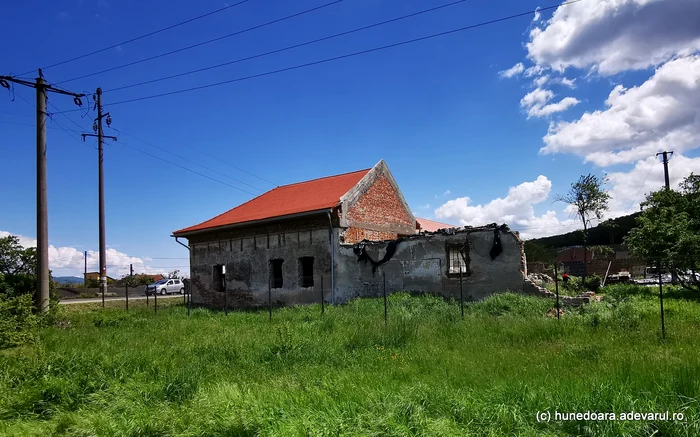
The place of the Piski inn. Photo: Daniel Guță
In the 20th century, the inn was nationalized and was used as a collective agricultural household. After 1990, his buildings and land were retrocessed, but in the following years they remained in comparison. Nearby, you can see remains of the old wooden bridge over the Strei River, permanently destroyed during the First World War. The place loaded with history from Simeria Veche was bought by the Saint Ladislau Foundation, founded by the Franciscan monk Csaba Bojte. He announced in 2021 that he intended to transform the former inn and his two-hectare land into a memorial place.
Restored monuments sought by Hungarian tourists
In recent years, several historical buildings and monuments with significance for the Hungarian community have been restored and have become tourist attractions, especially for visitors in Hungary. Some, such as Nopcsa Castle at the foot of Retezat, were rehabilitated by the Romanian state, their rightful owner.
The red bastion of Ilia, the birthplace of the Transylvanian Prince Gabriel Bethlen (1580 – 1629), administered and restored by the St. Francis Foundation in Deva. It is now one of the most visited places by the Hungarian tourists who arrived in western Romania.
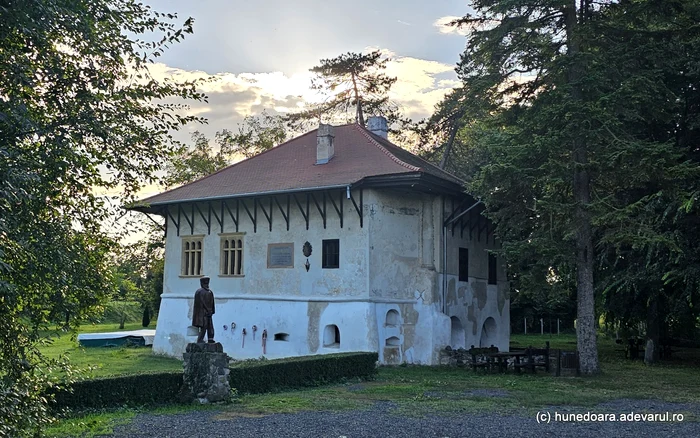
The red bastion of Ilia. Photo: Daniel Guță
Although in Geoagiu, the Hungarian community also includes a few people, the city – resort is increasingly sought after by Hungarian tourists, due to its two medieval monuments, restored in recent years with the help of the reformed diocese.
The rotation in Geoagiu dates from the 11th-19th centuries and is among the oldest churches in Romania.
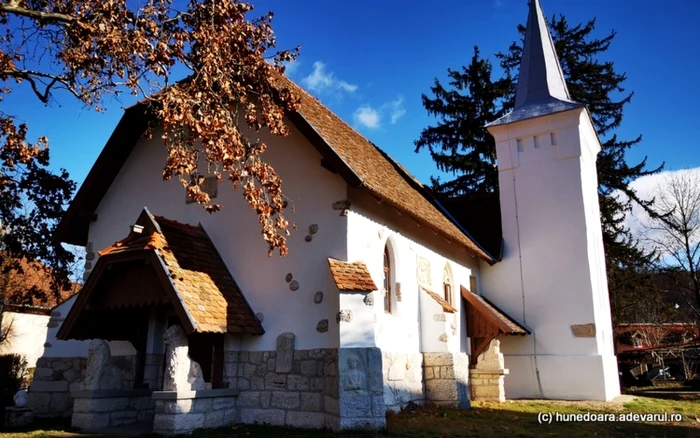
Reformed church in Geoagiu. Photo: Daniel Guță
In his beginning, the Rotonda would have functioned as a church and probably fortification, but from the 13th century, it would have become a chapel, after the current reformed church in Geoagiu, a monument that kept in its walls precious vestiges was erected.
