
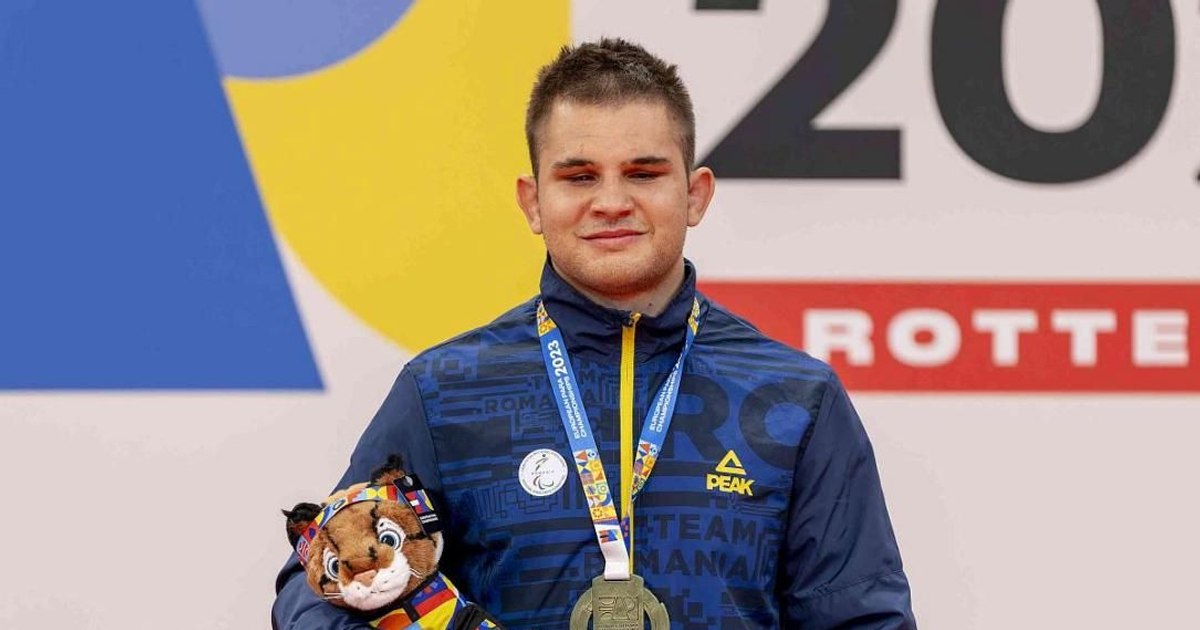
Alex Bologa has not seen since he was 7 years old, the age at which he left home. He is struggling with the problems of life in a country that is not very friendly to the blind and has trained hard for the last three Olympics. However, he has never complained about his situation, and even looks at it with humor.
Alex Bologa won the gold medal in judo at the Parlympic Games in Paris. PHOTO: sportsnet
The Romanian athlete Florin-Alexandru Bologa won the gold medal in judo for the blind, cat. 73 kg (J1), on Friday, at the Paralympic Games in Paris, after defeating the Kazakh Iergali Shamei in the final, by ippon.
For Bologa (28 years old), this is the third medal at the Paralympic Games, after the two bronze medals obtained in 2016, in Rio (category 60 kg), and in 2021 in Tokyo (category 60 kg).
Sportsman trained by Gergely Tamas, Bologa has four consecutive European titles, being European and world champion en titre.
Alex Bologa has been training for more than 15 years “at the factory of champions from Cluj”, the judo hall of Florin Bercean, which gave Romania the most judo champions.
Alex narrated, about two weeks ago, in an emotional podcast his impressive story, but also how he trains, has fun and what his dream is.
He lost his sight in childhood. He left home when school started
“I lost my sight completely at the age of 6-7. I was recommended to study at a special school for the blind, I come from a village in Sălaj county, the nearest school was in Cluj-Napoca“, Alexandru tells his interlocutor, Răzvan Cuc.
He lost his sight gradually, the problems starting from the age of 2-3 years, and by the age of 7 he ended up not seeing at all. “I had a botched operation in Belgium and after that I basically stayed the way I am now”. The athlete completely lost his sight.
He started his sports career with swimming, which he practiced for 2-3 years: “At the age of 13-14, through a selection at the special high school for the visually impaired, I was selected for a group of children who practiced judo. Pretty late I could say.”
He spent most of his life in boarding school, practically since he started school he moved away from home. “The first time at school I did judo, but later I started training here in this gym (hall of fame Florin Bercean-no)“Alex explains.
The athlete says that he found judo interesting because he learned different moves at each training session: “There is a great complexity of movements in judo. I mean you need very, very much study, you can never say: “now I know everything”. You always have something new to learn.”
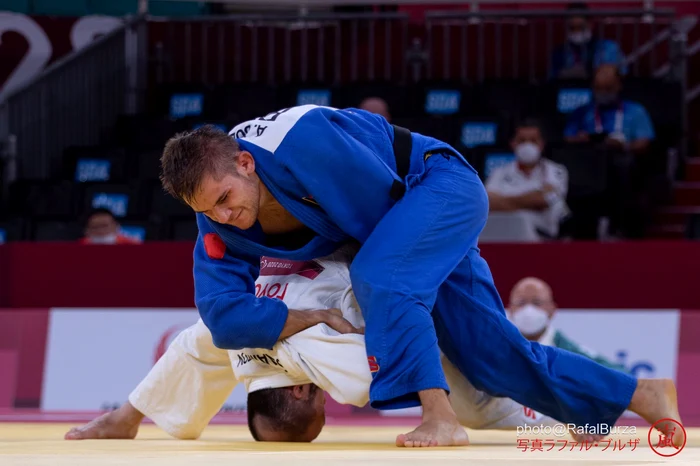
Photo from the athlete’s Facebook profile. PHOTO: Rafa Burza
How a blind judoka fights
Alexandu explained how a blind judoka fights. He started judo training with the blind in the early years, but then and even today he trains with sighted athletes. Asked if a sighted judoka has an important advantage over him, the athlete claimed: “If we start from the socket, then you and I are about equal. The only adaptation of judo for the blind is that the fight starts from the socket (athletes are in contact-no), the rest is the same. I feel the movement that the opponent makes, if he moves his leg I feel that he has changed his center of gravity, if he raises his elbow I feel.”
Alex says that the shock of living in a world without light was not so great for him, because he lost his sight at a very young age and did not get to make a certain perception of the world.
Life for a blind man
Alex says that in order to manage in everyday life, he memorizes certain routes, from home to the store, to the pharmacy, to the gym. “When you go along a certain route, you take visual landmarks: a pole you see, a sign. I need tactile, sound cues, I orient myself by smell sometimes. A hole, a pillar, anything, a certain texture of a wall, a smell”he explains.
Signaling for the blind in Romania, in this case in Cluj-Napoca where he lives, is quite deficient, he explains, amused: “At the pedestrian crossing, sometimes the acoustic signals of the traffic lights are not well matched and sound wrong, when it is red, not green. You ride the trolley and the driver turns on the audio system that announces the stations mid-way. Or a tactile carpet is built on the sidewalk, and the worker who installs it, and doesn’t know what it’s for, puts it in such a way that you end up in the fence”.
In the West, he says, things are better set up.
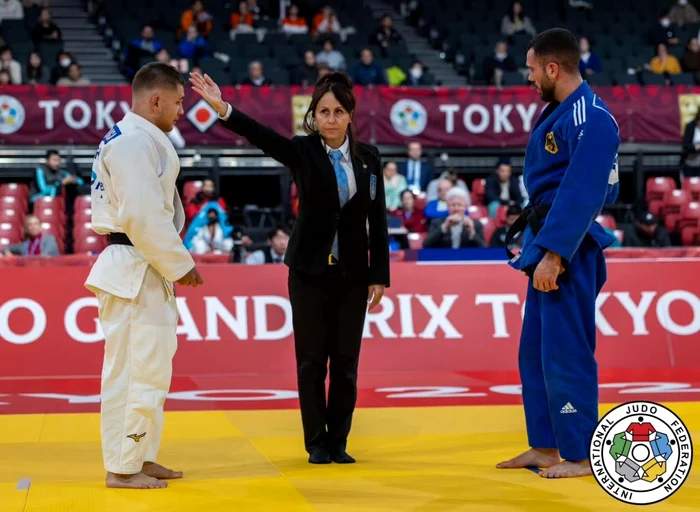
Alex Bologa is a feared opponent.
How to win gold in the Olympics
The actual preparation for an important competition takes about 6 weeks – two months, Alex explains. There are two trainings per day. The overall preparation for the Olympics takes years. “During the last two months the detailed training is done because only then do you know the athletes you will be fighting. You build the basic preparation in years, the preparation for each opponent is done a few weeks before. We do video analysis, the coaches watch the matches and show me what the opponents are doing, how they won, how they lost, every detail. We come to the gym, practice them and look for training partners who physically resemble the real opponents, but also in terms of the competitor’s fighting style.”
In the context where all fighters study each other, surprises are very important. “He knows what I do, so I always have to come up with something new. We try to surprise him with something else. Always come up with new things because, like in any field, if you don’t bring new things at some point you stop making progress.”
In addition to explosiveness, technique, strength, to win a fight you need intelligence and creativity to know when to apply the move that brings you victory: “There are 64 standing and 36 ground techniques that come combined. You can do four leg bound techniques to finish in one attack. Or you can only have one direct attack. So it depends a lot on the strategy you have. You do a large part of the strategy beforehand, but if it doesn’t work out, you improvise, because you have nowhere else to go. You have to be able to change the strategy”.
Alex believes that in order to win you have to be as calm as possible, so that you can be focused on what you are doing. He claims that one of his weaknesses is his emotions at the beginning of the match, because he does not know what awaits him: “Fear of the unknown. I’m thinking: what will he surprise me with? Many times this stresses me out at competitions”.
His strength is that he trusts himself: “I tell myself that as I solved the previous times, I will solve it now. Sometimes I get energized watching the fights I’ve won,” he says.
In addition, the mental state during the match is also important: “I think you have to be as calm as possible in the match, to be able to be as focused as possible.”
Also, he says, it’s important to listen to your coach. “He is on the sidelines and can give you instructions during the match: what to do; what procedures to try; opponent’s position. The way you manage to put into practice his instructions from the sidelines is very important”.
“Victory is like a drug”
Asked what motivates him to come to the demanding training day in and day out and do it now for his third Olympics, Alex replied: “What you like, you can’t get bored. It’s like a drug, that is, once you get the taste of victory or medals, you want more and more victories and medals. Basically when you’re, especially at the Olympics, where the most important competition in the world, where basically the best are there and you know you’re the best of the best, then that’s motivation.”
The athlete claimed that motivation also depends on what you aim to achieve at the Olympic Games.
“First of all, I set myself a better result than in the two previous editions. At least the silver. That’s my goal because to achieve more, you have to set a bigger goal”he concluded.
Alex not only met his goal, but exceeded it!
Alex Bologa’s lesson. “What are you doing, me, why aren’t you working out?”
Alexandru Bologa graduated from the Faculty of Psychology, specializing in special psychopedagogy. “I can’t say now that what I studied helps me a lot as a performance athlete. I think it will help me in the future, because I want to deal especially with the sports side of athletes with disabilities, and I think that through the studies I have I will be able to do that.”
Asked what he regrets not being able to do being blind, he promptly replied: “To drive, I would like to drive the motorbike (motorcycle-no). I still go with the coach, but it’s different when you drive”. Alexandru also likes hiking in the mountains.
The most impressive thing about Alex and the lesson he gives us, beyond the enormous amount of work he puts in to perform, is that he doesn’t complain about his situation and the hardships of everyday life on which has it in Romania.
He speaks with serenity, optimism and even has a very developed sense of humor, being able to make fun of the fact that he is blind.
“It also happened to me here, in the gym. There’s a training dummy back there. The other day, I went up to him and said, “What are you doing, me?” I felt something down there and I said, “What are you doing, why aren’t you training?“, he said laughing.
