
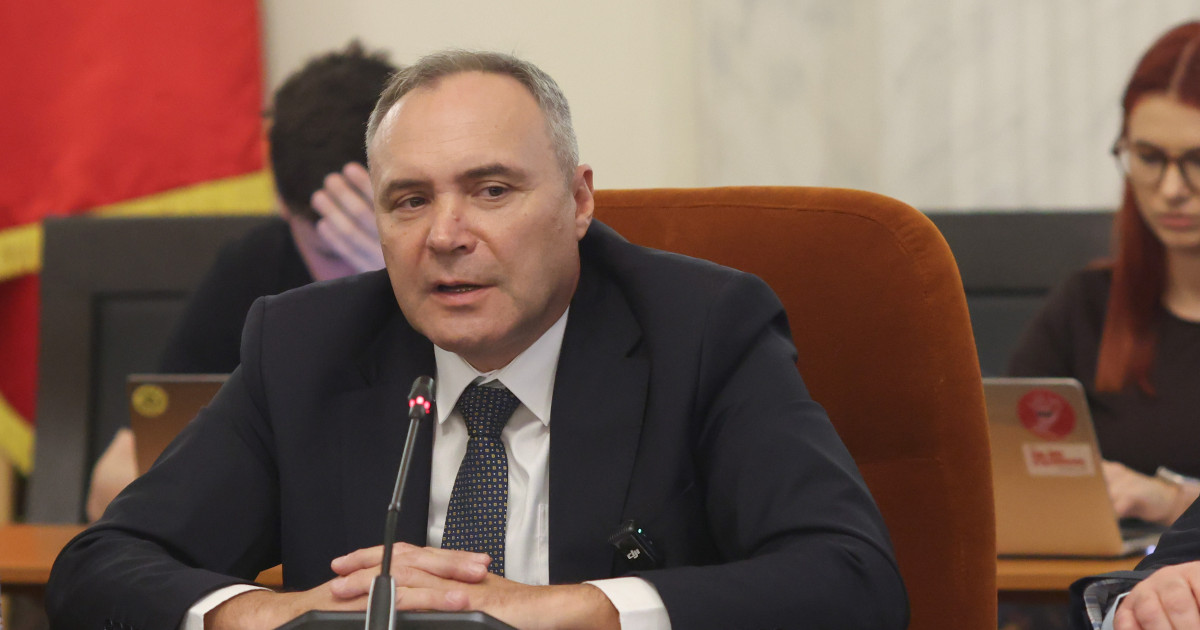
The final bills for natural gas could decrease by approximately 10% from April 1, 2027, if the project prepared by the Ministry of Energy will be applied in its current form, Dumitru Chisăliță said on Tuesday, at the presentation of the balance sheet of the first month of his mandate. The estimate only takes into account the reduction in the administered price of gas, and the evolution of tariffs, taxes and suppliers’ margins could change the final result.
The draft ordinance, in decisional transparency since November 16, would apply between April 1, 2027 and March 31, 2028 and ensure the gradual transition from the current administered system to the free market.
“The Emergency Ordinance, applied as we thought, will cause a potential decrease in the price to the final consumer. Why do I say potential? Because we deal strictly with the goods side. An evolution of tariffs, taxes or the trade margin of the suppliers can overturn the calculation we made. But, actually taking into account the administrative price that we set, we believe that the final price should decrease compared to what there is currently about 10%. The measure will enter into force on April 1, 2027, with applicability until March 31, 2028,” said Dumitru Chisăliță.
During this period, suppliers would sell a certain percentage of gas to households on a monthly basis under the conditions established by the new mechanism, so that the transition to the free market would be gradual.
“Slowly, within a year, consumers must move from this administrative phase to a free phase, simultaneously with information and information dissemination measures,” explained the minister.
For non-domestic consumers, transitional measures related to energy efficiency and access to financing are analyzed.
“We believe that a transitional measure must also be applied to non-domestic consumers. We are considering a series of measures that will come together with the development of energy efficiency activities at the level of these consumers, through credits that will reach them, so that they can reduce their energy consumption and costs and be better prepared for the next period,” said Dumitru Chisăliță.
The Ministry of Energy has also submitted to the Ministry of Labor proposals for the continuation of the current support for vulnerable consumers in the winter of 2026-2027 and for the subsequent transition to a system that more precisely determines who needs help and how much.
“The scheme we have proposed can come up with a unique and fair approach for consumers depending on income, issues related to the geometry of the house, medical issues and so on. Our proposal is to think of a dynamic approach so that the number of vulnerable consumers will decrease by 50% in ten years,” the minister said.
Chisăliță believes that a support of 50 lei could cover the needs of many consumers, but he did not present the formula according to which future aid will be determined. In February 2026, of the 1,016,852 applications for electronic energy tickets registered in the EPIDS application, 724,847 met the eligibility conditions.
In parallel, the Government established an interministerial committee that will analyze all components of the final price and look for solutions for the cold season.
“The price of energy is not an exclusive element of the Ministry of Energy, because we have, in addition to the price of the commodity, the transport, distribution and storage tariffs, which belong to ANRE, but also the fiscal measures that make up the final price. This committee brings together all the parties, not only the Ministry of Energy, but also the other institutions, to identify concrete solutions and to come up with prices that benefit both domestic and non-domestic consumers”, explained the minister.
New production and storage capacities
In addition to the measures on invoices, the balance sheet of the first month included the preparation of the Winter Command, the investments from Cernavodă and the commissioning of some new capabilities.
“This month, thanks to the intensification of the supervision and the discussions we had with the distribution operators, with ANRE and with the producers, we managed to achieve 100 megawatts of new production capacities, respectively 36 megawatts of new storage capacities. We are considering that, by the end of the year, we will reach somewhere around 1,500 megawatts of storage capacity in Romania, through the activities carried out both in terms of investment, through the Ministry Energy, as well as private”, said the minister.
At Cernavodă, the procedures for re-technologically upgrading Unit 1, preparing the projects of Units 3 and 4 and resuming the activities for the detritus facility were expedited.
“Specific activities were carried out both for the restart and commissioning of the equipment, as well as for the prevention of similar situations, through actions carried out by the Ministry of Transport, us and Nuclearelectrica, so as to avoid the situations we had this summer and which caused a significant amount of energy not to be in the system”, declared Dumitru Chisăliță.
In the last month, meetings were also held with the Ministers of Energy from the states of Central and Eastern Europe and from the Caucasus area, for the resumption of some regional projects. Chisăliță cited a report presented in Warsaw in which the wording “Romania has been put back on the European energy map” appears.
“We found 850 late contracts”
Another chapter of the balance sheet concerned the accumulated delays in the contracts managed by the ministry and the payments made in the last month.
“When we arrived at the ministry, we found a lot of delayed contracts. We are talking about 850 contracts, some with delays of up to a year. We carried out intense activities and this month we managed to make payments for contracts worth 200 million euros. Until the end of the year we intend to continue these payments, so that we are up to date,” said the Minister of Energy.
The Ministry technically completed the documentation for the development of offshore wind energy and resumed the procedures for approving some infrastructure projects for the transport of natural gas, including investments by Transgaz that were blocked.
The balance sheet also includes the draft amendment to the Electricity and Natural Gas Law no. 123/2012, by which the producers would conclude bilateral contracts for 50% of the available energy, and the suppliers would buy through such contracts 30% of the necessary.
“We are talking about a 50% obligation for producers and a 30% obligation for suppliers to purchase these amounts of energy, with the aim of increasing liquidity on the market and, at the same time, lowering the price of energy,” said Dumitru Chisăliță.
For state-owned energy companies, general competence criteria were also initiated for holding positions in the boards of directors and supervisory boards, given that many mandates are due to expire in 2027.
Asked if he supports the transfer of ELCEN to the Capital City Hall, the minister replied that he is not opposed to the takeover, provided that legal procedures are followed: “There is this concern and this analysis. It is not a procrastination, there are some legal procedures that must be completed. The Ministry of Energy is in the phase of carrying out certain activities according to the law, and this procrastination, from my point of view, is not supported, taking into account the legal provisions for certain operations that must be carried out. As long as the takeover is carried out in compliance with the legislation and legal procedures in force, I do not see a problem”.