
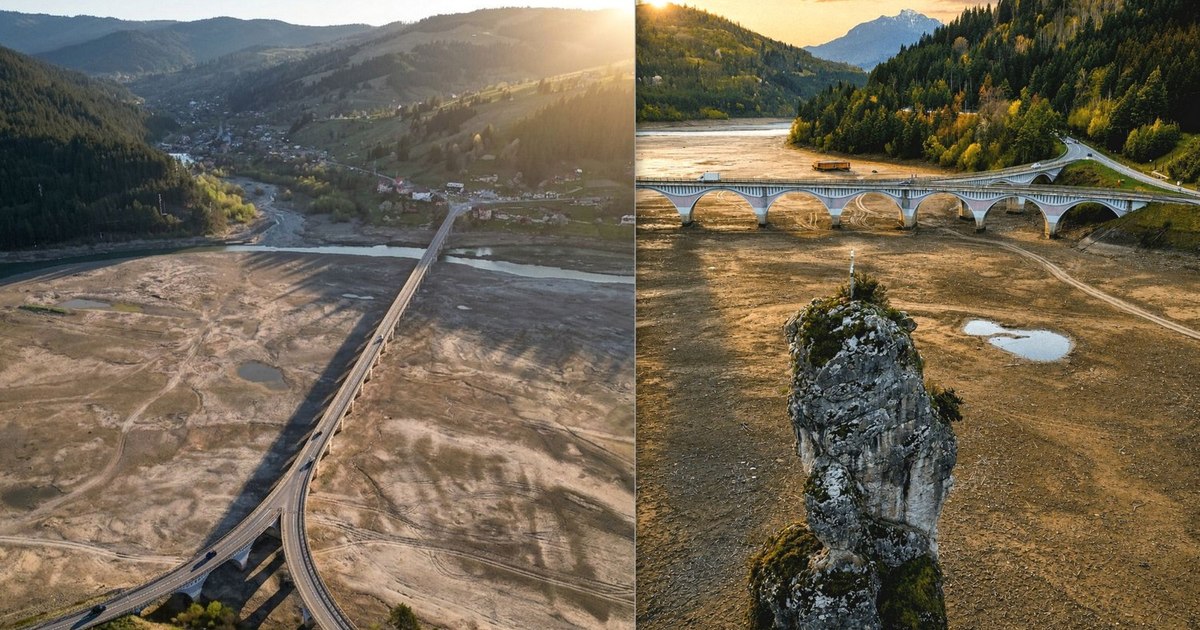
The Poiana Teiului Viaduct, built at the end of the 1950s together with the hydropower development from Bicaz, crosses one of the most spectacular areas of the Bistrița Valley. Erected near the legendary Piatră a Teiului, the monument on DN15 reminds of the huge construction site.
In the early 1950s, more than 15,000 people were brought to Bicaz to work on the large hydropower complex on the Bistrița River, which included the Bicaz dam, its reservoir of over 30 square kilometers and the then-named VI Lenin hydroelectric plant, with an installed capacity of 210 MW.
The colossus from Valea Bistriței
The development at Bicaz, inaugurated in 1960, was the first large hydropower project started in Romania after the Second World War and it competed in volume only with the works on the Danube – Black Sea Canal.
“The Bicaz Dam (Izvorul Muntelui) was, at the time of its completion, the largest dam in the country and the fourth in Europe among constructions of the same type. The Bicaz Dam is a heavy concrete dam, with a constructive height of 127 meters and a crown length of 435 meters, for which it was necessary to put into operation 1,650,000 cubic meters of concrete and reinforced concrete”shows Hidroelectrica.
Bicaz was considered the first major hydropower achievement in Romania, being also called the Romanian Hydropower School, the place where numerous hydropower specialists were trained who, in the following years, continued their work on the construction sites of the large hydropower plants on the Argeș, Lotru and Danube.
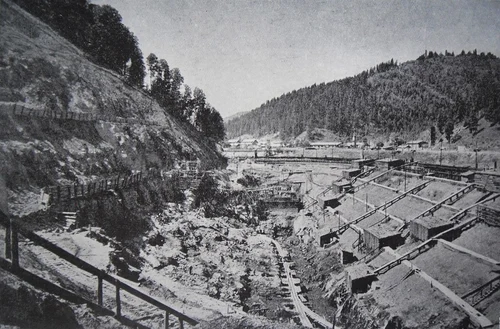
“The construction of Bicaz-Stejaru meant a gigantic effort for that time. The unprecedented scale of the work that had to be done required the execution of more than 3 million cubic meters of excavation, almost half of which in the rock and approximately 700,000 underground. Over 2.3 million cubic meters of concrete and reinforced concrete were poured and 11,000 tons of electromechanical equipment were installed. The construction site, organized according to the political concepts of the time, imposed extreme rigor, maximum effectiveness, millimeter precision, under the conditions of a technology that was far from being considered modern for that time. Hydroelectric note.
The development on the Bistrița river, carried out in the Eastern Carpathians, in one of the most spectacular crossing areas between Transylvania and Moldova, close to Bucovina, required the displacement of over 20 villages with 18,000 inhabitants. The towns of Răpciune, Cârnu and Rețeş, in Neamț county, disappeared completely, together with their cemeteries, and in Hangu and Fârțagi, many locals dug up their dead and moved them to the cemeteries on the hills, climbing a so-called “road of the dead”.
The spectacular viaduct, built at the end of the lake
40 kilometers upstream from the Bicaz dam, in the “tail” of the reservoir, its waters are crossed by one of the emblematic viaducts in the area. The Poiana Teiului Viaduct (Poiana Largă) was built at the end of the 1950s, being included in the hydropower and infrastructure works on the Bistriței Valley. Along with the hydropower development, it was necessary to reconstruct more than 30 kilometers of National Road 15, which ran parallel to the Bistrita river.
Video: Lucian Ignat
The new road was built on the left bank of the Bistrița river, in an area with difficult relief, but advantageous due to exposure to the sun, which allowed the roadway to be kept dry and reduced expenses for snow removal. The project involved earthworks with rock excavation, hundreds of meters of retaining walls, over 10 kilometers of drains, 147 footbridges and several bridges and viaducts.
The longest of these, the viaduct on DN 15 that allows crossing the reservoir near the Piatra Teiului nature monument, was built in the period 1958–1960, and, in addition to the works on its structure and superstructures, it was beautified with the help of architects.
The viaduct is a strategic connecting artery between Moldova (Piatra Neamț and Târgu Neamț), Bucovina (Vatra Dornei) and Transylvania (Borsec, Târgu Mureș), noted the specialists of the Professional Association of Roads and Bridges from Romania, in a work dedicated to DN 15, also called “Baltagului Road”.
The main viaduct has 26 spans of 23.00 m each, of which 22 are on the in-line portion, and a span of 36 meters over the original bed, resulting in a total length of 634 meters. To this is added the connecting brace with DN17B, which has three spans of 23.00 m and a length of 69 meters.
“After the completion of the construction works of DN 15, in 1965, there were already about 70 slip points, which affected either the roadway or the adjacent constructions. In order to ensure traffic conditions, it was necessary to carry out a large number of consolidation works“, noted the representatives of the Professional Association of Roads and Bridges from Romania.
The transformation of the area at the tail of the lake, hastened by floods
For a long time, the construction at the foot of the Ceahlău mountains crossed the meadow covered by water, but in recent years, only torrential rains have flooded the meadow formed at the tail of the reservoir. One of the strongest occurred in July 2025, when the flow of the Bistrita River reached 534 mc/s, causing great destruction in hundreds of households in the localities located upstream of the dam, in Neamț and Suceava counties.
The disturbing secrets of the lakes of Bicaz. How the “pearls” of the Eastern Carpathians appeared
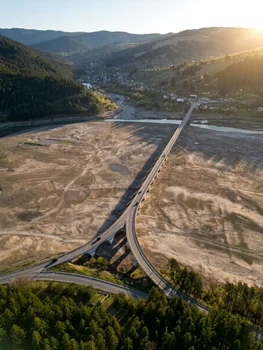
Lake Bicaz took over the flood, but the waters brought here impressive amounts of trunks, branches, alluvium and waste. Floods contribute the most to the clogging of reservoirs, and the area at the tail of the reservoir went through this phenomenon. If, several years ago, the waters covered the clearing under the viaduct, the water’s sheen is now much more limited, the images taken by the photographer Lucian Ignat show.
“Approximately 50 percent of the annual volumes of alluvium drain in less than a month, when floods are recorded. The rapid clogging process is explained by the energetic action of eroding the bed, favored by the following factors: the geological nature of the formations in the hydrographic basin; the torrential nature of the flows; the pulsating nature of the flows discharged on the river by the operation of the upstream plant, with values higher than in the natural regime“, shows the study published by the Technical University of Constructions in Bucharest, with the title “Clogging of accumulations”, by Laurentiu Mihai Lungu.
Piatra Teiului, the lonely rock surrounded by the lake
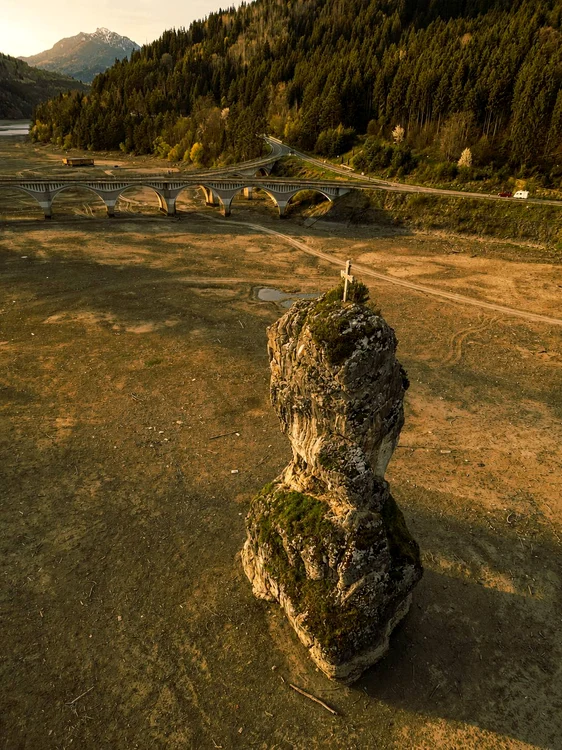
In the vicinity of the viaduct, once raised from the waters, now only from the marshy ground, Piatra Teiului has remained a legendary place in the clearing at the foot of Ceahlău. The rock rises 15 meters above a base with a diameter of five meters, dominating, solitary, the valley around it. It is composed of a compact, bruised and yellowish limestone, with a scaly crack that contrasts with the geology of the hills around it, Surduc and Baba, composed of sandstones.
Scientists have concluded that the limestone block has the same composition as the peaks of Ceahlău, located 12 kilometers away, and is believed to have reached the valley from here. A local legend provides an explanation for the Limestone.
“Two devils, sitting on the top of Ceahlău and looking at the great platform of the mountains, illuminated by the moon of a cool summer night, were seized with an irresistible envy, seeing the prosperity of the villages on the beautiful valley of Bistrita, and the foaming waves of this river, which rolled at their feet, awakened in them an even more unbridled appetite to eat the tasty fish of this Reddened by these two passions, they said to themselves: “Why don’t we punish these inhabitants for all the evils they have done to us through their piety and prayers? Let’s drown them and all their property, by diverting the waters of Bistrita. With this we take revenge against them and satisfy ourselves.” and we lust after the fish left on the empty bed of the river by the drying up of its waters”, noted the magazine Almanah Turistic, in 1979.
The devils, according to the legend, broke a rock from the top of Ceahlău, took it each with their little finger and started to go down the mountain with it.
“They reach the valley and head towards Bistrita, so that the river’s rapids will throw it away, and thus the stopped waters will swell, leave their motherland and flood the villages, and the river bed, below this weir, drying up, to catch the fish they were so eager for. But, as the stone was too heavy and the distance too long, they walked with difficulty. When they reached Poiana Teiului – and more they had but a short distance to the river — the roosters crowed from the day, and as evil spirits do not walk, according to the people’s belief, but at night, the devils struck the stone and fled. The rock thus abandoned is the Limestone.” the publicists showed.
The dream roads to the great lakes in Romania: Danube Gorge, Transalpina, Cheile Bicazului
The legend, popularized by Mihail Sadoveanu
The legend of the Teiului Stone was also mentioned by Mihail Sadoveanu in the novel “Baltagul” (1930). Arriving at the inn of the merchant David from Călugăreni, Vitoria Lipan sees from the window the “lonely rock, with a man’s hood growing up”, and the merchant tells her the story of the devil who allegedly broke the stone from Ceahlău in order to steal it in Bistrita.

“It is a story as if the devil once broke this stone from the top of Ceahlău, at night, he brought it all the way there in his arms, like a swallow in the Bistrița river, to stop the waters and drown the contents. But, as he was bringing it in flight, the last song of the roosters caught him. He threw it away and fled into the desert, in the dark, so that the sun wouldn’t strike him. But these are only the words of men (…) It might be true, but that devil had little sense. Why didn’t he kick the stone in Bistrita? So, the stone has been here since there were no people, nor devils.” wrote Mihail Sadoveanu.
Piatra Teiului has been declared a natural monument and is one of the tourist attractions around the lake, along with Bicazului Gorge and Red Lake.
