
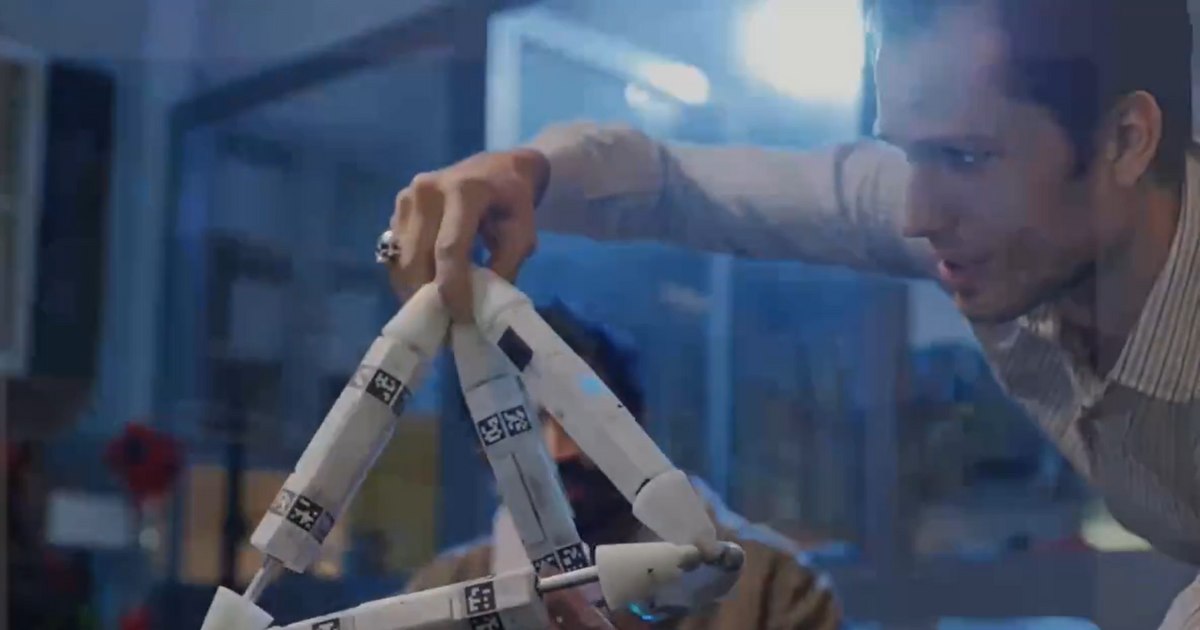
A revolutionary robot, developed by researchers at Colombia University in the US, could become an essential tool in areas such as marine research, rescue missions or even exploring extraterrestrial life in the future. It grows its own body and repairs “Consuming” pieces from other surrounding robots.
The robot is not the first of this type. Photo: video capture x
This transformable and self -regenerable robot, called Truss Link, is not the first of this type, but its unique way of operation has attracted the attention of the scientific world.
“True autonomy means that a robot not only think alone, but also to physically maintain itself”, said Philippe Martin Wyder, main author and researcher at Colombia Engineering and Washington University, quoted by Euronews.
Made of magnetic sticks, Truss link can be transformed from a flat shape into a 3D structure, adapting quickly to the environment. Moreover, it can integrate new components from nearby robots or eliminate defective parts, thus increasing its performance.
A video published by the team of researchers shows how the robot attaches a nearby piece and uses it as a cane, accelerating its speed by over 50%.
“Give feet to artificial intelligence”
Researchers have called this self -assembly and regeneration process “Robotic metabolism” – inspired by the way biological organisms absorb and integrate resources.
“Robotic metabolism offers a digital interface with the physical world and allows artificial intelligence to evolve not only cognitively, but also physically – opening a new dimension of autonomy.” Philippe Martin Wyder also explained.
Colombia Engineering describes Truss Link as a tool that “Give the feet of the AI”, giving him the ability to interact dynamically with the real world.
Future applications: from oceans to space
With potentially integrated in artificial intelligence systems, Truss link could become essential in developing innovative technologies – from underwater research to space missions or emergency interventions in hostile environments.
“Finally, this type of technology could allow the AI to build physical structures or robots, as today composes or changes an e-mail”, emphasized the main author.
You would make robots accessible to the general public
So far, robot programming has been reserved for specialized engineers, but you could democratize this process.
“We now have the technology needed to make programmable robots in a general and accessible way, so that ordinary people-not just the engineers-can program them.” said Rev Lebaredian, Nvidia vice president, for Euronews Next.
