
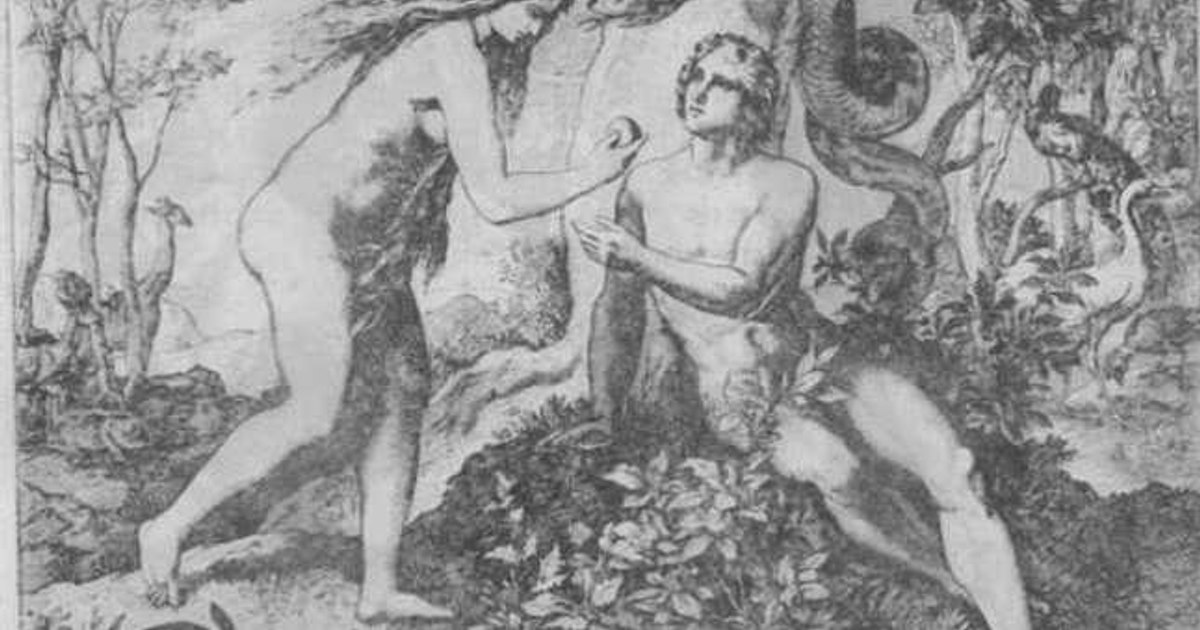
According to the Bible, Adam and Eve were the first man and the first woman on Earth. They are said to have been made of dust and to have lived in the Garden of Eden, the two characters being central to the belief.
Adam and Eve, biblical image PHOTO: Archive, The Truth
While this may seem far-fetched, there is now a growing body of evidence to suggest that at least some parts of the story may be true. Archaeologists have found surprising signs that Eden was not only a real place, but could have been the birthplace of civilization as we know it, according to the dailymail.
Biologists have also demonstrated that all humans living today do indeed have a single common ancestor. However, in order for the Bible to fit modern science, it is necessary to discard much of the traditional story.
This could mean saying goodbye to the idea that God created Adam and Eve, or even questioning whether our biblical ancestors were Homo Sapiens.
A true Garden of Eden
In the Bible, Adam and Eve live in a place called the Garden of Eden, a beautiful land of abundance and plenty. Interestingly, the Bible also gives a relatively accurate description of where this mystical garden is located.
In Genesis, the Bible states that a river flows through Eden and divides into four branches: Pishon, Gihon, Tigris and Euphrates. Of these, the Tigris and Euphrates are well known and still flow through Iraq today.
However, Gihon and Pishon are much more obscure, and their locations, if they still exist, are unknown. This has led to a multitude of suggestions as to where the Garden of Eden may have been, ranging from Iran and Mongolia to Jackson County Missouri.
However, the most promising theory is that the Garden of Eden is located in an area called Mesopotamia.
Professor Eric Cline, a classical and biblical archaeologist at George Washington University, argues that this theory fits the scriptural and archaeological evidence.
In his book From Eden to Exile Professor Cline states: “This makes sense from a textual point of view, because not only does the biblical account say that the garden was “in the east,” that is, east of Israel, but it also mentions the Tigris and Euphrates rivers in connection with the Garden of Eden.”
Nicknamed “Fertile Crescent”the nutrient-rich sediments of the two rivers allowed the deliberate planting and harvesting of the first grains by humans.
This development led to the earliest transition from a hunter-gatherer to an agricultural lifestyle and precipitated the birth of the first permanent human settlements.
Professor Cline adds: “It is possible that this area also became a kind of agricultural paradise for the inhabitants of the area after the invention of irrigation during the 4th millennium BC.
If this is true, then it is plausible that the biblical story of Adam and Eve captures an ancient story of the origin of civilization that took place somewhere around present-day Iran.
A genetic Adam and Eve
It might come as a surprise to learn that scientists actually believe that all living humans are descended from a single woman. The so-called “mitochondrial Eve” is the common female ancestor from whom the DNA of all modern human beings can be traced.
This common ancestor exists because, no matter how large the initial population, chances are that most female lines will eventually end.
Although Mitochondrial Eve was not the first human being, all other female descendants eventually died and failed to pass on mitochondrial DNA—a type of genetic material passed from mothers to their children.
Also, applying the same logic, scientists have determined that there must also be a “Y-Chromosome Adam” from which the male Y-chromosome in every living human is derived.
Since DNA accumulates mutations at a constant rate, scientists can use this “genetic clock” to find out how long ago everyone had the same DNA.
In 1987, geneticists analyzed the mitochondrial DNA of 147 people from around the world. By comparing the differences in their DNA, the researchers were able to calculate how many mutations must have occurred since their most recent common ancestor.
Dividing this number by the mutation rate shows that Mitochondrial Eve probably lived in Africa about 200,000 years ago.
Also, a 2013 study of 1,200 Sardinian men also showed that the Y-chromosome Adam may have lived about 180,000-200,000 years ago.
Of course, no scientist really believes that humans descend from a single pair of humans. This Adam and this Eve would have been just one of the many people living on Earth at that time.
Our two most recent common ancestors likely lived hundreds, if not thousands, of years apart and almost certainly never met—much less had children together.
Their unique status as common ancestors of mankind is merely a product of statistics rather than divine intervention.
A genealogical story
However, some scientists believe there is a way to make science fit a biblical story of Adam and Eve.
Dr. Joshua Swamidass, a biologist at the University of Washington, argued that there is no reason to believe that humanity did not descend from a single couple.
As the case of mitochondrial Eve and Y-chromosome Adam shows, there is no scientific barrier that prevents people from having a common ancestor, even if the population never dwindled to a single couple.
In an article published in Perspectives on Science and Christian Faith, Dr. Swamidass writes: “Many individuals are each the ancestors of “all living things”.
“All living people descend from each of these universal ancestors. The same can be said of all those who lived in AD 1. or about everyone alive when recorded history began. Two of them could be a special couple, called Adam and Eve in Scripture, from whom we all descend.” says Dr. Swamidas.
It is important to note that Dr. Swamidass does not provide a positive case for the existence of Adam and Eve. Rather, he merely shows that there is nothing in our understanding of evolutionary biology that forbids the existence of an Adam and Eve couple.
However, as noted by Dr. Swamidass, there is still the issue that Homo Sapiens were not the first humans on Earth.
Starting from the idea that Adam and Eve should be the literal ancestors of all humans who have ever lived, some researchers have looked even further into the past.
Professor William Lane Craig, a philosopher at Houston Christian University, argues that Adam and Eve must have been the first truly human people.
Using criteria that include the capacity for abstract thought, depth of planning, technological innovation, and use of symbols, he argues that the first true humans appeared much earlier than homo sapiens.
In an article published in First Things, Professor Craig writes: “Adam and Eve can plausibly be identified as belonging to the last common ancestor of Homo Sapiens and Neanderthal, usually referred to as Homo heidelbergensis. It is plausible that Adam lived somewhere between about 1 million years ago and 750,000 years ago, a conclusion consistent with population genetics evidence.”
Even if Homo Heidelbergensis is the first human and humans could have descended from a single pair, there is still no reason to believe that this pair were the only humans on Earth.
Furthermore, if Adam had been a Homo Heidelbergensis, then he would not have lived in the proposed Garden of Eden location in Iraq.
Also, the admission that Adam and Eve were not even Homo Sapiens is likely to disturb some more conservative Christian thinkers.
However, it remains a striking fact that there is nothing in our current theories of human evolution that strictly forbids the existence of an original Adam and Eve couple, at least in some sense.
