
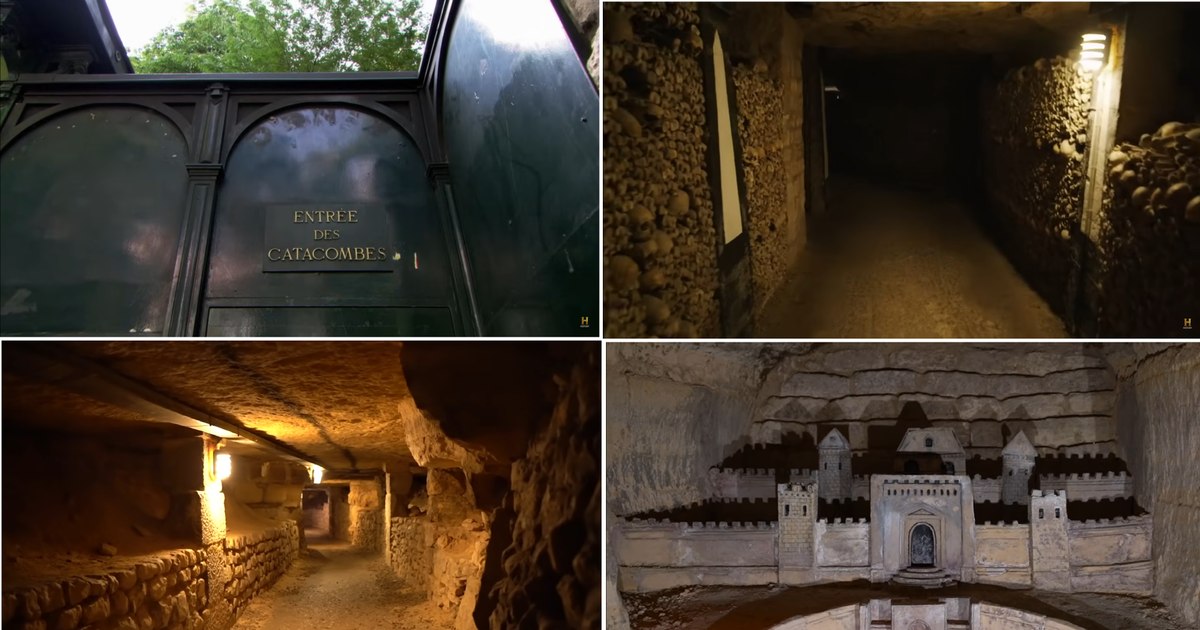
Current Paris was built on the largest ossuary in the world, a huge cemetery. For this reason, its catacombs are known as the “Kingdom / Empire of Death”. The secrets of millions of corpses are now coming to light, revealing some of the darkest stories ever written.
Beneath the vibrant streets of Paris – France, a whole universe of untold stories is waiting to be unearthed from the darkness of the catacombs. The tunnels that house the remains of more than six million people have become the subject of groundbreaking scientific research.
A team of specialists in archeology and anthropology, led by Philippe Charlier, decided to decipher the mysteries of Paris, opening a window into the dark history of the metropolis and its public health, to reveal how millions of Parisians died, how they ended up in catacombs and how diseases have developed over the centuries.
In a world where past and present intersect, “entrails” Parisians offer us not only a guide to history, but also a profound meditation on human mortality.
Among the many documentaries and clips available online about the mysteries and catacombs of Paris, I opted for one from the series made by the History Channel (SEE VIDEO)which captures the essence of these fascinating tunnels, providing a concise and engaging presentation of the atmosphere and history of the place.
The Mysterious Catacombs of Paris YouTube Collage
“This is probably the largest ossuary in the world, so unique”
Beneath the streets of Paris, the dead seem to finally be making their story heard. This labyrinth of catacombs, where it is estimated that between five and six million people were buried, is now being investigated for the first time in a scientific study.
“The bodies were thrown into the shafts of the old stone quarries”mention the archaeologists who bring to light the secrets of the skeletons in the catacombs of Paris. Teams of archaeologists, anthropologists and biologists analyze the remains to understand the causes of death and the evolution of disease over time.
Philippe Charlier, the project coordinator, states, for The Guardian that so far no serious study has been made of these catacombs: “Our research examines 1,000 years of public health history in Paris and its suburbs, the medicine and surgery people underwent, and the diseases they suffered from. There are other ossuaries in the world, but this is probably the largest, therefore unique. It is the ideal place for an anthropological and paleoanthropological study”.
Mysteries of Paris: The “Empire of Death” and Real Estate Interests
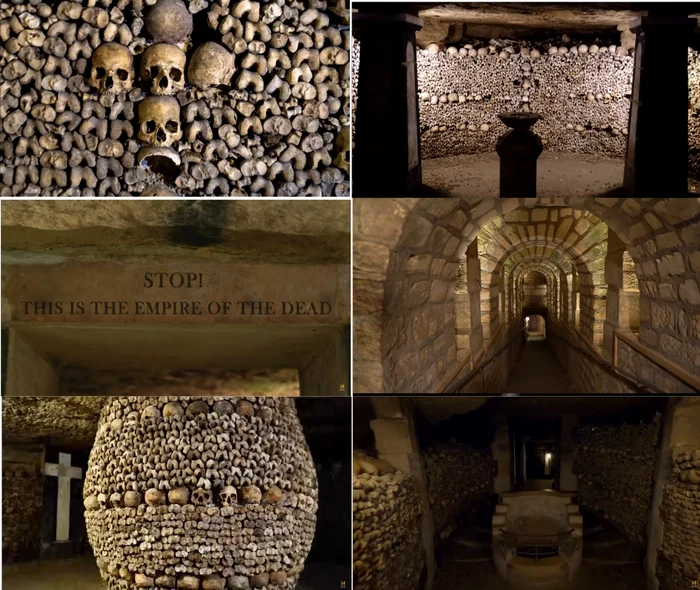
At the entrance to the Paris catacombs, a network of tunnels stretching 300 km, located 20 meters underground, a sign warns in large letters: “Stop it! Here is the Empire of Death”.
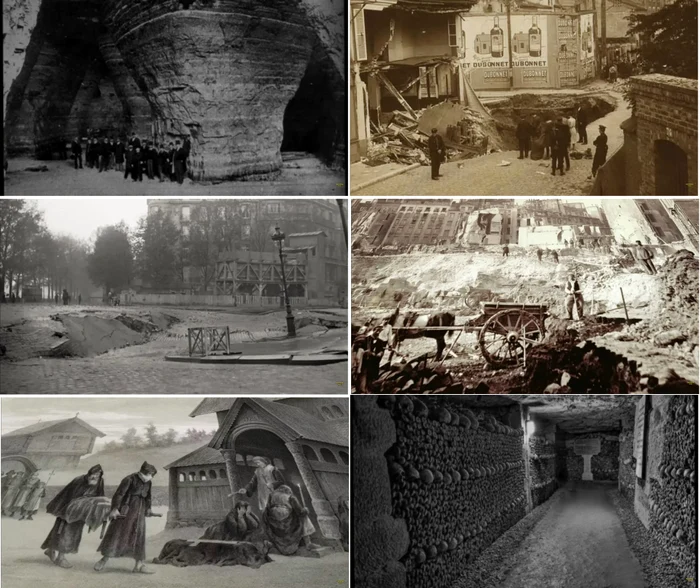
In the second half of the 18th century, the city authorities decided to exhume the bodies buried at Les Innocents, near what is now “Les Halles” in central Paris, and from other overcrowded cemeteries, citing health reasons.
“It is said that people were drinking, eating or dancing in an underground tavern when a wall collapsed and decaying bodies fell on top of them. Picture the scene. Then the authorities realized that the cemeteries of Paris could no longer cope with the number of dead. They considered the miasma dangerous to public health, so a commission was set up to decide what to do with the corpses. The official justification was public health, but I suspect that because of demographic pressure, there were also real financial interests in reclaiming the land for estates.” admitted the project leader.
The Mysterious Catacombs of Paris – Archive Images YouTube History Channel Collage
Thrown into the shafts of the stone quarries, the skeletons turned into exhibits
In 1788, under the cover of night, an operation to exhume millions of corpses began. These were dug up and loaded onto ox-drawn carts, which moved through the city, accompanied by a priest, to the then suburbs.
“The bodies were simply thrown into the disused quarries previously used to extract the stone needed for the construction of Paris, leaving them where they fell”Philippe Charlier also told.
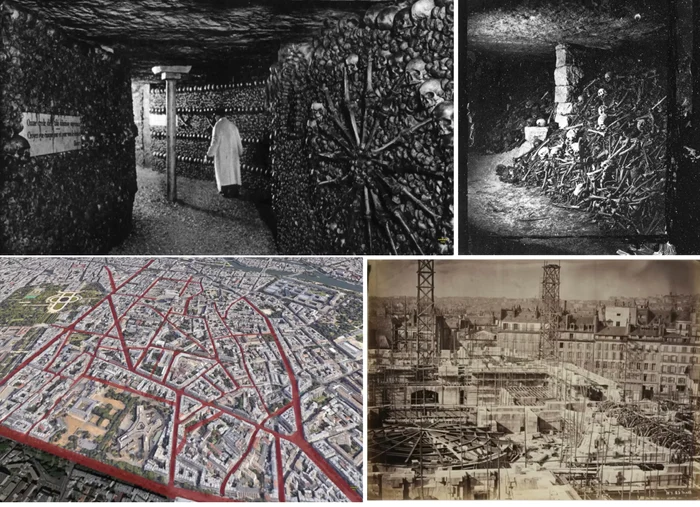
But in 1810, the inspector general of quarries, the noble Louis-Étienne Héricard de Thury, decided that respect should be shown to the dead and organized the skulls and long bones – femur, tibia, humerus – into decorative walls, known as of the Hague.
“He turned this place into a space that could be visited, not just for touristsbut also as a kind of philosophical cabinet with engraved inscriptions”, added Charlier.
But beyond the meticulously arranged facades, built like dry stone walls, the remaining bones were in a state of disarray, akin to rubble.
Count de Thury wrote an influential book entitled “Description des catacombes de Paris” (“Description of the Catacombs of Paris”)published in 1815, which laid the foundation for further studies of these tunnels. The work details the history and structure of the catacombs, contributing to their popularization. Héricard de Thury is frequently mentioned in historical and scientific works related to engineering, mining and the history of Paris, having a significant impact on how the catacombs are now perceived.
The Mysterious Catacombs of Paris – Archive Images YouTube Collage
The number of dead in the catacombs of Paris, three times higher than that of the living
In the 18th century, cemeteries as we know them today did not exist. These were large open grounds with mass graves, located right in the center of Paris. When a person died, they were put in a mass grave, covered with boards and that was it.
With the Age of Enlightenment, people began to take an increased interest in science and medicine. Although these cemeteries were tolerated for many years, it was decided to move the dead away from the city center. Thus, it was decided to move the cemeteries outside of Paris. But the question arose: who will pay for the new lands? Here a solution was proposed: why not make better use of the catacombs?
Later, the tunnels became a place of silence, where religious services were held until 1960. It is estimated that the catacombs contain the remains of about six million Parisians, in contrast to the current population of Paris, which is about two million inhabitants. This means that the number of dead in the catacombs is three times higher than that of the living.
Hagues – the macabre art of the Parisian catacombs
Today, in another section of the maze of tunnels, masons employed by the Catacombes de Paris – which manages this heritage site – are repairing a section of the hague that has caved in due to water seepage.
“Hagues” are decorative structures made of bones, especially skulls and long bones, aesthetically arranged, similar to dry stone walls. They are found in the catacombs of Paris and serve both funerary and tourist purposes, being an important part of the historical heritage of the place. Arrangements are made to honor the dead, turning the area into a space that can be visited and appreciated.
“It is the same “savoir-faire” (a concept often used in the field of crafts and craftsmanship, referring to the expertise and skill required) used in the construction of a dry stone wall. It makes you think about our own mortality and how we all end up in this situation”admits Florent Bastaroli, as he places the smaller bones between meticulously arranged rows of larger bones and skulls.
Discoveries from the catacombs: the study of bones and the hidden diseases of Paris
After one of the “hagues” gave way in 2022, Charlier’s team from the University of Versailles and Saint-Quentin-en-Yvelines had the opportunity to study the site.
The study is not limited to amputations, trepanning, autopsies and embalming, but also includes what researchers call paleopathology, to determine the diseases and parasitic infections they suffered from, as well as heavy metal poisonings, including lead, mercury, arsenic and antimony (stium).
The Mysterious Catacombs of Paris – Archive Images YouTube Collage
Charlier states that certain diseases, such as rickets, syphilis, and leprosy, leave marks on human bones, making them easier to identify. However, extracting DNA from teeth allows them to locate infectious agents, such as plague, that act too quickly to leave traces.
Charlier also points out that DNA analysis can reveal the evolution of pathogens, comparing 16th-century syphilis to modern-day syphilis.
So far, his team has scanned the bones and taken samples, estimating that the total number of corpses in the catacombs actually exceeds six million.
Exploring Eternity – The Catacombs of Paris project in its third year of research
The project in the Paris catacombs is now in its third year, and the team will present the first preliminary results by the end of 2024.
Charlier predicts the work will outlast his career: “The task is enormous. It is a never-ending thing. I think the children of my students will also continue this work, and that’s good.”
The Comte de Thury preferred not to look too far into the future. An inscription placed in the catacombs reminds visitors: “Think in the morning that you may not reach the evening and in the evening that you may not reach the morning”.
From Roman quarry to medieval ossuary, underground gallery and tourist attraction
The stone quarries that form the catacombs of Paris began to be exploited in the Roman period, around the 1st century AD. This activity continued throughout the centuries, and in the Middle Ages, the quarried stone was used in the construction of important buildings, including cathedrals and churches, such as Notre-Dame de Paris.
The Catacombs of Paris were opened to the public starting in 1809, although access was limited and some areas were sealed off to prevent people from getting lost in the underground labyrinths. Since then, they have aroused immense interest, both among those in search of the sensational, as well as among researchers and specialists in various fields.
This interest also explains the presence of works of art and architecture inside, such as the famous sculptures made by an anonymous worker in the 18th century, who created detailed replicas of some monuments. Some galleries also feature improvised altars, bas-reliefs carved directly into tunnel walls, and architectural structures that reflect Gothic or Romantic influences. In the 20th century, modern artists and urban adventurers continued to contribute to the decoration of the catacombs, leaving behind graffiti and temporary art installations, thus transforming this macabre space into a form of unconventional underground gallery.
In recent years, a series of documentaries have been made that have further increased interest in the mysteries of the deep, promoting the catacombs and mysteries of Paris as a tourist attraction. Also, they have been the host of various events, and in the last half century, they have often represented the scene of organizing meetings for secret organizations.
