
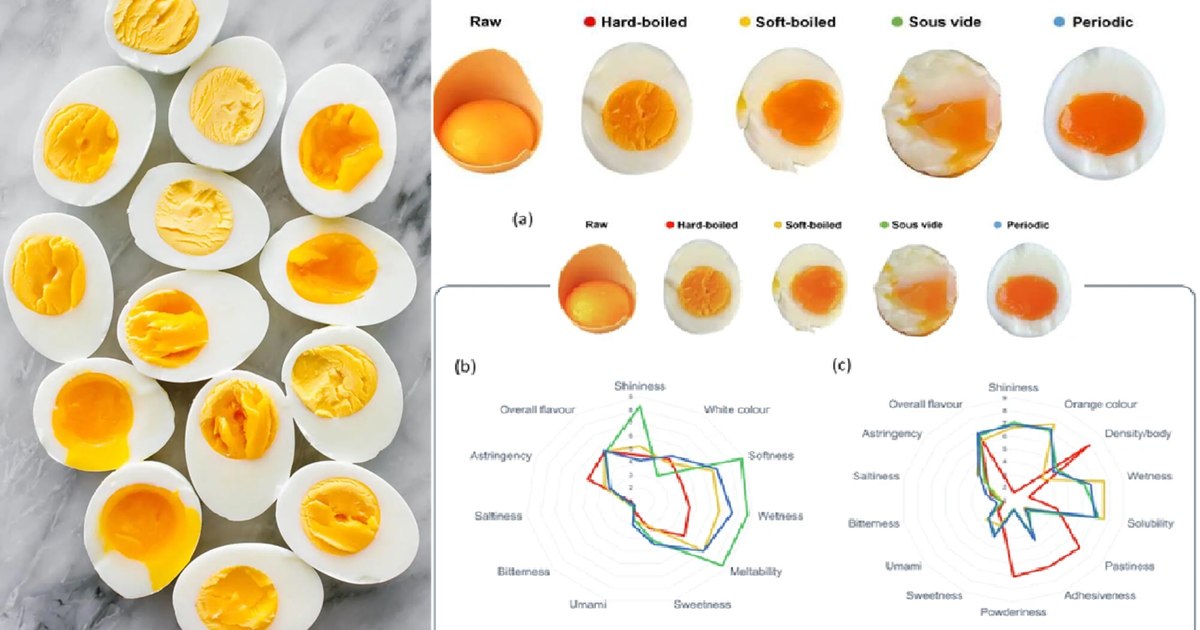
A new revolutionary method of cooking eggs, which ensures an optimal preparation of the yolk and white, has recently been scientifically developed. named “Cooking periodically”this technique allows to obtain a uniform cooked egg with a superior nutritional content compared to that of the eggs cooked in the shell by conventional methods or “Sous Vide”.
An innovative boiling approach has been developed in an Italian laboratory and involves changing the temperatures to which the egg is exposed. The eggs are practically alternated between cold water and boiling water every two minutes, for 32 minutes. Experts have analyzed various methods, and the results are truly interesting. In this case, a final product with a nutritional content higher than that obtained by other methods resulted. The technique seems to ensure the perfect cooking and the ideal texture for an egg still in the shell.
From the perspective of material physics, cooking an egg in the shell is much more complex than it seems. The chefs face the challenge that the yolk and white are composed of different proteins, which are distorted and thickened at distinct temperatures – 85 ° C for white and 65 ° C for the yolk.
The main problem is that the yolk cannot be heated separately from the white, unless they are extracted and cooked in different vessels. As a result, the egg white and the outer layer of the yolk are often super-hin, while the center can remain insufficiently cooked.
Egg cooked perfectly by a method inspired by the science of materials-Naturecom collage periodically
Periodic cooking: from materials to the perfect egg obtained in half an hour
In 2002, the French molecular gastronoma Hervé this proposed an alternative solution: cooking the egg in a water bath at 65 ° C for at least one hour. Method “Sous Vide” It gives the yolk an unmatched taste and texture, even if the white does not strengthen.
Also, in Japan, the onsen Tomago egg, ie “The egg of thermal springs”it is boiled in the shell at temperatures between 63 ° C and 70 ° C, resulting in a whitish and a creamy yolk.
Both in the Onsen and Sous method at 65 ° C, the white is not fully strengthened, because not all proteins reach a sufficient temperature to coagulate; Therefore, the chefs often remove the translucent portions left uncooked.
Therefore, the conventional boiling methods at 100 ° C make the yolk strengthen, while cooking in a water bath at temperatures between 60 and 70 ° C for one hour (Sous Vide technique) leaves the white cooked white.
The new technique, called “Cooking periodically”is based on a previously used method to create layers in plastic objects. “It allows us to obtain a unique material, with different structures and, implicitly, with distinct properties”explains Ernesto di Maio, specialist in materials at Federico II University in Napoli, in the laboratory to which this method was developed.
A friend suggested to apply this method in the kitchen. “After all, the famous Italian chef Carlo Cracco sells eggs for 80 euros piece”he motivated his di Maio approach.
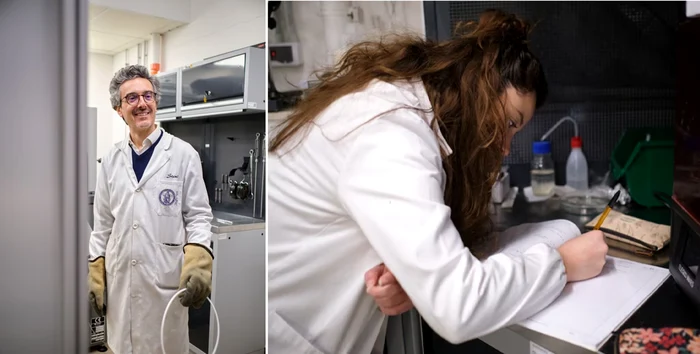
Ernesto Di Maio and Emilia Di Lorenzo Photo Collage Foam Lab University of Naples
Discover how you get the egg with creamy yolk and gelatin white
His student, a doctoral student Emilia di Lorenzo, created a mathematical model that follows the transfer of energy through the layers of an egg and the dynamics of cooking, thus establishing a basic method. Later, she perfected this method using computational fluid dynamic software.
The innovative technique consists of alternating the egg between a pot of boiling water, maintained at 100 ° C, and a bowl of water at 30 ° C, every two minutes, for 32 minutes (totaling eight cycles). By interrupting the heat transfer from the shell to the inside, the temperature of the yolk does not exceed 65 ° C, reaching only a gelatinous consistency. Research results were published in the magazine Communications Engineering.
Experiment that revolutionizes egg cooking, repeated at home: more intense aroma
But an experiment of this kind, conducted at home with the help of an aquarium heater, proves to be anything but a simple play, with eggs. At the first attempt, the result can be a too liquid egg, a problem attributed to the use of an egg larger than the one for which the calculations were performed. Di Maio explained: “The calculations were based on an egg of 68 grams. If a significantly larger egg is used, the cooking time should be increased by about 20 seconds in each cycle. ”
At the second attempt, the desired result could be obtained: the whites acquires a gelatin consistency, and the yolk turns into a gel-like liquid.
Compared to a cooked control egg according to another method (Delia), the egg prepared by this technique has a more creamy yolk and an aroma with a more intense depth.
But Dr. This, from the National Institute of Agricultural Research in France, who was not involved in the study, noted that although the cooking method presented is interesting, it is not an innovation: “The periodic cooking method was proposed about a century ago for meat, by alternating between hot and cold water.”. He added that he tried the technique and did not notice “No sensory benefit”on the other hand, it was surprised that the authors of the study did not include comparison and methods such as microwave cooking (high pressure sterilization).
The secret of the yellowish -rich yellowish, proven by nuclear magnetic resonance
Di Lorenzo also used nuclear magnetic resonance and high -resolution mass spectrometry to analyze the nutritional composition of regularly cooked eggs, compared to those prepared by the technique “Sous Vide” and soft boiled. The results have shown that periodically cooked egg yolks contain several polyphenols – micronutrients with significant health benefits.
Di Maio also stated that he currently uses this method to boil all the eggs, and friends and family thank him: “Of course, it takes time. But I think it is worth to dedicate time to your loved ones. “
However, there is a need for further research to explain why the regularly cooked egg has a superior nutritional content compared to those prepared by other methods. At the same time, the notion of “Perfect egg” remains a subjective and controversial matter.
