
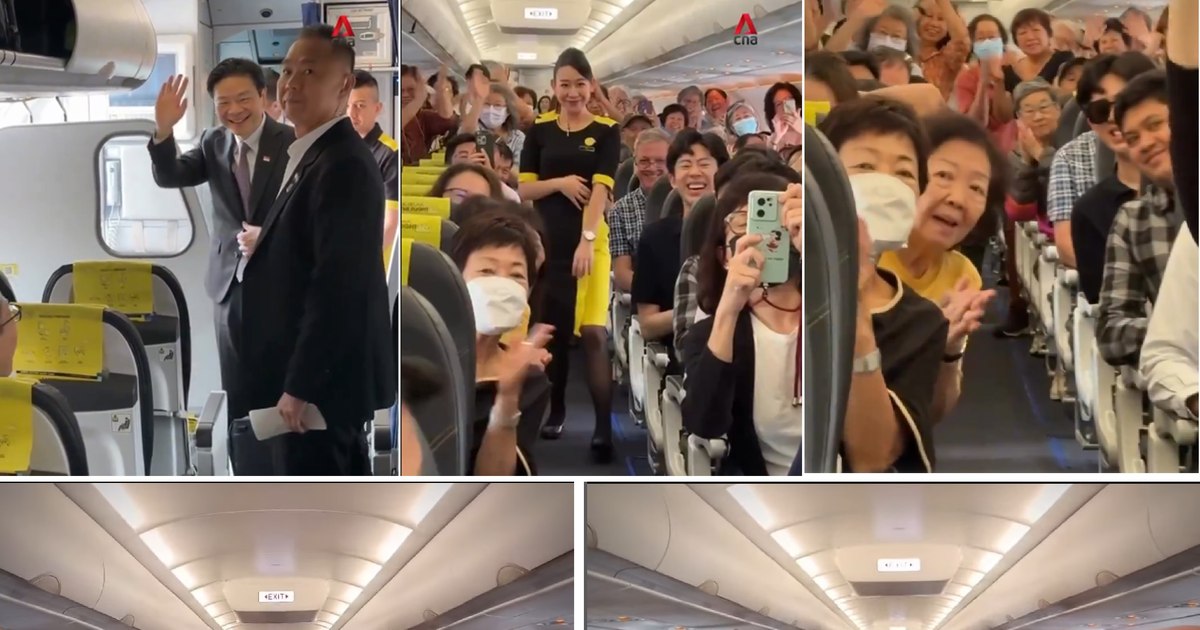
Recently, the Prime Minister of Singapore, Lawrence Wong, attracted the attention of the whole world with a simple but significant gesture: he returned home from a series of international summits on a low-cost air ride.
The choice of this public transport was not only surprising for a high-ranking leader, but also underlined a striking contrast with the behavior of other dignitaries, especially from less developed countries, who do not hesitate to use public resources to travel or live in luxury and opulence.
Wong was filmed flying low-cost airline Scoot, receiving a standing ovation from passengers and sparking a wave of backlash on social media. Many users were impressed by the way Singapore’s prime minister chose to travel while on an official mission, pointing out that respect is earned through modesty and efficiency, not extravagance.
Singapore Prime Minister Lawrence Wong applauded in a low-cost race Collage X hvgoenka & lawrencewong
“I felt at home as soon as I got on the plane”
A global center for finance, trade and logistics, with a highly active port and one of the largest international airports in the world (Changi Airport), Singapore has one of the most developed economies in the world, regularly being ranked as one of the best countries for business.
Despite this, Prime Minister Lawrence Wong, 51, took a low-cost airline and traveled economy class from Vientiane, Laos to Singapore on his way home from ASEAN summits and related international meetings. His gesture was met with applause from passengers on the same flight.
The PM of Singapore travels on official duty aboard a low-cost airline—on a normal scheduled flight, no frills, no national or private jet, and without a large entourage at the taxpayers’ expense. This is how respect is earned. 🫡 pic.twitter.com/JHTdQnJcXi
— Harsh Goenka (@hvgoenka) October 14, 2024
An Indian entrepreneur shared one of the viral videos of the moment on the X platform, writing: “Prime Minister of Singapore travel on official business with a low-cost airline — on a normal scheduled flight, no extra amenities, no national or private jet, and no large escort at taxpayer expense. That’s how you earn respect!”.
Other reactions from around the world highlighted the distinction between Prime Minister Wong and other prominent world leaders: “It is not about a leader, but about a national culture. Most leaders expect and demand VIP treatment, be it flights, endless lines of cars or an excessive display of grandeur! They have no shame in making you wait while their column goes by. They look so colonial and uneducated” or “This is true leadership! Setting an example by prioritizing modesty and efficiency over extravagance.”
Prime Minister Wong also posted a video on Instagram, thanking the crew members for their hospitality. “I’m back from Laos. I felt at home as soon as I got on the plane! Thank you all for the warm welcome!”, wrote the prime minister.
Examples of responsible leadership, modesty and efficiency
Lawrence Wong’s actions are a lesson in modesty for all world leaders, reminding them that as representatives of the people, it is essential to show respect for citizens’ financial contributions. In a world where equality and transparency are becoming increasingly important, his humble approach to travel is an example of responsible leadership and social awareness.
The gesture of the Prime Minister of Singapore is not a singular one. Jacinda Ardern, former prime minister of New Zealand, has often been praised for her low-key and approachable leadership style. In 2019, when he also attended a number of international summits, he frequently traveled on commercial airlines instead of using luxury aircraft. Moreover, she was appreciated for the sense of normalcy she brought to politics and for showing empathy and responsibility during her tenure.
Likewise, former German Chancellor Angela Merkel was known for her modest lifestyle, being seen throughout her career traveling by train or commercial flights for official travel, thus promoting an image of simplicity and efficiency.
Barack Obama, the former president of the United States, was also known for his rational travel choices despite his access to US resources. On certain occasions, he traveled commercially, and his policy of transparency and modest approach were often mentioned.
Mark Zuckerberg, the co-founder of Facebook, although not a political leader, has always been an example of modesty in business, wearing simple clothes and opting for a relatively modest lifestyle compared to the extravagance of Silicon Valley.
Mahatma Gandhi and Argentine revolutionary leader Ernesto Che Guevara were also legendary figures of modesty and simplicity, eschewing luxury and opulence. And the examples could go on.
Leaders in the Mirror: Criticism and Extravagance in Politics
However, there are numerous leaders who have been criticized for their extravagant lifestyles and the way they conduct business, particularly in terms of public spending and/or lack of accountability to citizens.
Including the president of Romania, Klaus Iohannis, has often been criticized for the way he uses public resources. He uses a luxury plane, Gulfstream 550, for his foreign trips, a plane worth about 40 million dollars. It is a leased aircraft, operated by Global Jet Luxembourg, which can carry a maximum of 13 passengers and has a flight range of 12,500 kilometers. On board it, the president of Romania flew to the Middle East, Africa, Asia and even to the USA, which caused controversy and criticism from public opinion. Although the costs of his travels have never been made public, analysts’ calculations show that each of the flights is in the order of tens and hundreds of thousands of euros.
However, compared to the president of Romania, there are leaders who have distinguished themselves by even more reprehensible examples in terms of managing public resources and ostentatiously displayed opulence.
Robert Mugabe, the former president of Zimbabwe (1987-2017), was often accused not only of his authoritarian leadership style and endemic corruption during his regime, but also of the fact that, despite the country’s severe economic crisis, he traveled with luxury aircraft and spending public money on extravagance, while the majority of citizens lived in precarious conditions.
Venezuela’s current president, Nicolás Maduro, is also often criticized for his lavish lifestyle, in contrast to Venezuela’s severe economic crisis, where millions are suffering from hunger and deprivation. He has been accused of corruption and using public funds to support his extravagant lifestyle despite the country’s economic collapse.
Another example is that of Syrian President Bashar al-Assad, criticized for his lavish lifestyle while the country is ravaged by civil war.
Former Ukrainian President Viktor Yanukovych was accused of corruption and an extravagant lifestyle that included a lavish palace, while many Ukrainians lived in poverty. His extravagant spending contributed to massive protests in 2014 that led to his ouster.
There are negative examples in developed countries as well. David Cameron, former Prime Minister of the United Kingdom, has been criticized for using a private jet during the economic crisis, especially in the context of austerity measures imposed on the British population. The “Panama Papers” scandal also revealed links to offshore funds, raising questions about its transparency and ethics.
Silvio Berlusconi, Italy’s former prime minister, has also come under fire for his extravagant lifestyle and personal scandals, having been accused of corruption and abuse of power during his tenure, which included lavish spending on parties and public events.
Even Donald Trump, former president and current candidate for the US top office, has been criticized for his frequent use of his personal residences and resorts for official business, raising concerns about public spending. He has also been accused of corruption and favoritism, particularly in relation to his personal and financial affairs.
