
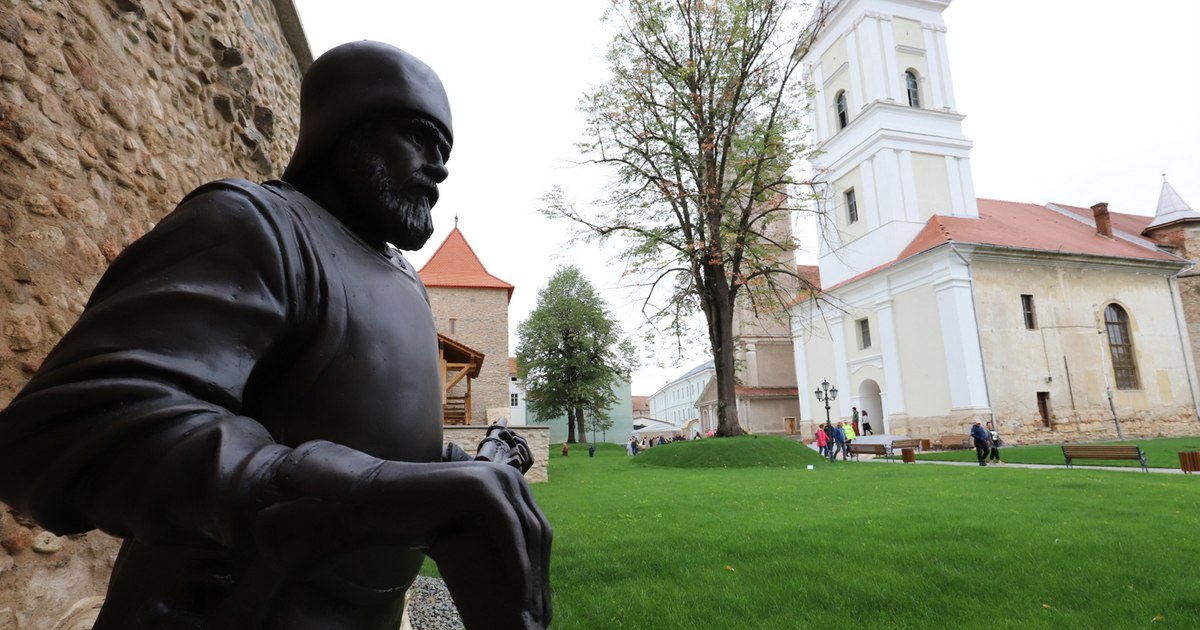
The medieval fortress of Orăștia reopened its gates to tourists, with a new look, after three years in the construction site. The fortification built by the Saxons eight centuries ago is once again the center of one of the most attractive tourist areas in Romania.
Orăștiei Citadel. Photo: Daniel Guță, THE TRUTH
The medieval fortress of Orăștia (video) entered the restoration site in the fall of 2021, and three years after the start of the works, it was reopened to the public in September, to mark the completion of 800 years of documentary attestation of the municipality of Orăștie in Hunedoara county.
“The works at Orăștiei Citadel are mostly completed. It can be visited, but from the spring of next year there will also be guides, and some spaces will be furnished. Also, work is being done on the arrangement of the building of the new museum of Dacian civilization, which will operate in the neighboring building, from the 19th century, of the former city hospital”says Ovidiu Bălan, the mayor of Orăștia.
The medieval fortress was built eight centuries ago, when the first Saxon settlers came here.
Revitalized after decades of neglect
The settlement was an old residence of some grevi (leaders of the Saxon community). Some historians claim that it would have been built on the ruins of an older settlement or that there would have been a Dacian fortress in this place, the locality being on the road that connected the Mureș Valley to the land of the Dacian fortresses.
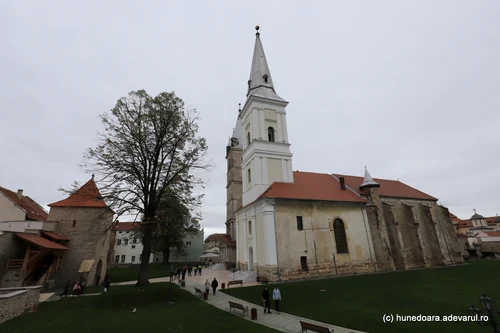
Image 1/11:
Citadel of Orastiei Photo Daniel Guță THE TRUTH (75) jpg
A millennium-old rotunda, now in ruins, and two ancient churches are contained within its mighty walls and towers.
“Orăștia, one of the seven main Saxon towns in Transylvania, was colonized by the Saxons in the middle of the 12th century. It was the westernmost locality of the so-called Fundus regius (no – the royal land), such a privileged territory for the newcomers. The city, not having a defensive wall, an actual fortress, as was customary in these towns in feudal times, had a fortified church, provided with walls and a wide courtyard, which could be used as a refuge for the population in case of danger”. pointed out the historian Octavian Floca.
Over time, the fortification of Orăștie has gone through numerous sieges, fires, earthquakes and renovations that have affected its original appearance. The Tatars plundered it in the middle of the 13th century, the Turks also devastated it in the early 15th century and burned it again in the middle of the 17th century.
Its defensive ditches, filled with water in the past, have disappeared, and around it, from the 19th century, the historical buildings of Orăștiea were built.
The municipality expanded during the years of communism, and several residential blocks and industrial buildings were erected around the medieval fortress, which also contributed to its transformation.
“If you don’t pass like the wind through Orăştie, you can stop to see the agglomeration of statues. Well covered by all kinds of buildings, which are more and more degradable from an architectural point of view, you will probably also find what is left of the old fortress of the last western burgh of the Saxon University. After being attacked, in the most aggressive way possible, by the urban planners of Ceausescu’s time (destruction of components, shielding with blocks), the restorations after 1990 were only worthy of a so-called beautifying action, which was not following some serious study of architecture and military history“, informed the historian Adrian Andrei Rusu, in an article published on medievistica.ro.
The 1,000-year-old rotunda and the church of John of Hunedoara
After being neglected for several decades, so that it was no longer of particular interest to visitors to the city, the restored citadel in Orăștie is gradually resuming its role as the tourist center of the eight-century-old city.
In its premises, two old churches, Reformed and Evangelical, and the ruins of a rotunda, a chapel built almost 1,000 years ago from stone and mortar, recognized as one of the oldest such monuments in Romania.
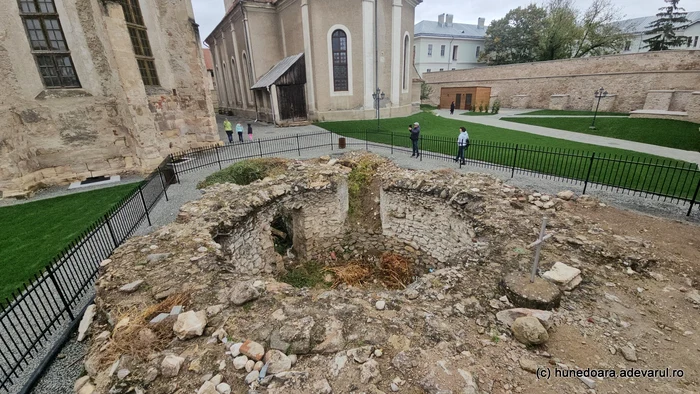
The roundabout in Orăștie. Photo: Daniel Guță
The rotunda in Orăștie was investigated by archaeologists in the early 1990s, and today visitors can see the foundation and part of its walls. The reformed church in Orăștie was originally a Roman Catholic church, founded in the 15th century. John of Hunedoara would have ordered the construction of a tower from where the Mures Valley and the lands to the west, towards the Retezat Mountains, could be supervised:
“The tower of the church, originally erected by the order of John of Hunedoara in memory of the battle of Sântimbru (1442), was 27 cubits high (no – almost 50 meters) and from which on a clear day you could see the outline of the city of Alba Iulia”historian Anton E. Dorner pointed out.
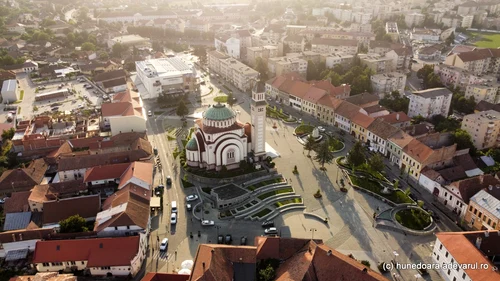
Image 1/20:
Orastie Aerial images Photo Daniel Guță (41) jpg
The evangelical church in Orăștie, also located in the medieval fortress of Orăștie, was built two centuries ago. The tower of the Evangelical church and that of the reformed church were built from the remains of the tower of the old church of Ioan de Hunedoara, which collapsed after an earthquake. The bells are also two centuries old, and the evangelical church organ was brought here in 1902. Tourists who want to admire the panorama of the city can do so by climbing the tower of the old church.
Near the medieval fortress is a Franciscan monastery, founded in the 13th century. And here travelers also find the historic center of Orăștie, a wide square surrounded by old buildings from the 19th century, in the middle of which, in the interwar years, the Orthodox cathedral of Orăștie, one of the most imposing churches in western Romania, was built.
Leave during war, return for a bio life
The medieval fortress of Orăștiei is the place that most reminds of the history of the Saxons in these lands. In the area of Orăștie, the community was formed almost nine centuries ago. At the beginning of the 12th century, seven localities were part of the Orăștiei Seat, all adjacent to the municipality.
In the 12th-13th centuries, the number of villages in the Orăștiea seat increased, but the invasions of the Turks and Tatars led to the destruction of some former Saxon settlements. In those that survived the time, the Saxon community was reduced, being completely dominated by Romanian locals.
Before the start of the Second World War, more than 1,000 ethnic Germans still lived in the territory of Orăștiei and Deva, twice less than in the previous centuries. In the period 1940-1945, hundreds of young Germans from Hunedoara enlisted in the SS troops of Nazi Germany, and many of them, sent to the front line, never returned.
After the war, thousands of Germans were deported to camps in the Soviet Union, and some of them died there. In the following decades, many ethnic Germans born in Romania left the country. Some managed to settle in the West during the communist years. Others left for Germany immediately after 1990. Some of them returned, in recent years, to Orăștie and the villages in the vicinity of the municipality, like Romos (video) the birthplaces of their families.
“For us, it’s much better here than in Germany, where we lived in a block of flats in an 80 square meter apartment and paid rent. Here we live in a house of almost 300 square meters, plus a garden. We eat organic from our garden, potatoes, tomatoes, onions, peppers and everything else. We have full pantries, a full cellar, so there was no point in staying in Germany to buy everything”, recounts the German Johann Henning (video), returned to Romania to continue his life in his native village, Romos, neighboring Orăștie.
Junction of ancient roads
The municipality of Orăștie has 17,000 inhabitants and is located on the Mureșului Valley, crossed by the A1 Deva-Sibiu Highway, and due to its proximity to the Orăștie and Simeria Veche road junctions, it is one of the towns accessible to travel enthusiasts. From Orăștie, roads start to several attractive places of Hunedoara.
The most popular route connects the Mureș Valley with the land of Dacian fortresses in the Șureanu Mountains. The Orăștie-Sarmizegetusa Regia road (County Road 705 A), about 40 kilometers long, starts from Orăștie and goes up the Grădiști Valley to the wild forest land that surrounds the former capital of the Dacians.
Many Dacian and Roman settlements have been discovered over time on the spectacular route of the road to Sarmizegetusa Regia. The most famous of them are the stone fortresses of Costeşti, Blidaru, Fețele Albe and Sarmizegetusa Regia, but alongside them, a lot of other ancient settlements, civil, military or religious, were brought to light, by chance or as a result of archaeological research.
Riches of nature
Another tourist route that starts from Orăștie enters the mountains on the valley of the Sibișel river, on a modernized road to the village of Sibișel (video) adjacent to the municipality.
Travelers leave the asphalt behind here and sneak along a forest road of about 15 kilometers that goes up to the Măgureni hamlet in Hunedoara (video) and then continues to Vârful Godeanu (1,656 meters), located above Sarmizegetusa Regia.
The spectacle offered by nature is attractive, and the route through the Sibișel valley has been included, for three years, in the Via Transilvanica – a 1,400 kilometer long tourist hiking route that starts from Putna, crosses Transylvania and ends at Drobeta-Turnu Severin.
From Orăștie, another popular route crosses the Mureș River and goes up the Geoagiului Valley from Hunedoara. Less than 20 kilometers from the city is the Geoagiu Bai resort, the spa complex with thermal springs built on the ruins of ancient Germisara (video). Nearby, on a road that passes at the foot of the resort, is the Dacian fortress of Ardeu, conquered by the Romans at the beginning of the 2nd century.
Here, travelers enter the Metalliferous Mountains, where they can visit the spectacular Madea Gorges, but also the Ardeului Gorges, the Băcâiei Gorges, the Cibului Gorges and the Glodului Gorges, the Cigmaului Cave and the Geoagiu Bai Cave, natural monuments also located 20-30 kilometers from municipality.
